
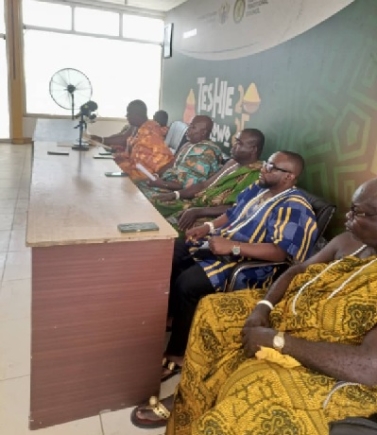
Teshie Traditional Council rejects Neo-Ga State Council, cites lack of custom making Ga Mantse overlord
The Teshie Traditional Council, led by Teshie Mantse Gbetsoolor Nii Ashitey Akomfra III, formally distanced itself from the proposed neo-Ga State Council.
At a press conference on Thursday, November 20, 2025, in Accra, the Council stressed that the historical and legal foundations of the Ga State do not support any claim of overlordship by the Ga Mantse over other Ga towns.
Central to their position was the finding of the 1975 Ga Traditional Affairs Committee of Inquiry, which stated unequivocally that “no custom made it imperative for the mantsemei of Osu, Labadi, Teshie, Nungua and Tema to look upon the Ga Mantse as their overlord.”
The report also held that the Ga Mantse never possessed authority to confirm or recognize chiefs of these towns.
“We found no custom which made it imperative for the mantsemei of Osu, Labadi, Teshie, Nungua and Tema to look upon Ga Mantse as their overlord".
The Teshie leaders emphasized that before colonial restructuring in 1927, the six Ga towns existed as independent sovereign states with equal status, collaborating only in wartime.
They traced the imposition of Ga Mantse leadership to the 1927 Native Administration Ordinance—a colonial creation later abolished in 1961 due to abuses and conflicts.
According to the Council, attempts to resurrect a neo-Ga State Council are unconstitutional, violate the Chieftaincy Act (Act 759), and disregard established judicial outcomes.
"Therefore, what the proponents of neo-Ga State Council are trying to do after several years of being caught in the web of “estoppel per rem judicata” is an attempt to overreach the 1992 Constitution and the Chieftaincy Act 2008 [Act 579]."
They condemned what they described as intimidation tactics by proponents of the new structure and criticized the conduct of the current Ga Mantse claimant, calling it disrespectful to the Chieftaincy Institution.
The Teshie Traditional Council reaffirmed its allegiance to the 1992 Constitution, the Chieftaincy Act, and the independence of each Traditional Council, rejecting any unlawful or parallel authority such as the proposed neo-Ga State Council.
Legal Focus
The Council argues that the Ga State Council—originally created under the Native Authority Ordinance of 1927—was a colonial legal construct and not a body rooted in authentic Ga customary law.
This Ordinance was abrogated in 1961 through the State Councils (Abolition) Act, 1961 [Act 85], which transferred all chieftaincy regulatory functions to the Chieftaincy Act, 1961 (Act 81) and later to the current Chieftaincy Act, 2008 [Act 759].
A decisive legal basis cited by the Council is the 1975 Ga Traditional Affairs Committee of Inquiry Report, which found that no customary law rendered the mantsemei of Osu, La, Teshie, Nungua and Tema subordinate to the Ga Mantse, and that the Ga Mantse had no customary authority to confirm or recognize their chiefs. The statement reads:
“We found no custom which made it imperative for the mantsemei of Osu, Labadi, Teshie, Nungua and Tema to look upon the Ga Mantse as their overlord.”
The Council stresses that this finding has never been challenged before the National House of Chiefs or the Supreme Court, placing the matter under estoppel per rem judicata, and making attempts to reassert Ga Mantse overlordship legally untenable.
The Teshie Traditional Council bases its rejection of the proposed neo-Ga State Council on clear constitutional, statutory, and customary law principles.
They emphasise that the Ga State Council originated solely from the Native Authority Ordinance of 1927, a colonial creation, noting:
“The Ga State Council is a creature of law… which law was later abrogated in 1961 and replaced by the National and Regional Houses of Chiefs and the Traditional Councils.”
This colonial structure was abolished by the State Councils (Abolition) Act, 1961 [Act 85], and its functions reassigned under the Chieftaincy Act. As a result, any attempt to recreate it—whether as a “neo-Ga State Council” or otherwise—lacks legal foundation.
The Council heavily relies on the findings of the 1975 Ga Traditional Affairs Committee of Inquiry, which stated unequivocally that the Ga Mantse has no customary overlordship over the other Ga towns. The Report concluded:
“The Ga Mantse has never been the customary overlord of these mantsemei…” and
“We found no custom which made it imperative for the mantsemei of Osu, Labadi, Teshie, Nungua and Tema to look upon the Ga Mantse as their overlord.”
They underline that these findings were never appealed or overturned: “The Ga Paramount Stool never challenged this verdict at the National House of Chiefs or the Supreme Court of Ghana as prescribed by law.”
Accordingly, any attempt to revive an overlordship claim is barred by estoppel per rem judicata.
The current constitutional and statutory framework assigns chieftaincy authority solely to Traditional Councils, Regional Houses of Chiefs, and the National House of Chiefs.
The Council stresses that only Paramount Chiefs may elect their own president, and no external figure can impose authority over sovereign stools. As they put it:
“No power or authority under this Constitution can override or detract the functions of any of the entrenched units of the Chieftaincy Institution.”
They therefore reject the neo-Ga State Council as an unlawful structure: “We shall also not support any unlawful parallel institution such as the neo-Ga State Council that has no formal or written locus or mandate.”
In conclusion, the Teshie Traditional Council situates its position firmly within both customary and constitutional law, affirming: “We hereby register our objection and abhorrence to the neo-Ga State Council proposition as being an affront to law and order.”
