
The Forestry Commission has blamed weak cooperation from some local communities for slowing down efforts to combat illegal mining, warning that the pollution of water bodies is fast becoming a serious public health concern.
The Acting Deputy Chief Executive of the Commission, Mr Timothy Ataboadey Awotiirim, said residents in areas affected by galamsey must take greater responsibility for protecting their environment, as state authorities cannot be present at all times.
“Our major drawback has been the fact that the communities where this galamsey is taking place have not been very cooperative,” he told journalists in Accra on Wednesday, March 18, 2026.
“We cannot be there all the time, but they should be policing their own environment,” he added.
Mr Awotiirim was speaking on the sidelines of an inter-university debate organised to mark the International Day of Forests.
Public health risk
He warned that the contamination of rivers and streams with chemicals such as cyanide had elevated the issue beyond environmental degradation to a direct threat to human health.
The Acting Deputy Chief Executive noted that reports of the effects of polluted water on vulnerable groups, including pregnant women, underscored the urgency of the situation.
“It is an existential threat that we must confront frontally. All hands should be on deck,” he said.
Call for media focus
Mr Awotiirim also proposed the establishment of a dedicated television channel by the Forestry Commission to provide continuous coverage of forest destruction and its consequences.
“I think that it is about time the Forestry Commission has its own TV station to broadcast 24 hours of the activities of the destruction of our forest,” he said.
He suggested that competing interests within sections of the media could limit sustained attention to the issues.
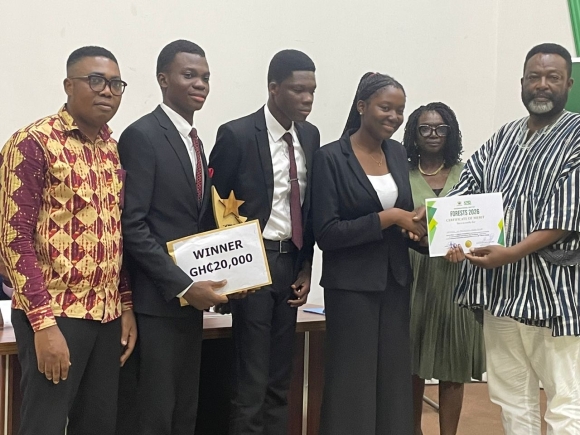
UPSA wins debate
The comments followed a closely contested debate between the University of Professional Studies, Accra (UPSA), and the University of Ghana, Legon, on whether the economic value of forests should be measured solely by timber and non-timber forest products.
UPSA, which argued against the motion, won the contest with 81 points, narrowly beating Legon, which scored 78 points. Judges described the outcome as close, with marks awarded based on content, style and delivery.
UPSA was coached by Dr John Appah, Operations Manager at the Forest Services Division, while Legon was guided by Mr Michael Pinto, Operations Manager for Natural Forests.
For their efforts, UPSA received a cash prize of GH¢20,000, while Legon took home GH¢15,000. Each participant also received a tablet computer and souvenirs from the Forestry Commission.
Economic value of forests
The debate focused on whether forests should be valued only for tangible products such as timber and medicinal plants, or whether broader ecosystem services, including carbon storage, climate regulation and water protection should be considered.
Arguing against the motion, UPSA maintained that forests generate measurable economic value beyond physical products. The team cited Ghana’s participation in the REDD+ programme as evidence of financial returns from forest conservation.
They referenced data from the World Bank’s Forest Carbon Partnership Facility, which shows that Ghana received $4,862,280 for its first monitored emission reductions and a total of $21.8 million for verified reductions between 2019 and 2021.
The team also pointed to efforts by the Ghana Statistical Service to incorporate natural resources into the calculation of Gross Domestic Product, using a broader measure of national wealth.
“Simplicity should not come at the cost of accuracy. A measurement that ignores millions of dollars in real economic value is not simple; it is misleading,” the lead speaker said.
Legon, which supported the motion, questioned the reliability of assigning monetary value to ecosystem services, arguing that such estimates lack verifiable source documentation.
“When I open my accounting textbooks, I see economic data. I see verifiable data from source documents. I do not see speculative things like the water cycle,” one speaker said.
Engaging the youth
Mr Awotiirim said the debate formed part of efforts to involve young people in environmental issues, describing students as key agents of change.
“If you are able to catch them young, if you are able to bring them on board to understand the issues that confront our environment, it stays with them,” he said.
He called for the initiative to be expanded beyond a single annual event to regular programmes at the district level.
“It should not be a nine days’ wonder,” he added.
Tree planting drive
The debate formed part of activities marking the International Day of Forests 2026, on the theme “Forests and Economies”.
It also preceded the launch of the Forestry Commission’s “Tree for Life” reforestation initiative on March 19, 2026.
The Commission has urged district assemblies, schools and other institutions to actively participate in tree planting efforts across the country.
