
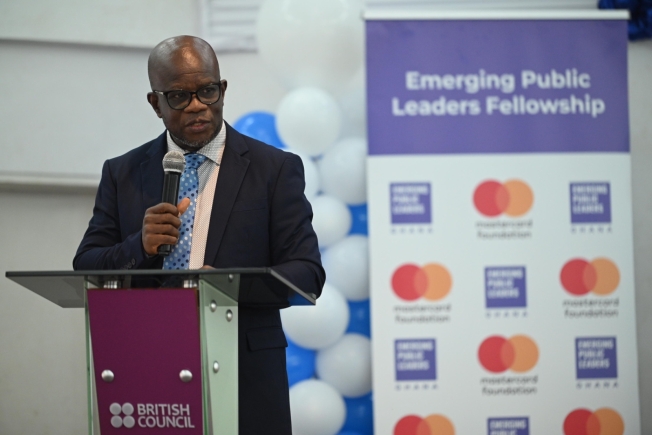
The Director-General of the State Interest and Governance Authority (SIGA), Prof Michael Kpessa-Whyte, has charged new public officers to begin working to leave a legacy and not see themselves as merely starting new jobs.
"When last did you pause — really pause — and ask yourself why you chose public service?" he said and added, "Not the sanitised answer you give at interviews. Not the line you rehearsed for your fellowship application. I mean the real answer. The quiet one. The one you carry in your chest," he questioned, when he addressed new public officers in Accra at the British Council auditorium on June 30, 2026.
"You are here today because somewhere, somehow, somebody in public service chose to do the right thing. You are here to become that person for the next generation," he said.
Prof. Kpessa-Whyte did not offer easy resolution to that tension. He offered something rarer: the honest acknowledgement of the tension itself, and the insistence that it is precisely in that space — between the ideal and the institution — that character is actually formed.
It was a keynote address for Emerging Public Leaders of Ghana (EPL Ghana) at the 7th Cohort Inauguration into the Public Service Fellowship Alumni Network.
The address was on the theme: "Stewards of Change: Building Transparent and Responsive Institutions."
The fellows filed out into Accra's late afternoon light carrying, it seemed, something more than a certificate. Whether the system they are entering is ready for them is, of course, the next story.
Attached below is a copy of the full address
I. Opening — A Moment Worth Feeling
The Chairperson of the occasion, distinguished guests, the leadership of Emerging Public Leaders of Ghana, proud families seated in this auditorium, and above all — the brilliant young men and women of the Seventh Cohort who stand on the threshold of a lifetime in service:
Good afternoon.
I want to begin, if you will permit me, not with statistics, not with a policy framework, and not with a congratulatory platitude. I want to begin with a question.
When last did you pause — really pause — and ask yourself why you chose public service? Not the sanitised answer you give at interviews, not the line you rehearsed for your fellowship application. I mean the real answer. The quiet one. The one you carry in your chest.
For some of you, there was a moment — maybe a scholarship that saved your family, a health centre that stayed open through the night, a teacher in a public school who saw something in you that you had not yet seen in yourself. A moment when the state — imperfect, understaffed, underfunded — showed up. And in showing up, changed everything.
You are here today because somewhere, somehow, somebody in public service chose to do the right thing. You are here to become that person for the next generation.
"You did not enter public service to be comfortable. You entered to be consequential."
II. The Weight of the Charge — Stewardship, Not Entitlement
Today, this Seventh Cohort formally enters the Alumni Network of the Public Service Fellowship. To the uninformed observer, this is a ceremony. To those of us who understand what the past twelve months have demanded of you, this is something far more profound. It is a commissioning.
You have undergone an intensive one year of training, mentorship, work immersion, and active supervision in the live machinery of Ghana's public institutions. You have sat in offices where resources were short but expectations were high. You have watched good people make difficult decisions. You have seen, perhaps for the first time, how fragile good governance really is — and how dependent it is on individuals who refuse to cut corners.
That experience is irreplaceable. And it has given you something that no classroom can fully confer: the understanding that public service is not a career. It is a calling.
I use the word stewardship deliberately — because it carries within it a truth that we must never lose sight of. A steward does not own what they manage. A steward holds something in trust. The budget you will administer does not belong to you. The institution you will serve was not built by you and will outlast you. The citizen whose query sits on your desk is not a disruption to your workday. That citizen is the reason for your workday.
The moment any public officer begins to confuse stewardship with ownership — when a position becomes a personal empire, when a signature becomes a gate, when access becomes a commodity — in that moment, something irreplaceable is broken. Trust. And trust, once broken in public institutions, takes generations to rebuild.
Ghana has paid that price before. You are part of the generation that must ensure we do not pay it again.
III. Transparency — The Hardest Virtue
The theme you have been given is not gentle: Stewards of Change — Building Transparent and Responsive Institutions.
Let me speak plainly about transparency, because it is the most romanticised and the least practised virtue in governance.
Transparency is easy to celebrate in a speech. It is terrifyingly hard to practise when you are the one sitting on uncomfortable information. When the report shows underperformance. When the contract is inconvenient. When the truth threatens someone powerful.
At SIGA, we work daily at the intersection of governance and accountability for state-owned enterprises across Ghana. And I can tell you this: the greatest governance failures we encounter are rarely the product of malice alone. Far more often, they are the product of silence.
Of reports that were filed but never published. Of audits that were conducted but never acted upon. Of boards that knew and said nothing.
Silence is not neutrality. Silence is a choice. And in public institutions, silence almost always benefits those who are wrong.
"Transparency is not a favour the government grants to citizens. It is an obligation the government owes to citizens."
I am asking you, the Seventh Cohort, to be constitutionally incapable of comfortable silence. To become the kind of officer who writes the report accurately even when the numbers are bad. Who raises the concern even when the room is hostile. Who protects the process even when it would be easier to look away.
Not because it will always make you popular. It will not. But because the alternative — public institutions that function as black boxes, where power operates without scrutiny — is a future none of us can afford.
IV. Responsiveness — The Citizen Is Not Waiting for Your Convenience
The second pillar of your theme is responsiveness. And here I want to speak directly, as a fellow public servant who has had to learn this lesson himself.
Responsiveness is not about speed alone. It is about posture. It is about how an institution orients itself relative to the people it exists to serve.
Too many of our institutions have developed a culture of making citizens feel like supplicants. As though asking for a birth certificate, registering a business, accessing a public service, is an act of imposition on the civil servant's time. We have normalised queues that humiliate. We have made information difficult to find, not because the system is complex, but because the culture did not prioritise the citizen's experience.
You can change this. Not tomorrow. Beginning today.
A responsive institution returns calls. A responsive institution explains its decisions. A responsive institution acknowledges that the farmer in rural Ghana, the market woman in Kejetia, the person who cannot afford a lawyer — they deserve the same quality of service as anyone who walks in wearing a suit.
You will one day have the power to set the culture of the units you lead. Please remember this moment. Remember how it feels to be young and idealistic and certain that the system can be better. Because it can. And you are the proof.
V. The National Stakes — Why This Matters More Than Ever
Ghana stands at a consequential moment. We are emerging from fiscal turbulence, rebuilding credibility with international partners, restructuring public debt, and asking ordinary Ghanaians to bear extraordinary burdens with dignity and patience.
In this environment, the quality of our public institutions is not an abstract governance conversation. It is an economic variable. A transparent and responsive public sector reduces the cost of doing business. It attracts investment. It builds the tax morale that funds the schools and clinics and roads that determine whether the next generation gets a fair start.
I want you to understand the stakes clearly: when a public institution is corrupt or opaque or indifferent, it is not just a headline. It is a child who does not get treatment and dies. It is a small business that dies because it could not get a licence processed in time. It is a community that stops believing the state is on its side.
Conversely — and this is the part I want you to hold — when public institutions work, the transformation is profound. When citizens experience government as fair, they comply. They participate. They build. They stay.
You are entering institutions at a moment when Ghana desperately needs public servants who remember that governance is, at its most fundamental, a relationship. Between the state and the citizen. Between power and accountability. Between the promise of independence and the delivery of development.
"The credibility of the Ghanaian state is rebuilt one honest decision at a time."
VI. A Word to the Families
I would be remiss if I did not pause and acknowledge the parents, siblings, partners, and families who are here today. You sat through difficult months. You watched your child or your sibling or your partner leave early in the morning and return exhausted. You answered late-night calls about assignments, about placements, about moments of self-doubt.
What you did — what you continue to do — is not small. Behind every committed public servant is a family that chose to support a path that does not always pay the highest salary, that does not always come with the most prestige, but that matters enormously.
Ghana thanks you. I thank you.
VII. To the Seventh Cohort — A Personal Word
I want to end by speaking to you directly. Not as an official. As someone who has spent a career in public service and in the study of how governance either uplifts or betrays a people.
You will face pressure to conform to the worst habits of whatever institution you enter. Someone senior will tell you that this is how things are done. A colleague will suggest that idealism is for students. A system will make it structurally easier to sign off on something questionable than to ask the hard question.
In those moments — and they will come — I want you to remember one thing:
Character is not what you display when the conditions are favourable. Character is what you protect when the conditions are not.
You are not just starting jobs. You are beginning a legacy. The decisions you make over the next decade — quiet decisions, small decisions, decisions that no one may ever know about — will determine whether Ghana's institutions become more trustworthy or less. The accumulation of your choices is governance.
Do not underestimate the power of one person who refuses to look away. History does not always remember their names. But their institutions remember their courage.
Stewards of Change. That is who you are being asked to be. Not heroes. Not martyrs. Not perfect. Simply officers of uncommon commitment — who hold in trust, on behalf of thirty-three million Ghanaians, the fragile and precious idea that institutions can serve everyone equally, honestly, and with dignity.
Go. Serve well. Build what Ghana needs you to build.
May God bless you, your families, and the republic you are about to serve.
Thank you.
