
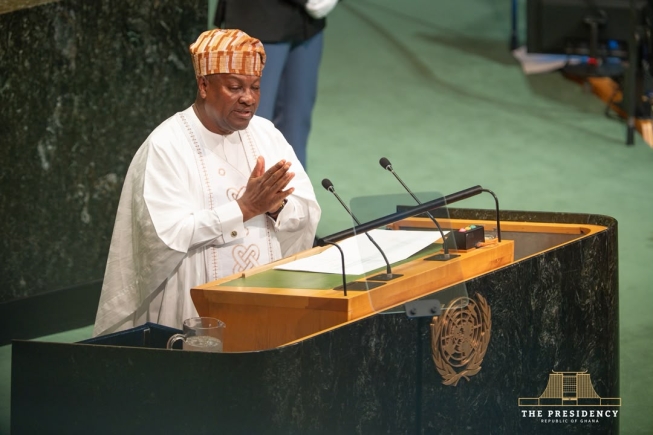
President John Dramani Mahama has demanded from world leader equal partnership anchored in mutual respect for Africa, stressing that Africa is not asking for charity.
The President who was addressing the UNGA in New York on Thursday (September 24) also warned that the continent will no longer accept the colonial model of resource extraction.
Addressing that packed room of diplomats who listened attentively, President Mahama said Africa's demographic and resource endowment places it at the centre of the world's future, but that future must be defined by Africans themselves.
"Our continent possesses the world's youngest population, vast arable lands, and parallel cultural vitality and the critical minerals required to drive the global green energy transition," he said.
Issuing a strong warning to major powers competing for Africa's green transition minerals including lithium, cobalt, manganese, graphite and rare earths , the President said the continent would not remain a spectator in its own transformation.
"Let me warn. Africa will not remain a passive arena for a new scramble for resources.
"Critical mineral extraction in Africa must not replicate the colonial-era exploitation. We will process our minerals at home. We will build local industries that create dignified jobs for our youth. And we will retain the value of our natural resources in Africa,” he said.
Dismantle engines of exploitation
The President also called on the UN to move beyond symbolism and dismantle what he described as the "persistent engines of exploitation" that continue to hold Africa and the Global South in subjugation, including unfair trade, predatory resource extraction and a punitive global financial architecture.
On the adoption of the landmark Resolution on reparatory justice, President Mahama said the resolution must now lead to structural transformation of global governance and finance.
"Real repair demands structural transformation. It requires dismantling the persistent engines of exploitation, unfair global trade, predatory resource extraction, discriminatory credit ratings, unsustainable debt burdens of the Global South, and the continued export of raw materials from Africa while real value addition and job creation occur elsewhere," President Mahama said.
The President argued that the resolution was necessary because the structural legacies of slavery continue to fuel modern inequalities.
"It was adopted because the structural legacies of those historic crimes continue to fuel systematic racism, economic marginalisation, and a global financial architecture that is weighted against Africa and people of African descent," he said.
He welcomed what he called positive overtures since the resolution's passage.
"We welcome the positive overtures from many countries and institutions that have joined the Dialogue on Reparative Justice. The Netherlands, Germany, and France have all made positive moves to join the conversation on reparative justice."
He, however, warned that dialogue alone was not enough.
"Mr. President, the injustices of the past remain embedded in today's power structures," he said.
President Mahama added that, the same systemic inequalities permeate the international financial system.
He indicated that developing nations and the Global South borrow at interest rates that are up to eight times higher than industrialised nations. He added that, African and Caribbean nations struck by climate disasters are forced to take on crippling debts to rebuild from floods and droughts that they did not cause.
"Governments are forced into a tragic choice to service predatory debts or to serve their people. We demand reform. We need long-term, affordable, and accessible concessionary financing that enables developing economies to invest in human capital, in industrialisation and climate adaptation," he said.
Africa must have permanent UNSC seat
Making the case for urgent UN Security Council reform, President Mahama said Africa's exclusion was indefensible.
"Africa is home to 1.5 billion people, over 18 percent of humanity, and constitutes the largest regional voting bloc in this General Assembly. And yet, Africa remains without a single permanent seat on the United Nations Security Council. This is fundamentally unacceptable in the 21st century.
"Africa must be granted permanent representation on the UN Security Council, complete with all the rights and responsibilities. We cannot credibly champion the sovereign equality of nations while preserving a global governance structure that was designed for the post-war geopolitical realities,” he said.
The President added that, the Security Council reform is not a favour to Africa, but an imperative for the legitimacy, the credibility, and the survival of the UN.
Condemnation of embargo
President Mahama warned of an alarming breakdown of the current global order, saying the world is witnessing a dangerous shift towards unilateralism, lawlessness and the erosion of multilateral norms, and that the United Nations must not suffer the fate of the League of Nations.
He said the UN Charter must reign supreme over the cynical doctrine that might makes right; stressing that, credibility of the global system was being tested by selective application of international law.
"The veto power must never serve as a license for impunity. Sovereign equality cannot be a privilege that is reserved only for nations that are aligned with global superpowers," he declared.
Stop using diplomatic euphemisms
President Mahama condemned the actions of Israel in Gaza, stressing that nowhere was the crisis of credibility more painful than in the ongoing persecution of the Palestinian people in Gaza and the West Bank.
He also condemned the actions of Hamas, which has led to the actions of Israel.
He called on world leaders to stop hiding behind diplomatic language.
"The time has come for us to stop using diplomatic euphemisms to veil the human carnage that is taking place in Gaza. How many more lives must be lost before the world acts with decisive moral authority? The blood of five-year-old Hind Rajab and the more than 20,000 children that have been killed in this brutal conflict cries out to the conscience of the world.
"Collective punishments, enforced starvation, and mass displacement are flagrant violations of international law,” he said.
President Mahama reaffirmed Ghana's long-standing foreign policy position on the Middle East.
"Ghana remains unwavering in its recognition of the sovereign state of Palestine and its steadfast support for a viable two-state solution where Israel and Palestine will live side by side in peace, security, with guaranteed borders. At the same time, we condemn all acts of terrorism by Hamas that triggered this conflict. And we insist that all parties unconditionally respect international humanitarian law. Our moral standards cannot be selective."
Lift embargo on Cuba
President Mahama reiterated call for the immediate lifting of the decades-long economic, commercial and financial embargo imposed on Cuba by the United States.
He added that, the world must support Cuba's new economic and social programme; adding that, measures that inflict collective economic hardship on ordinary citizens run counter to shared commitment to human dignity and international law.
The President also drew attention to what he described as the world's worst humanitarian crisis in Sudan and the worsening security situation in the Sahel.
He called for the exercise of solidarity with nations that are facing the terrorist scourge, especially in the alliance of Sahel states.
President Mahama added that the Middle East crisis was having a deleterious effect on the world economy and called for a return to the negotiating table.
"The current Middle East crisis is having a deleterious effect on the world economy. We call for a return to the negotiating table. And let me add that no human civilization deserves to be annihilated and certainly not a member of the United Nations," President Mahama said.
President Mahama insisted that international law must be applied uniformly, regardless of where conflicts occur.
"Across every conflict, whether in Europe, the Middle East, Africa, the standard must remain uniform. Respect for sovereign integrity, protect civilians, ensure unhindered humanitarian access, and hold perpetrators of war crimes accountable," he stated.
