


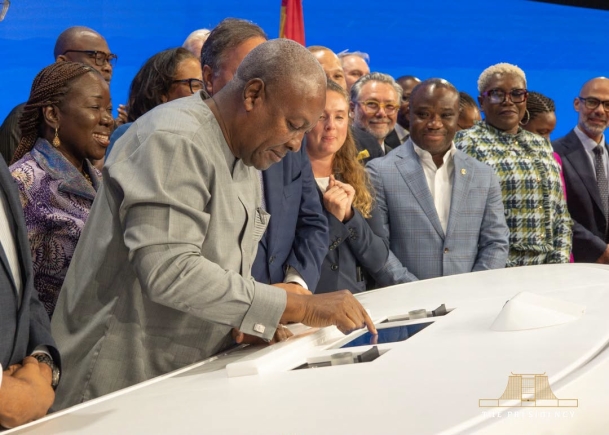
President John Dramani Mahama has reaffirmed Ghana’s openness for business as he pitched to corporate America from the heart of global finance, welcoming American capital, technology and manufacturing into value-addition, energy and technology.
Speaking at the NASDAQ in New York on Wednesday (September 23), on the sidelines of the 81st United Nations General Assembly, President Mahama assured investors that the country’s macroeconomic turnaround and political stability make it the ideal gateway to Africa.
"Ghana therefore welcomes American investors. Power is stable in Ghana, I can assure you. Chevron, when you come, you'll find out.
"Ghana therefore welcomes American investment and technology in power generation, transmission, and distribution, in renewable energy and industrial energy solutions," he said.
AfCFTA opportunities
President Mahama urged American companies to see Ghana not just as a 34-million-person market but as a production hub for Africa and the world.
"For an investor, Ghana's domestic market is only one part of the opportunity. The African Continental Free Trade Area is bringing together a continental market of more than 1.4 billion people, and this secretariat is headquartered in Accra.
"And so a company that establishes production in Ghana should be thinking beyond our borders. It should look for opportunities across West Africa and the wider continent as implementation of the AfCFTA progresses. Do not look at Ghana's 34 million population only for what you can sell there. Look at Ghana for what you can produce and sell across Africa and to the world,” he stated.
He linked this to Ghana's upcoming chairmanship of the African Union in 2027.
"Ghana is also preparing to assume the chairmanship of the African Union, and we use that responsibility to support Africa's work on infrastructure industrialisation, regional integration, and implementation of the African Continental Free Trade Area. Regional integration will also require roads, ports, reliable energy, digital connections, and efficient borders.
These, he said were areas in which American businesses have a comparative advantage. Adding that, he sees Ghana's 2027 responsibility as an opportunity to advance an African economic agenda in which governments create the condition for growth.
Value retention
President Mahama said while opportunities discussed at last year's US-Africa business forum in agriculture, agribusiness, energy, mining, health, pharmaceuticals, and technology remain, Ghana's focus has sharpened.
The President affirmed that Ghana produces cocoa, gold, manganese and many other commodities, while farmers grow cashew, shea fruits, vegetables and grains, yet too much still leaves the country in raw form while the country imports finished products it could produce at home.
"This pattern must change if we are to create enough jobs and build stronger Ghanaian enterprises," he said.
President Mahama said Ghana, one of the world's leading cocoa producers, could no longer be content with exporting raw cocoa beans.
"Opportunities exist in cocoa processing, cashew, shea, horticulture, grains, poultry, livestock, and food manufacturing. Processing more of what our farmers produce in Ghana creates a market for farmers, work for processors, businesses for suppliers, transporters, and jobs along the value chain," he said.
Technology, he added, is another frontier with considerable room for cooperation.
"Opportunities exist in digital infrastructure, data centres, artificial intelligence, financial technology, and other technology-enabled services," he added.
New US-Ghana chapter
President Mahama said Ghana and the US have built a strong partnership, with trade in goods and services reaching approximately $4.6 billion in 2025, and Ghana benefiting from the African Growth and Opportunity Act (AGOA) for more than two decades.
"We value this relationship, including the development cooperation that has supported Ghana over the years. The next chapter of this relationship must play greater emphasis on trade and investment, technology, and productive enterprise," he said.
He added that American capital, American technology and experience can work with Ghanaian businesses and skills to produce goods and services for Ghana, Africa, and the world market. He, therefore, urged more American companies producing in Ghana, buying from Ghanaian suppliers, and sharing technology and knowledge with Ghanaians.