
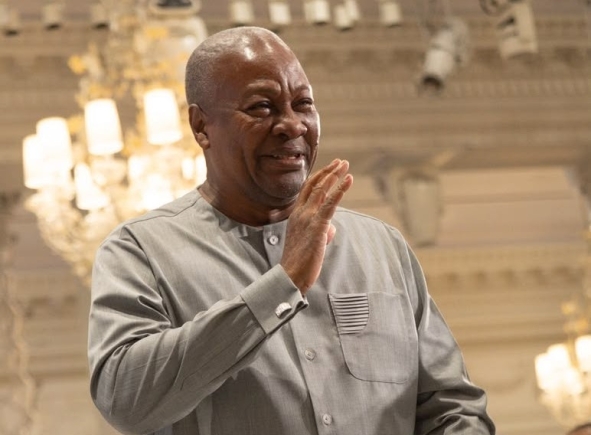
President John Dramani Mahama will address the 81st Session of the UN General Assembly today, with reparatory justice expected to dominate his message.
Sources close to the President's delegation in New York said he would report to the world body on significant momentum gained since the passage of the historic Ghana-led resolution on reparatory justice for Africans and people of African descent.
The President is expected to tell the General Assembly the concrete actions the passage of the resolution had yielded from former colonial powers and institutions that participated in and benefited from the transatlantic enslavement of Africans, which classified Africans as chattel, as property, as subhuman, and as not worthy of any human dignity and protection.
President Mahama, who chaired the 24-member Global Advisory Panel for Reparatory Justice prior to his departure to New York, a panel comprised of Heads of State from African and Caribbean countries and activists, including Reverend Al Sharpton, is expected to outline the next frontier and strategy for the global reparations movement.
The sources further said that President Mahama's address would frame reparatory justice not as retribution, but as part of building a new, fair and just world without racism and discrimination; a world of inclusivity where no person is judged by the colour of his skin or where he comes from.
Effect
The reparatory justice effort had seen France repeal its Code Noir, a 17th-century law that legalised slavery and codified Africans as property, and had formally written to Ghana, expressing its desire to collaborate in establishing a scientific commission to be hosted in Ghana.
The commission would help conduct research and build the necessary scientific basis for securing reparatory justice, including reviewing educational curricula to ensure the horrors of the transatlantic era are not repeated.
President Mahama would also highlight growing atonement by faith-based institutions. Pope Leo XIV had apologised on behalf of the Catholic Church following the adoption of the resolution, acknowledging the role of previous papal bulls that gave theological and doctrinal justification for enslavement.
Similarly, the Church of England had apologised for its role. The first female Archbishop of Canterbury, who recently visited Ghana and toured the Cape Coast Castle, witnessed the dungeons beneath the church where enslaved Africans were held. The church pledged 100 million pounds towards reparatory efforts.
Sources say the UK and Portugal have also begun engagements with Ghana on how to atone for their historical roles, signalling broadening European support. This indicates that even though European countries abstained from the vote on the resolution, they have since come on board.
As part of activities ahead of his address, President Mahama held side events focused on restitution, as many European countries have begun returning African heritage and spiritual objects held in their museums and institutions.
Accra Reset push
President Mahama is also expected to send a message that the Global South must gain real control over its health and development destiny.
His address will be a direct expansion of the high-level Accra Reset dialogue he hosted on Monday, September 21, 2026, where he launched the High-Level Panel Report "A Sovereign Future for Health."
For decades, nations of the Global South have been asked to practice "country ownership" while distant boardrooms in Geneva, Washington and Brussels retained complete control over funding, programme design, and production.
In his now-viral metaphor from Monday’s event - "We were handed a broken cauldron and asked to own a soup cooked entirely in someone else's kitchen”, he is expected to argue that this model has left Africa and the Global South facing three burdens: “geostrategic marginalisation, geopolitical vulnerability, and donor dependence.”
Recent cuts and weaponisation of aid have exposed how fragile it is.
He would formally present to the General Assembly the outcomes of the one-year Accra Reset process and its pivot from diagnosis to execution.
