
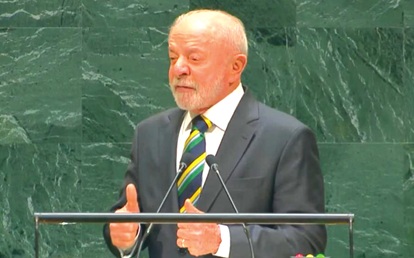
Brazilian President Luiz Inácio Lula da Silva has commended the passage of the landmark United Nations (UN) resolution declaring the transatlantic trafficking of enslaved Africans as the gravest crime against humanity.
According to him, the initiative led by President John Dramani Mahama, and endorsed by the General Assembly, represented the correction of history.
President Lula da Silva, who was addressing the 81st UN General Assembly in New York, USA, last Tuesday, also welcomed the recent decision to correct the historical distortion of the world map.
He described the General Assembly’s endorsement of the two actions as acts of truth long overdue for the Global South.
"This General Assembly recently corrected a historical distortion in the world map. It recognised the trafficking of enslaved Africans as the gravest crime against humanity. It approves a more accurate representation of the world map. Now it needs to focus on issues crucial for the future of humanity," he said.
The UN Resolution, A/RES/80/250 -“Declaration of the Trafficking of Enslaved Africans and Racialised Chattel Enslavement of Africans as the Gravest Crime against Humanity”, was adopted on March 25, 2026 — the International Day of Remembrance of the Victims of Slavery — after President Mahama, as African Union (AU) Champion on Reparations, tabled it.
The Ghana-led resolution, co-sponsored by the AU, Caribbean Community (CARICOM) and the African diaspora, was adopted with 123 votes in favour, three against — the United States, Israel and Argentina — and 52 abstentions, including the United Kingdom and European Union members.
It declared the trade, which saw more than 12.5 million men, women and children stolen from Africa over 400 years, as a crime defined by its scale, duration, systemic nature and enduring consequences, and called for reparatory justice, including formal apologies and restitution of looted cultural artefacts.
President Mahama, who led the campaign, described it as "a safeguard against forgetting" and against the erasure of Black history.
The “Correct the Map" resolution, adopted on September 5 this year, sponsored by Togo and backed by all 54 AU members, was passed with 164 votes in favour, one against (the United States) and six abstentions.
The resolution encourages governments, schools, international organisations and technology companies to replace the 16th-century Mercator projection, which shows Greenland and Africa as roughly the same size, with the 2018 Equal Earth projection, which shows that Africa is in fact 14 times larger than Greenland.
Critical moment
President Lula da Silva, who made his 10th appearance at the UN rostrum since he first spoke in 2003, said: “This is undoubtedly the most critical moment for the United Nations”.
"The feeling that drives me today is one of indignation. The UN is failing in one of its most important missions, to rid humanity of the scourge of war. Its credibility has never been lower.
Its ability to protect the most vulnerable, those who have no armies or arsenals, has never been so weak," he said.
President Lula da Silva also warned that geopolitical tensions and a new arms race were threatening to transform regional conflicts into a conflagration of global proportions, with 2025 recording the highest number of armed conflicts since World War II.
"We are all held hostage by the National Security Council for failing to fulfil its role. In 1946, at the first session of this assembly, Brazil warned of the high price that the international community would pay for the right to veto.
This inherent flaw in the UN Charter granted the great powers the luxury of being insensible.
"To this original sin, a profound leadership crisis is now added.
Trillions of dollars are funding a new arms race,” he said.
The Brazilian President called on the permanent members of the UN Security Council to meet and act with responsibility.
"I'm no stranger to the realities of power, but concessions to the law of the stronger have surpassed all limits.
This is not idealism, but pure realism.
War is not the continuation of politics by other means. It's the complete breakdown of politics.”
“In an interdependent world, leading is to reconcile the interests of the nation with those of humanity," President Lula da Silva said.
