
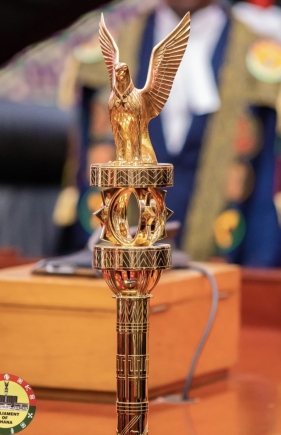
The Speaker of Parliament, Alban Sumana Kingsford Bagbin, has summoned Parliament to sit on Tuesday, September 29, 2026, amid growing calls for parliamentary scrutiny of recent major narcotics seizures linked to Ghana.
In a notice issued on Thursday, September 24, the Speaker said the sitting would commence at 12 noon at Parliament House in Accra.
“Pursuant to Article 112 (3) of the Constitution and the Standing Orders of Parliament, I, Rt. Hon. Alban Sumana Kingsford Bagbin, hereby summon Parliament to sit on Tuesday, September 29, 2026 at 12 noon at Parliament House, Accra,” the notice stated.
The notice, however, did not specify the particular business to be considered by the House during the extraordinary sitting.
The summons comes days after the Minority in Parliament petitioned the Speaker to recall the House from recess to consider what it described as urgent national security concerns arising from a series of major drug seizures involving consignments linked to Ghana.
Read also: Recall Parliament for extraordinary sitting over cocaine seizures – Habib Iddrisu leads petition
Minority petition
The petition, dated September 18, was submitted on behalf of the Minority Caucus by the First Deputy Minority Whip and Member of Parliament for Tolon, Habib Iddrisu.
The petitioners said they had secured the support of at least 15 per cent of Members of Parliament required under Article 112(3) of the 1992 Constitution to request an extraordinary meeting of the House. The provision requires the Speaker to summon Parliament within seven days after receiving such a request.
At the centre of the petition is the seizure by French customs authorities of nearly 3.9 tonnes of cocaine at the Port of Dunkirk on September 10, 2026.
According to reports cited by the Minority, the cocaine was concealed in a container of plastic waste that had arrived in France from Ghana. French authorities reportedly valued the consignment at about €225 million, or roughly US$260 million.
The Minority argues that the incident raises questions about the security and integrity of Ghana’s ports and export systems, customs controls, intelligence gathering and the effectiveness of narcotics enforcement.
The MPs want Parliament to establish how the container was processed, inspected, cleared and exported from Ghana, including the port or facility from which it departed.
They are also seeking information on the companies and institutions involved in processing and clearing the consignment, the status of investigations and arrests, and the extent of cooperation between Ghanaian authorities and their French and other international counterparts.
Other drug-related incidents
The Minority has placed the French seizure in the context of several other narcotics-related incidents since 2025.
Among the cases cited is the reported seizure of more than 3.3 tonnes of cocaine at Pedu Junction in Cape Coast in March 2025.
The caucus has also referred to another consignment of about 120 slabs of cocaine allegedly intercepted along the Takoradi-Cape Coast Highway.
In August 2026, authorities reportedly seized 866 parcels of suspected cocaine concealed in sacks of gari at a warehouse within the Tema Harbour enclave.
The Minority also cited the seizure by Australian authorities of 320 kilogrammes of methamphetamine in June 2026 from a charcoal consignment reportedly traced to Ghana.
The caucus says the incidents collectively warrant an examination of Ghana’s systems for detecting and preventing international narcotics trafficking, including the identification of the financiers, organisers and networks behind major drug-trafficking operations.
Institutions to face scrutiny
The petition calls for officials from the Ministries of the Interior, Transport and National Security, as well as the Narcotics Control Commission (NACOC), Ghana Ports and Harbours Authority (GPHA), Ghana Revenue Authority (GRA), Ghana Immigration Service and National Intelligence Bureau, among other relevant institutions, to provide information to Parliament.
The Minority also wants an assessment of the adequacy of scanning, surveillance, intelligence and security systems at Ghana’s ports, airports and other entry and exit points.
The petitioners have stressed that any parliamentary inquiry should not prejudice ongoing criminal investigations or the rights of persons under investigation.
Calls for inquiry
The demand for parliamentary scrutiny has also received support from some civil society and academic voices.
Dr Joshua Ebuntie Zaato, a Senior Lecturer at the University of Ghana’s Department of Political Science, has argued that Parliament’s oversight role could provide an additional avenue for examining information surrounding the seizures and the response of the various security agencies.
However, there has also been a different view within Parliament on whether an extraordinary sitting is necessary.
The Vice Chairman of Parliament’s Defence and Interior Committee and Wa West MP, Peter Lanchene Toobu, has argued that the relevant parliamentary committees could investigate the matter while the House remains on recess. He cited the Defence and Interior, Transport, and Trade and Industry committees as having oversight responsibilities relevant to the issues raised.
With the Speaker now summoning the House for September 29, attention will turn to the business that will be placed before Parliament and whether the extraordinary sitting will lead to a formal parliamentary inquiry into the recent narcotics-related incidents.
The sitting will also provide an opportunity for Parliament to seek clarification from the relevant institutions on the circumstances surrounding the Ghana-linked consignments and the measures being taken to strengthen the country’s border, port and narcotics-control systems.
