
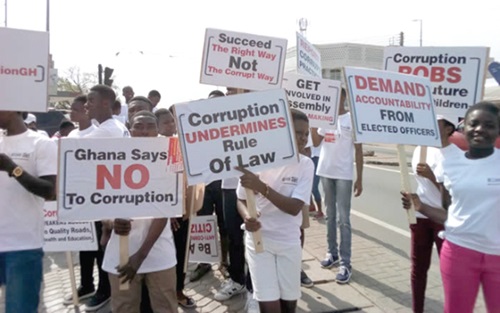
Corruption is not just a moral or legal problem in Ghana.
It is fundamentally a governance and development issue.
At its core, corruption represents a failure of accountability, transparency and institutional integrity
It undermines the ability of the state to deliver development, erodes trust in democratic governance and perpetuates inequality.
Ghana’s challenge today is not merely the loss of billions of cedis, but the way in which corruption corrodes the very foundations of governance and hampers progress.
The Ghana Anti-Corruption Coalition (GACC) estimates that Ghana loses about US$3 billion annually through corruption (GACC, 2025).
Other analysts suggest that when tax evasion, smuggling and resource mismanagement are included, the figure rises to nearly US$9 billion every year.
These are not abstract figures; they represent the roads left untarred, hospitals without beds, schools without textbooks and young people without jobs.
IMF bailout
To appreciate the scale of the problem, one must compare these losses with Ghana’s ongoing US$3 billion International Monetary Fund (IMF) bailout programme.
The bailout, stretched over three years, is far smaller than the amount Ghana loses through corruption in a single year.
If governance systems were stronger and corruption curtailed, the country would not be forced into repeated cycles of external borrowing and dependency.
Thus, corruption is not only a fiscal problem but a direct development bottleneck.
It diverts resources from social investment to private pockets, thereby delaying Ghana’s progress toward the Sustainable Development Goals and the aspirations of national development plans.
Corruption thrives where governance is weak, where oversight institutions lack teeth, where accountability mechanisms are ignored, and where transparency is absent.
This is why Parliament’s role is pivotal.
The legislature, as the people’s representative, has both the constitutional mandate and democratic responsibility to scrutinise how the executive uses public resources.
The Public Accounts Committee (PAC), in collaboration with the Auditor-General’s Department, has recently shown that parliamentary oversight can deliver results.
According to PAC Chairperson Abena Osei Asare in a media interview on Wednesday, October 1, 2025, the Committee has facilitated the recovery of more than GH¢12.9 billion in misappropriated public funds.
This is an important reminder that when governance institutions perform their functions, development outcomes improve.
Every cedi recovered and redirected into public services enhances the state’s capacity to deliver for citizens.
Yet the recovery of such vast sums also raises fundamental governance questions: Where did these funds go?
Who authorised their misappropriation?
And how much more remains hidden in the system?
These questions highlight systemic governance gaps that must be addressed if Ghana is to make progress.
Transparency
For governance to support development, transparency must become non-negotiable.
Citizens need to know not only how much money has been recovered but how it is being used.
Announcements of recoveries, without corresponding transparency on utilisation, do little to rebuild trust.
The public has the right to demand clarity and insist on detailed reporting on all state finances.
Transparency is central to democratic governance. It ensures that resources are allocated fairly, reduces opportunities for misappropriation, and enhances citizen participation.
Without it, development becomes elite-driven and exclusionary, leaving ordinary citizens marginalised.
Addressing corruption as a governance challenge requires institutional strengthening on multiple fronts.
Parliamentary oversight must move beyond debating Auditor-General’s reports to enforcing recommendations and applying sanctions, with proactive scrutiny of state funds.
Independent anti-corruption bodies such as the OSP, EOCO, and CHRAJ need adequate resources and protection from political interference to function effectively.
Digitisation and e-governance through digital procurement, payroll, and tax systems can close loopholes and reduce discretion.
Finally, civic engagement is crucial: citizens, civil society, and the media must demand accountability and ensure public funds serve development.
Transformed economies
The link between governance and development is clear.
Countries that have reduced corruption and strengthened oversight, such as Botswana and Singapore, have transformed their economies and improved the quality of life for citizens.
Ghana can learn from these examples.
Every cedi misappropriated represents a governance failure and a missed development opportunity.
Conversely, every cedi recovered and properly invested represents good governance and development in action.
That is why the recovery of GH¢12.9 billion by the PAC must not be seen only as a financial milestone but as proof that accountable governance is possible when institutions work.
Governance challenges
In conclusion, corruption is Ghana’s most pressing governance and development challenge.
It drains the economy of more than what the country receives from the IMF in three years, crippling development efforts and undermining democracy.
The PAC’s recovery of misappropriated funds demonstrates what effective oversight can achieve, but it also raises urgent questions about the whereabouts of billions of cedis lost annually.
Ghanaians must demand to know: where are these funds, and how are they being used?
The public must insist that all state funds are accounted for and used for the common good.
Development cannot thrive where corruption is tolerated, and governance cannot be credible where accountability is absent.
The fight against corruption is, therefore, not merely about recovering money; it is about reclaiming governance for development.
If Ghana is to achieve its aspirations, citizens, Parliament, and oversight institutions must unite to ensure that corruption is curtailed, resources are protected, and governance is directed toward building a prosperous, equitable society.
The writer is a Political Scientist
