
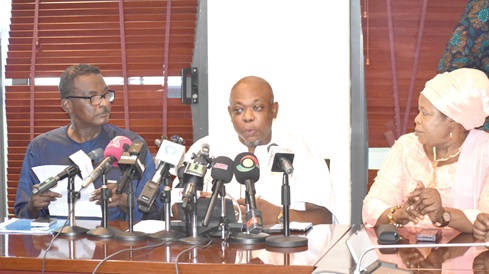
The Majority Caucus in Parliament has called on security and law enforcement agencies to strengthen collaboration and work as one front to combat the growing threat of narcotics trafficking in Ghana.
The caucus said the fight against narcotics was not the responsibility of any single agency, particularly the Narcotics Control Commission (NACOC), but required sustained collaboration among all relevant institutions.
“The profiling and screening, investigation, prosecution and asset recovery are all critical elements in the chain, and only when agencies are better coordinated, sharing intelligence and working together can Ghana really disrupt and dismantle networks that traffic narcotics,” it said.
Job not for single agency
Addressing the press on the drug situation in Ghana at Parliament yesterday, the Majority Leader, James Agalga, said continued and concerted inter-agency cooperation was essential to the country’s fight against the drug menace.
“There is a need for continued, concerted inter-agency cooperation as the bedrock of the nation's struggle against the drug menace.
“We urge the NACOC, the Ghana Police Service, the Ghana Immigration Service, the Ports and Harbours Authority and others to increase their cooperation since this is no job for any single agency,” he said.
The Majority Leader said NACOC had, for years, been under-resourced, under-staffed and under-institutionalised, making it difficult for the commission to effectively respond to the growing, sophisticated and adaptable narcotics trade.
“This was not a commandment which was not carried out.
This is a need that was not met, and resources were not available to do so,” he said.
Mr Agalga said Ghana decided in 2018 that NACOC would no longer be subject to mandatory joint inspection at Tema Port.
“A narcotics control agency without eyes to see the cargo coming through this country's busiest port is an agency that has been called upon to guard a door without a key,” he said.
He said the decision had broken a critical link in the profiling, screening and interdiction chain at a point where transnational trafficking of cocaine, tramadol and other controlled substances was most vulnerable.
The narcotics-risk intervention was not fully implemented in Tema, he said, adding that the institution responsible for safeguarding the country against narcotics trafficking was excluded from a process designed for that purpose.
No dedicated court
Mr Agalga said Ghana had, for years, lacked a dedicated court to deal with narcotics-related offences.
Narcotics cases, he said, were assigned to the regular criminal calendar, where they competed with other cases for judicial attention.
The situation, he said, resulted in a growing backlog of drug-related cases, with suspects, some guilty and others presumed innocent, languishing in limbo, while prosecutions dragged on and the punitive effects of narcotics laws diminished slowly with time.
“But when justice delays in narcotics cases is not neutral outcome, it is an advantage that is handed, free of charge, to trafficking networks which know that our institutions move slower than theirs,” he said.
Dedicated narcotics courts
Contrary to the situation in the past, he said the current administration had set up a special court for the trial of narcotics offences.
“This is not just a symbolic gesture; it means that the backlog of pending narcotics cases that had been accumulating for years can be systematically eradicated, prosecution will be carried out at a speed and level that will deter criminal enterprise and the credibility of our narcotics laws will be restored by timely and consistent prosecution,” he said.
Human capacity
He said the current government had approved the recruitment of another 2,200 staff for NACOC, a bold and consistent move that would go a long way to fill the deficit in the commission's staffing, which had limited it from having a full complement to man its expanding network of district commands and put the operational capacity of NACOC on a pedestal Ghana had never known.
Arrests
Mr Agalga said in 2024, NACOC recorded 73 arrests nationwide, which became the commission’s most productive enforcement year on record.
Under the current government, he said NACOC enforcement operations in 2025 produced 217 arrests across 165 cases, an increase of 197 per cent over the largest annual enforcement increase in the commission's history.
“This growth in enforcement was matched by growth in results across the board,” he said, pointing out that in 2025, seizures of narcotic substances totalled 1,497.75 kilogrammes, with an estimated street value of $5.244.065 and an estimated 61,974 units of controlled substances, such as pharmaceutical opioids and new psychoactive substances.
“Denying traffickers the fruits of their labour, asset-based enforcement resulted in cash seizures of GH¢6.93 million and $440,382, and the seizure of 19.72 kilogrammes of gold believed to be used for suspected drug-money laundering,” he said.
Mr Agalga said the 32,122.42 kilogrammes of narcotics that were destroyed permanently included over five million tablets of tramadol.
