
When politics rediscovers humanity
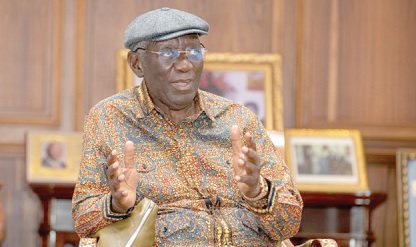
At a recent ceremony organised by the Kufuor Scholars Programme to graduate a new cohort and induct fresh entrants, I had the privilege of attending at the invitation of former President John Agyekum Kufuor, Chairman of the John A. Kufuor Foundation.
The occasion offered a window into a decade of purposeful investment in leadership, service and intellectual formation across borders.
The programme, now in its 10th year, has produced a good number of alumni who serve in diverse capacities across the globe.
The event reflected both scale and substance. It affirmed that intentional mentorship, grounded in values, can yield a generation equipped not only with knowledge but also with a sense of duty to society.
Yet, beyond the structured speeches and dignified proceedings, a single moment captured a deeper truth about politics, leadership and public perception in Africa.
Testimony
During the testimonies, a young Nigerian woman from the graduating cohort rose to speak.
With disarming honesty, she recounted her experience upon entry into the programme.
As is customary, newly enrolled scholars had the opportunity to interact closely with President Kufuor.
She spoke with admiration about that encounter, but one observation stood out.
Throughout the interaction, she noted, the former President returned repeatedly to the theme of humanity—our shared condition and the obligation to express that humanity through service to others.
What astonished her, she confessed, was not only the rare privilege of meeting a statesman of such stature, but the content of his emphasis.
“I was surprised,” she said, “that a politician should be so concerned about humanity.”
Expectation in public life
Her remark drew laughter from the audience. Yet, beneath the humour lay a sobering reflection.
That such a sentiment could be expressed, even innocently, signals a deeper crisis of expectation.
It reveals how far public trust in political leadership has eroded when the prioritisation of humanity appears unusual, even remarkable.
This moment deserves careful reflection.
Why should it seem extraordinary that a politician—one entrusted with authority over public resources and the welfare of citizens—should place humanity at the centre of public life?
In principle, the very essence of political office rests on service to people.
The mandate of leadership presupposes empathy, responsibility and a commitment to the common good.
Promise and practice
However, the young woman’s reaction does not arise in a vacuum.
It reflects a broader political culture within which promises often dissolve upon the assumption of power.
Across parts of the continent, electoral rhetoric frequently departs from governing reality.
Leaders who campaign on transformation sometimes preside over stagnation.
The gap between promise and practice has widened to the extent that sincerity now invites surprise.
This pattern finds literary expression in Money Galore by Amu Djoleto, where political duplicity emerges as a recurring theme.
In one memorable episode, a minister pledges to provide computers to a school during an anniversary celebration.
After a prolonged wait, representatives of the school approach him with a reminder.
His response is as startling as it is revealing: the promise, he explains, was merely political and was never intended for fulfilment.
Fiction, in this case, mirrors lived experience with uncomfortable accuracy.
Moral purpose of leadership
Within such an environment, it becomes less surprising that a young scholar might regard a politician’s concern for humanity as noteworthy.
The tragedy lies not in her perception, but in the conditions that have shaped it.
When leadership loses its moral anchor, public expectation adjusts accordingly—often downward.
Yet, the narrative need not end in pessimism.
The example set by former President Kufuor offers an alternative tradition within African political life—one that affirms dignity, responsibility and service.
His emphasis on humanity is neither incidental nor rhetorical; it reflects a philosophical orientation rooted in the belief that leadership must elevate, not exploit, the human condition.
Democratic ethic
This tradition resonates with the enduring insight of Kofi Abrefa Busia, who, in his inaugural address on October 1, 1969, articulated a principle that remains as relevant today as it was then: political office must be regarded as an avenue for service.
That statement captures the ethical foundation upon which democratic governance ought to rest.
Expectation
The task before contemporary Africa, therefore, is not to invent new ideals, but to reclaim and institutionalise enduring ones. Political leadership must recover its moral purpose.
Citizens, too, must demand accountability not only in performance but in principle.
The distance between authority and humanity must narrow, if governance is to command legitimacy and trust.
The young woman’s testimony, though simple in expression, thus serves as a mirror.
It reflects both the deficit and the possibility within African politics.
If her surprise can give way to expectation—if humanity becomes the norm rather than the exception—then the future of public leadership on the continent may yet be secured.
The writer is the Executive Director, Busia Institute for Rural and Democratic Development (BIRDD).
Writer’s email: Email:
