
Who wins NPP’s January 31 primary?
Delegates of the New Patriotic Party (NPP) will head to the polls in roughly three weeks to select a flag bearer for the 2028 elections.
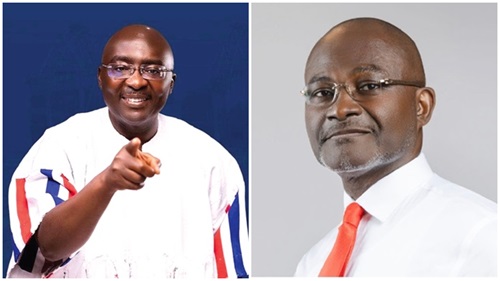
While there are five candidates vying for the enviable position, a close observation of the race points to a two-person race between 2024 flag bearer/former Vice-President Dr Mahamudu Bawumia and former Member of Parliament for Assin Central, Kennedy Agyapong.
I call the race a fight between the party establishment (Dr Bawumia) and the establishment’s anti-establishment (Kennedy Agyapong).
Let me explain. Dr Bawumia is the establishment candidate. He has been since 2024 when he was elected party flag bearer during that primary.
I describe Dr Bawumia as the establishment’s candidate because directly or indirectly, back in 2024, there were signals from the party hierarchy that he was their preferred choice.
Of course, ultimately, the decision came down to who the delegates preferred, but you cannot discount the influence of such signals.
I see same playing out in 2026, although I must acknowledge that some of the establishment voices have switched copies and now support his main rival.
Since 2024, I have been describing Mr Agyapong as the establishment’s anti-establishment candidate for primarily two reasons.
He has been part of our establishment politics, especially since winning a parliamentary seat and contributing in financial and non-financial ways to the NPP.
But every so often, he echoes anti-establishment sentiment.
For example, he is on record for expressing some very harsh reservations about his own political party and the system in general.
He has developed the skill of being entrenched in our duopoly politics but speaking out against it.
This was made clear in a recent interview where one of his ardent supporters, Kweku Kwarteng admitted to Umaru Sanda on Channel 1 TV that while Mr. Agyapong is a politician, he is also a disrupter.
Who Will Win?
So, who will win? In the famous words of the late Sir John, “fear delegates.”
The two candidates are regularly received with rousing and warm welcomes whenever they visit constituencies and engage with delegates.
Perhaps it represents the traditional Ghanaian hospitality and not necessarily a vote of endorsement.
It is therefore difficult to judge who will win based on the warmth shown by delegates and other party sympathisers.
If you judge by social media sentiments, especially Facebook, where I am a keen participant and observer, the race appears extremely competitive.
To borrow a term from American politics on election night “the race is too close to call.”
Putting aside some of the unpalatable rhetoric used by supporters of both camps, there is a strong sense of belief on each side that their candidate will emerge victorious.
Then there is the empirical evidence – polls.
Global Info Analytics has consistently shown that Dr Bawumia will emerge winner of the contest on January 31.
There is also a poll by Sanity Africa which shows Mr Agyapong winning the race.
If you are in Dr Bawumia’s camp, you’ll embrace the Global Info Analytics poll.
If you are in Mr Agyapong’s camp, you’ll prefer the Sanity Africa poll.
In the end, only one candidate can and will emerge winner.
And as former President Akufo-Addo once said, “the most important poll is what actually happens on election day.”
Both candidates have strengths and weaknesses which party delegates would have to weigh very closely as they try to answer the question – who presents us with the best chance of winning in 2028 if that is a possibility.
I have a policy of refraining from speculating who is likely to win political contests so I will wait to see what happens on election day.
When It Is All Over
On January 31, by 6pm at the latest, I am sure the party’s flag bearer would be known.
I hope the election day is peaceful and incident-free.
Electoral integrity matters to the acceptability of election outcomes.
The party’s election committee must do all it can to ensure that the primary passes the integrity test with flying colours.
Given the intense rivalry of the race between the two leading contenders, the biggest post-primary task the winning candidate will have is uniting the party.
And that will depend largely on the grace the victor shows the vanquished.
The vanquished, though, will also have to show some grace in accepting defeat and not delegitimising the process.
In the end, all contenders must come to the single most important realisation – the key political rival is not internal, but rather external.
The other post-primary post is how the winning candidate pivots and maintains momentum for the 2028 election.
I worry that thirty-six months is a long time to keep a presidential campaign active and energetic.
Unless after securing the nomination, the winning candidate plans to take a lengthy break before launching the official campaign for 2028.
Good luck!.
The writer is the Project Director, Democracy Project
