


“Education must evolve or risk irrelevance” — Telecel CEO warns
The Chief Executive Officer of Telecel Ghana, Patricia Obo-Nai, has called for urgent reforms to Ghana’s education system to align learning with rapidly evolving industry demands and technological change.
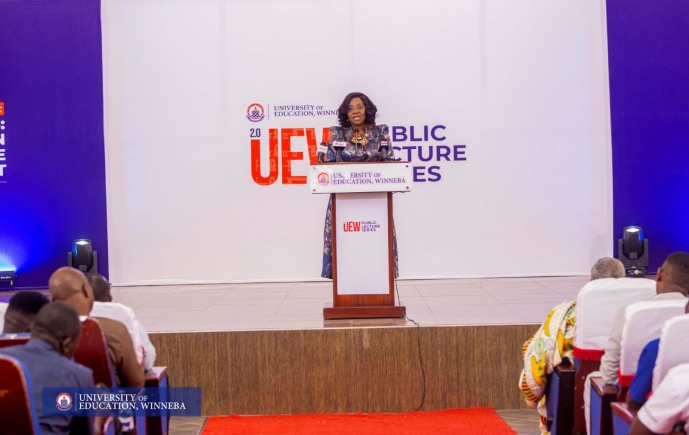
Speaking as chairperson of the 2026 Public Lecture Series at the University of Education, Winneba, she stressed that a disconnect between academic curricula and real-world skills could have far-reaching consequences for students, employers and the broader economy.
Addressing participants on the theme “Empowering Minds: Rethinking Education for Sustainable Development”, Ing. Obo-Nai warned that the pace of change in technology and industry was outstripping educational reforms, creating a growing gap between knowledge acquisition and practical relevance.
“The skills that industries demand are evolving faster than many academic curricula, and technology is changing faster than policy. If education remains unchanged while everything around it changes, we are creating a gap between learning and relevance, and that gap is costly because students feel it first, employers feel it next and eventually, economies feel it most,” she said.
She underscored the central role of teacher education in shaping future generations, noting that institutions such as UEW carry a unique responsibility in influencing how young people develop confidence, curiosity and ambition.
“You shape how children first learn confidence, how curiosity is formed, and how young people begin to imagine possibilities,” she said, adding that the university’s impact extends far beyond academia into national development.
Ing. Obo-Nai also advocated a collaborative approach to reform, emphasising that no single institution could transform the education system in isolation. Drawing on her industry experience, she highlighted the need for stronger links between classroom learning and practical application, particularly in an era where digital literacy has become essential.
She urged students to adopt a mindset of continuous learning and adaptability, stressing that education should not be seen as a finite process but an ongoing journey.
“Let’s not treat education as something you complete; let’s treat it as something you continue. We are not asking only what students read in school, we are asking how responsible they can lead and how confidently they can solve what has not yet been solved,” she said.
In his keynote address, Mohammed Ibn Chambas, the African Union High Representative for Silencing the Guns, described education as a critical driver of peace and development across the continent.
“Education is the most powerful catalyst for determining the destinies of nations. It is a strategic long-term tool to build a peaceful and prosperous continent by fostering equitable societies where grievances are resolved and justice is upheld,” he said.
Dr Chambas outlined three priorities for reform—relevance, resilience and responsibility—arguing that education systems must be deliberately designed to prepare learners for uncertainty while promoting ethical citizenship.
The lecture series brought together academics, policymakers, traditional authorities and industry leaders for a national dialogue on the future of education, reinforcing calls for closer collaboration between government, academia and the private sector.
Participants agreed that aligning education with the demands of a changing world would be critical to equipping young people with the skills needed to thrive in an increasingly competitive global environment.