


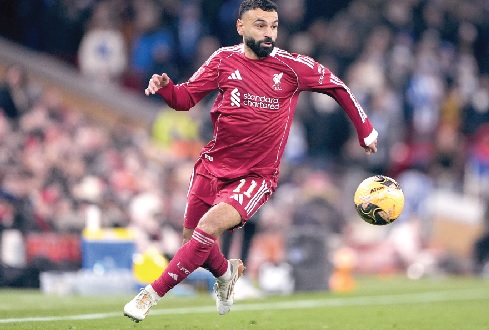
From £37m signing to global brand: Salah’s Liverpool exit strategic asset monetisation
The decision by Mohamed Salah to leave Liverpool FC this summer marks far more than the departure of a club legend.
It is, in business terms, the conclusion of one of football’s most successful asset cycles and the beginning of a new phase in which his brand equity will be redeployed within the rapidly expanding ecosystem of the Saudi Pro League.
After eight transformative years, Salah leaves as both a sporting icon and a high-performing asset whose value has been almost entirely extracted by the English giants.
Signed from AS Roma in 2017 for £36.9 million, the Egyptian forward departs with 255 goals in 435 appearances, placing him third on Liverpool’s all-time scoring chart and among the most productive players in English Premier League history.
Yet, the numbers alone do not capture the scale of Liverpool’s return on investment.
Undervalued asset to global powerhouse
Salah’s tenure at Anfield represents a textbook case in elite football asset management.
Liverpool acquired a player undervalued by the market following an underwhelming spell at Chelsea and converted him into a global superstar whose on-pitch output drove both sporting success and commercial expansion.
At his peak, the Egyptian icon averaged 30 goals per season — a level of consistency that underpinned Liverpool’s modern dominance, including Premiership and UEFA Champions League titles.
From a commercial perspective, Liverpool extracted exceptional value from their investment.
Salah’s impact cannot be measured solely through goals. He became the first North African player to achieve true global superstar status, carrying immense cultural and commercial significance.
His endorsement portfolio — spanning Adidas, Pepsi, Vodafone and Audi — positioned him as a premium global brand.
This translated into increased shirt sales and merchandise demand, enhanced broadcast appeal in key emerging markets, particularly across Africa and the Middle East and stronger leverage in commercial negotiations with sponsors.
For Liverpool, Salah was not just a performer; he was a brand amplifier.
Smart exit strategy
Despite his iconic status, Liverpool’s decision to part ways with Salah is rooted in financial discipline rather than sentiment.
At £400,000 per week — rising to approximately £25 million annually with bonuses and image rights — he represents the club’s largest wage commitment.
By allowing their most successful star of the last decade to leave, it frees up between £20.8 million and £25 million annually in wages and other emoluments to invest in younger assets, while Liverpool minimise risks associated with declining performance due to age.
Critically, his exit comes without a transfer fee — a trade-off that Liverpool's ownership group, Fenway Sports Group, appears willing to accept in exchange for long-term wage flexibility.
In purely business terms, this could be likened to portfolio optimisation and not sentiment-driven decision-making.
Saudis' strategic play
Salah’s likely move to Al Ittihad underscores Saudi Arabia’s broader strategy of acquiring global sporting icons as vehicles for economic and cultural influence.
Saudi clubs, backed by the Public Investment Fund, have demonstrated a clear pattern: acquire global icons not just for performance, but for their commercial ecosystems.
Salah fits this model perfectly. Unlike many ageing stars, the former African best player arrives with a massive pan-Arab and African following, established commercial partnerships that can be leveraged within new markets and a cultural resonance comparable to Cristiano Ronaldo in Europe or Latin America.
Shifting economic centre
The migration of elite players, including Africa's top earners to Saudi Arabia reflects a broader redistribution of capital within global sport. The financial gravity of Saudi football is evident in the wage structures of Africa’s elite players.
Currently, the continent’s highest earners include Algeria's Riyad Mahrez at £827,000 a week (Al-Ahli), Senegal's Sadio Mané at £634,000 a week (Al-Nassr) and Senegal's Kalidou Koulibaly at £550,000 a week (Al-Hilal).
Salah, earning £400,000 per week in England, is already behind Saudi-based peers, a gap that is expected to close dramatically with his next contract.
Financial lessons for Ghanaian institutions
1. Invest in undervalued assets with upside potential
Liverpool’s success with Salah began with identifying a mispriced asset. Ghanaian clubs and organisations must move beyond reactive recruitment and develop systems to identify high-potential talent before market inflation sets in.
2. Maximise lifecycle value before exit
Salah delivered peak output across multiple seasons before his departure. The discipline lies in extracting full value — sporting, commercial and brand — before divesting.
3. Prioritise financial sustainability over sentiment
Liverpool’s willingness to release a legend highlights a critical principle of sustainable organisations: making data-based decisions. Ghanaian institutions must adopt similar discipline in contract management, wage structures and talent retention.
4. Build brands beyond performers
Salah’s enduring value lies in his brand as much as his football. Ghanaian athletes and organisations must invest in storytelling, digital platforms and audience engagement to create scalable commercial assets that attract sponsors and partners.
For emerging markets such as Ghana, it is a reminder that the true value in sport lies not just in talent, but in how that talent is positioned, leveraged and ultimately monetised.