


The price of employing a banker in Ghana now depends less on the size of the institution than on the business model it has chosen.
An analysis of audited 2025 financial statements shows that personnel costs per employee vary by more than fourfold across the banking industry, exposing a widening divergence in how lenders deploy their most valuable asset—their workforce.
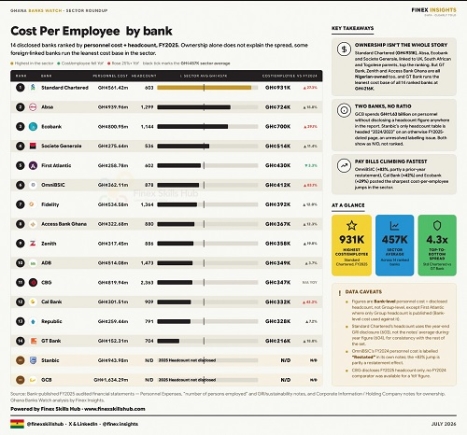
At one end of the spectrum, Standard Chartered Bank Ghana spent an average of GH¢931,000 per employee during the 2025 financial year, the highest in the industry.
Absa Bank Ghana followed with GH¢724,000 per employee, while Ecobank Ghana recorded approximately GH¢700,000.
At the other end, Guaranty Trust Bank (GTBank) Ghana spent just GH¢216,000 per employee—less than a quarter of Standard Chartered's average—raising questions about whether banks are competing by paying higher-paid specialist talent or increasingly relying on leaner, technology-driven operating models.
The findings are based on personnel expenses disclosed in audited financial statements divided by year-end employee headcount.
Only banks that consistently reported both figures were included, yielding a comparable sample of 14 institutions.
Across the industry, the average personnel cost stood at about GH¢457,000 per employee, but that figure masks significant differences in workforce strategy.
Beyond the ownership narrative
Data analyst, Founder and Lead Trainer of the International research firm, Finex Skill Hub, Bernard Obeng Boateng said the rankings appeared, at first glance, to reinforce the long-held perception that multinational banks pay more.
Yet, the data tells a more complicated story.
“While Standard Chartered, Absa and Ecobank dominate the top of the table, ownership alone fails to explain the disparities”, he said.
Access Bank Ghana and Zenith Bank Ghana—both subsidiaries of Nigerian banking groups—reported personnel costs below the industry average.
GTBank Ghana, another Nigerian-owned lender, recorded the lowest cost per employee among all banks analysed.
The figures suggest that remuneration is increasingly shaped by institutional strategy rather than nationality.
Banks concentrating on corporate and investment banking typically require smaller pools of highly specialised professionals whose expertise commands premium compensation.
Retail-focused institutions, by contrast, often employ larger branch networks and customer-facing workforces, resulting in lower average personnel costs despite larger payrolls.
Digital transformation reshaping equation.
Institutions that have invested heavily in automation, centralised operations and digital channels can operate with fewer employees, while maintaining or expanding business volumes, altering the economics of labour without necessarily reducing service quality.
What the numbers do—and do not—say
Personnel cost per employee is emerging as an increasingly useful indicator for investors seeking to understand operational efficiency, but the metric offers only part of the picture.
Mr Boateng said higher workforce costs do not necessarily imply inefficiency.
They may instead reflect deliberate investments in experienced relationship managers, risk specialists, technology professionals or executive talent capable of generating significantly higher revenues.
“Likewise, lower personnel costs should not automatically be interpreted as evidence of superior cost discipline.
They may reflect lower average salaries; different workforce composition or operating models built around scale and automation”, he added.
The more revealing question is whether those employees generate returns commensurate with what they cost.
Viewed alongside revenue per employee, profitability, cost-to-income ratios, and return on equity, personnel costs become a powerful indicator of how effectively banks convert human capital into shareholder value.
Changing workforce economics
The 2025 financial statements also point to shifting labour economics across the sector.
OmniBSIC Bank recorded the sharpest increase in personnel cost per employee following a restatement of personnel expenses in its audited accounts. CalBank and Ecobank Ghana also registered notable increases.
The movements may reflect annual salary adjustments, workforce optimisation programmes, organisational restructuring or accounting reclassifications rather than simple changes in staff numbers.
Nonetheless, they underline the extent to which Ghana's banking industry continues to recalibrate its workforce following years of regulatory reforms, digital investment and changing customer behaviour.
Banks are increasingly seeking to balance rising wage expectations with the need to preserve profitability in an environment where technology is steadily replacing routine banking functions.
A transparency gap
The analysis also exposes an important weakness in corporate reporting.
Two of the country's largest banks—Stanbic Bank Ghana and GCB Bank—could not be included because their published financial statements did not disclose employee headcount in a manner comparable with peers.
While personnel expenses are routinely reported, inconsistent disclosure of workforce data limits the ability of investors, analysts and shareholders to benchmark productivity and human capital efficiency across the industry.
That gap is becoming more significant as Environmental, Social and Governance (ESG) reporting gains prominence and investors increasingly scrutinise workforce metrics alongside traditional financial indicators.
More consistent reporting of employee numbers and related productivity measures would strengthen transparency and improve comparability across Ghana's banking sector.
Ultimately, personnel cost per employee is neither a scorecard of generosity nor a definitive measure of efficiency.
Rather, it offers a window into the strategic choices banks are making as they compete in an industry being reshaped by digitalisation, evolving customer expectations and mounting pressure to improve returns.
The banks paying the most for talent are betting that specialised expertise will deliver superior value, while those spending less are wagering that scale, technology and operational efficiency will prove the stronger competitive advantage.