
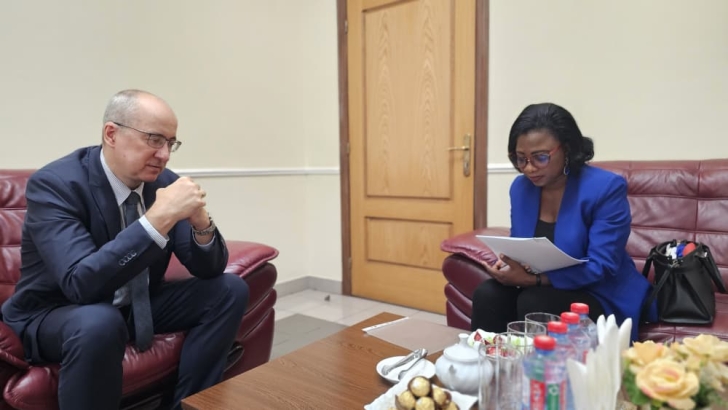
The Russian Ambassador to Ghana, Andrei Ordash (A.O.), in an exclusive interview with Graphic Online’s Augustina Tawiah (A.T.), spoke on a wide range of issues, including Russia’s war with Ukraine; the Russia-Africa Summit that will come off in October and scholarships for Ghanaian students.
Below are excerpts of the interview on Ghana-Russia relations, areas of cooperation, trade and investment and energy.
(A.T.): Ghana-Russia relations: How will you describe the cooperation of the two countries over the decades?
(Andrei Ordash): Relations between Russia and Ghana are built on a very solid historical foundation. Diplomatic relations between the Soviet Union and Ghana were established shortly after Ghana declared its independence, and from the very beginning our country regarded Accra as one of its key partners in Africa.
Cooperation was particularly close during the presidency of Kwame Nkrumah. The Soviet Union supported Ghana’s aspirations to strengthen its political and economic independence, pursue an independent foreign policy and overcome its colonial legacy. This cooperation took concrete forms in the fields of industry, energy, education, medicine and culture. Thousands of Ghanaian citizens received education and vocational training in the Soviet Union, and many of them subsequently made a significant contribution to the development of Ghana.
Therefore, when we speak of current Russian-Ghanaian relations, we are not talking about building a partnership from scratch. Our countries already share a long-standing human, political and professional capital. Many Ghanaian specialists, who hold senior positions today, have ties with Russia.
In recent decades, of course, relations have undergone a major transformation. The international system, Russia’s economy and the very structure of our ties have all changed. However, the political dialogue between Moscow and Accra has been maintained, and the foundation laid over previous decades allows us to gradually shape a new agenda.
Here is a very recent example.
In August 2026, Ghana’s Minister of Foreign Affairs, Samuel Okudzeto Ablakwa, visited Moscow and held talks with Russia’s Minister of Foreign Affairs, Mr Sergey Lavrov. The parties discussed promising areas for cooperation, as well as preparations for the ‘Russia-Africa’ summit. An agreement was signed on visa-free travel for holders of diplomatic and service passports.
Our task now is not simply to maintain the good relations that have developed in the past, but to infuse them with new substance. Our historic friendship is important, and it must serve the contemporary interests of our countries.
(A.T.): What are the latest areas of focus in Russia-Ghana cooperation and over what period?
(Andrei Ordash): As regards the current agenda, I would, first and foremost, highlight trade and economic cooperation, energy, agriculture, mining industry, education, scientific and technical cooperation and, of course, cooperation on a wide range of international issues, including security, taking into account developments in West Africa.
It is important to understand, however, that this is not a list of isolated areas. We would like to see them gradually become interlinked and form a sustainable partnership.
A telling example of such a partnership is linked with the adoption in March this year by the UN General Assembly of a resolution initiated by Ghana, recognising the transatlantic trade in enslaved Africans and racial slavery as the gravest crime against humanity and calling for further measures to restore historical justice. Russia supported this resolution without the slightest hesitation.
European states today actively make statements on international law, historical responsibility and the need to protect human rights; however, when Ghana proposed giving the issue of the transatlantic slave trade concrete political significance and raising the question of restoring historical justice, most European countries chose to abstain.
Incidentally, on the subject of education. I would describe this area as key. Without qualified national specialists, it is impossible to implement any energy project, modern industrial programme, digital transformation or development of the mining sector.
Expanding trade and business-to-business contacts may yield results in the very near future. Setting up joint ventures, localising production and implementing investment projects will take several years. Meanwhile, the energy sector, large-scale industrial infrastructure, the training of specialists and the development of a scientific and technological base are projects designed to span decades.
It is precisely this long-term approach that we consider to be the most sensible. Russia is not interested in a series of short-term deals, but rather in ensuring that, in a few years, Russian-Ghanaian cooperation has a much deeper structure than it does today.
(A.T.): Trade and investment: Ghana-Russia trade relations have grown significantly in recent years. From $247 million in 2022 to more than $800 million in 2024. What concrete investments are Russia and Russian businesses prepared to make in Ghana beyond the supply of fertiliser, petroleum products and grains?
(Andrei Ordash): Indeed, trade growth in recent years has been very substantial. Trade turnover increased more than three and a half times between 2022 and 2024. The main drivers were Russian supplies of petroleum products, foodstuffs and fertilisers. In 2026, following a slight decline, our trade relations are once again showing positive momentum: in the first half of the year, trade turnover rose by 2.1 per cent compared with the same period in 2025, with Russian exports to Ghana increasing by 11.5 per cent.
But I would like to make an important point straight away: for Russia, an increase in trade turnover is not an end in itself. If Russian-Ghanaian relations are limited to the export of Russian grain, fertilisers, petroleum products and other goods, we will be utilising only a small fraction of the available potential.
Our task is to gradually move away from a model in which one side mainly sells, and the other mainly buys, towards a more complex model involving joint investment, production, processing and technological cooperation.
One of the most promising areas here is the mining industry and geological exploration. Ghana possesses significant mineral reserves and is one of Africa’s leading gold producers. Russian companies and research organisations possess expertise in geology, geophysics, mining machinery, and the extraction and processing of raw materials. We can therefore discuss more complex projects in this area.
Russian companies are already keen to expand their supplies of food and fertilisers to African markets, including Ghana. But here too, we see a scope to go further. This could include projects involving food processing, the supply of agricultural machinery and technology transfer.
Our country has capabilities not only in the supply of energy resources, but also in engineering services, equipment and the implementation of major energy projects.
The Russian side is keen for our businesses to view Ghana not only as a sales market, but also as a place for localising certain production and service operations. Ghana’s potential as a member of the African Continental Free Trade Area is of particular interest here: manufacturing in Ghana potentially enables us to access the wider African market.
However, I would like to be precise here. We must not give the impression that all the projects listed are already investment contracts ready for signing. That would be incorrect. The initiatives are at the stage of preliminary negotiations, market assessment, the search for partners and the determination of commercial terms.
(A.T.): Russia to support Ghana with major infrastructure projects such as in energy, nuclear power or technology? What specific projects are currently under discussion?
(Andrei Ordash): It is important here to distinguish between the existing contractual and legal framework and the final decision on the construction of a nuclear power station.
In 2015, Russia and Ghana signed an intergovernmental agreement on cooperation in the peaceful use of nuclear energy. This provides for cooperation on a wide range of issues, establishing a legal framework for Russia’s participation in the construction of Ghana’s first nuclear power plant. The memorandum signed in 2012 between the Russian state corporation Rosatom and the Ghanaian Ministry of Energy pursues the same objectives.
Ghana itself has made significant progress in recent years in developing its national nuclear energy programme. Russia is keen to participate in this process. During recent Russian-Ghanaian talks at the level of foreign ministers, nuclear energy was once again identified as one of the promising areas for cooperation.
However, I would like to emphasise that the final choice of foreign partners, technology, capacity, financial model, timelines and other parameters lies solely within the competence of the Ghanaian side.
Russia proposes to provide Ghana with the full range of solutions required to establish a nuclear power sector. This goes beyond the power unit itself. It includes the training of specialists, engineering and scientific support, design, construction, operation, maintenance and the development of national expertise.
The issue of staff training is particularly important for Ghana. If the country decides to develop a nuclear power sector, it must simultaneously establish its own training programme for specialists engineers, physicists, and experts in radiation safety, operations and regulation. Russia has extensive experience in this field and is ready to share it.
As for the broader energy and infrastructure agenda, the opportunities here are not limited to nuclear power either. Russia can offer expertise in power engineering, engineering services and much more.
