
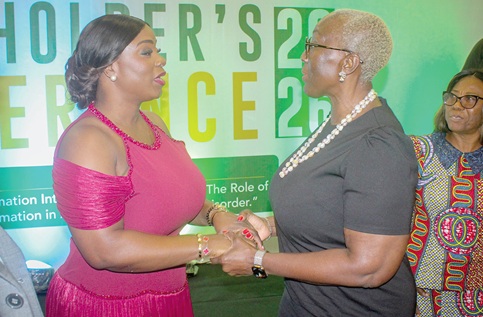
The Legal Advisor to the President, Marietta Agyeiwaa Brew, has urged the media to strengthen fact-checking practices to help combat information disorder in the digital age.
She explained that journalists and media organisations had a responsibility to verify information before publishing, particularly as many people continued to assume that information circulated through the media and social media was sacrosanct.
Ms Brew, who is also a former Attorney-General and Minister of Justice, stressed that the media must ensure that information published was properly checked to prevent false or misleading content from spreading rapidly, undermining public trust in the process.
Speaking at the 2026 Stakeholders’ Conference organised by the Right to Information (RTI) Commission in Accra on September 24, Ms Brew, who represented the President, stated that the speed at which information spread online made it even more important for journalists to verify facts before publishing to prevent misinforming the public.
Background
The conference provided a platform for stakeholders to move beyond general discussions on misinformation, disinformation and other forms of information disorder to examine practical, legislative and institutional measures under Ghana’s Right to Information Act, 2019 (Act 989).
On the theme, “Upholding information integrity in the digital age: The role of access to information in addressing information disorder,” the conference focused on how effective implementation of the RTI law could help bridge information gaps and strengthen public confidence in credible sources.
It also examined proactive disclosure by public institutions and the need to improve the accuracy, timeliness, accessibility and usability of information released to the public.
The Legal Advisor said the media had a duty to provide the public with accurate and verified information to enable citizens to make informed decisions.
Ms Brew stressed that the rapid spread of information through digital platforms could allow false claims to circulate widely before the facts were established.
“In your publications, check the way that you write it before publishing,” she said.
She urged journalists to verify their sources and exercise caution when reporting information obtained from social media and other digital platforms.
Ms Brew called for collaboration among the media, educators, civil society organisations and digital practitioners to help the public recognise manipulation while preserving legitimate debate and dissent.
Govt open to scrutiny
The Deputy Presidential Spokesperson, Shamima Muslim, said the government expected the media to be accountable through fair and factual scrutiny.
She said the government was committed to providing information in a timely manner as delays in releasing public information could create a vacuum that misinformation could fill.
“As a government, we do not fear media scrutiny. We do not fear their questions. I think what we expect is fairness to the facts,” she said.
She urged public institutions to take responsibility for responding to Right to Information (RTI) requests and to clearly explain the reasons whenever information could not lawfully be disclosed.
Credible information
The Board Chairman of the RTI Commission, Dr James Kwaku Asante, said access to accurate and credible information from public institutions was critical to helping citizens distinguish facts from falsehoods in the digital age.
He said the Right to Information had become a powerful tool for strengthening public governance, promoting accountability and enabling citizens to participate meaningfully in national development.
“Access to information is and has become a powerful instrument for public citizens,” he said.
He stated that the responsibility for promoting information integrity went beyond the RTI Commission.
He called for stronger collaboration among government institutions, the media, civil society organisations, academia, the private sector, development partners and citizens to strengthen openness, transparency and responsible information sharing.
