


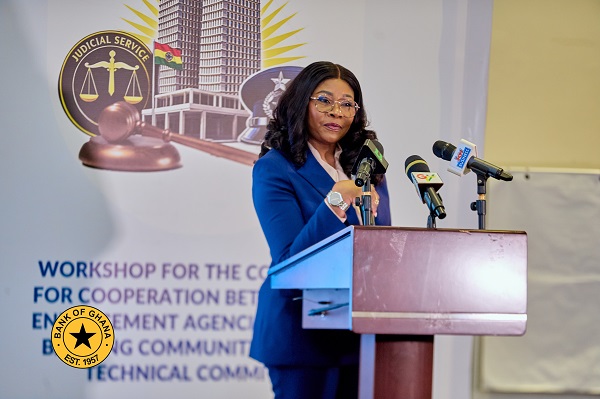
We need strategic national response against unlicensed financial operators — Second Deputy Governor
The Second Deputy Governor of the Bank of Ghana (BoG), Matilda Asante-Asiedu, has called for a strategic national response to curb the growing activities of unlicensed financial operators that threaten trust and stability in the country’s financial system.
She warned that economic recovery, rising digital finance, and expanding access to credit have also created opportunities for bad actors exploiting regulatory gaps across banking, telecoms, and media platforms.
Opening a technical committee workshop for the Committee for Co-operation between Law Enforcement Agencies and the Banking Community (COCLAB) in Accra on December 18, Mrs. Asante-Asiedu stressed that fragmented oversight has weakened enforcement and requires coordinated action among regulators, law enforcement, financial institutions, telecom operators, and the media.
“We need to demonstrate effective interagency cooperation and a strategic national response to these unlicensed financial service providers, because the trust, soundness and stability of our financial ecosystem is at stake,” she said.
The workshop
The formation of COCLAB in the country was spearheaded by Bank of Ghana (BoG), building on INTERPOL’s 1988 Resolution, to help curb economic crime around the world.
The workshop was on the theme: “Promoting financial integrity through multi-stakeholder collaboration.”
It was attended by representatives from the judicial service, police officials, national security and other law enforcement agencies.
Dozens of complaints
The deputy Governor stated that the rise in digital finance and instant loan platforms had made it easier for unlicensed operators to mimic legitimate financial products while imposing punitive terms and abusive recovery practices on consumers.
She said the central bank had received dozens of complaints in recent years linked to illegal savings, investment, and lending schemes, underscoring the scale of the threat.
“In 2024 alone, the Bank of Ghana received over 50 complaints related to unregulated savings, investment, and lending schemes,” she said.
She said while arrests, public warnings, and enforcement actions had been taken in collaboration with other agencies, these measures were no longer sufficient on their own.
She stressed the need for deeper intelligence-sharing and stronger institutional coordination to stay ahead of increasingly sophisticated actors.
“Collaboration had to move beyond dialogue to execution, because no single institution was responsible for the entire value chain,” she said.
Mrs Asante-Asiedu added that a unified and sustained multi-agency approach was critical to protecting consumers and preserving confidence in the country’s financial system.
Collective action
The Head of Financial Stability Department at BoG, Dr Kwasi Osei-Yeboah, stated that the fight against unlicensed and “cloned” financial institutions required collective action to protect the integrity of the financial system.
She explained that these entities exploit technological loopholes to prey on vulnerable members of the public for unearned profits.
He said that while technology had expanded access and created opportunities, it had also enabled criminals to constantly retool their strategies, making vigilance and adaptability essential.
Dr Osei-Yeboah said the presence of regulators, law enforcement agencies, banks, and the media demonstrated a shared commitment to addressing the growing risks posed by online financial schemes.
He urged participants to approach the discussions with purpose and pragmatism, as the session was a call to action rather than a routine engagement.
“It is incumbent on all of us to recalibrate our strategies to keep ahead of the curve so that the financial system is well sanitised and fit for purpose,” he said.
Unsuspecting citizens
An Appeals Court Judge, Justice Afia Serwaa Asare-Botwe, who was the chair of the event, said her years on the bench had exposed her to several cases of banking fraud and illegal financial operations that harmed unsuspecting citizens.
She recalled dealing with cases where misconduct by financial staff was downplayed, insisting that wrongdoing should be called what it truly is.
“Don’t call it suppression, call it stealing, because that is what it is,” she said.