
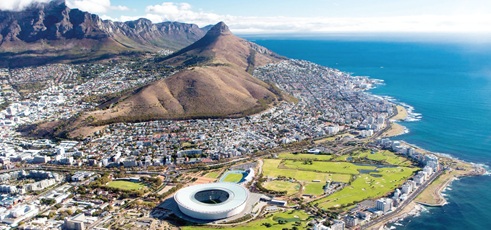
This April, Cape Town prepares to host two major fixtures on Africa’s business travel calendar – ILTM Africa from April 10 to 12, 2026 and WTM Africa from April 13 to 15, 2026, collectively branded as Africa Travel Week.
More than just back-to-back trade shows, the gatherings reflect a wider, continent-wide drive to reposition Africa as a serious player in the global meetings, incentives, conferences and exhibitions – MICE – industry and to grow its current share of roughly three per cent of the global meetings market.
Africa Travel Week arrives at a time when the continent’s meetings industry is finding its voice with greater confidence.
Recent conversations at Meetings Africa in Johannesburg revealed an industry no longer content with being labelled ‘emerging’.
Instead, destinations, associations and private sector players are increasingly focused on market share, bid competitiveness and long-term economic impact.
At Meetings Africa’s 20th anniversary edition held recently at the Sandton Convention Centre, South Africa’s Tourism Minister Patricia de Lille reinforced the economic case for business events, noting that over the past three years alone, the show’s contribution to South Africa’s GDP nearly doubled, while thousands of jobs were created and sustained.
Her message was simple but instructive – meetings are not an add-on to tourism, they are a strategic growth engine.
Gateway for African destinations
That perspective is shaping how African destinations now view platforms such as ILTM Africa and WTM Africa. While ILTM Africa is best known for luxury travel and high-end experiences, it plays an important role in the meetings ecosystem, particularly for incentive travel and executive-level corporate programmes.
These segments often sit at the intersection of luxury leisure and business travel, making ILTM an important gateway for African destinations seeking to diversify their MICE offerings.
“This year, ILTM Africa welcomes international delegates representing 32 countries, reinforcing its role as the leading meeting place for African luxury travel,” says Megan De Jager, Portfolio Director at RX Africa.
“We are excited to return to the iconic Norval Foundation, where art, culture and design intersect to create an inspiring backdrop for business-building and igniting long-term partnerships.”
WTM Africa, meanwhile, provides the broader marketplace.
As part of Africa Travel Week, it brings together tourism boards, airlines, hotels, convention bureaux, technology providers and buyers from across the globe. For Africa’s meetings industry, this diversity matters.
Business events thrive where airlift, accommodation, infrastructure, services and experiences align seamlessly.
Africa Travel Week
The City of Cape Town is again hosting these events as part of the Africa Travel Week programme. James Vos, the City’s Mayoral Committee Member for Economic Growth and Tourism, highlighted the importance of tourism for the local economy.
“Events like these showcase the best of our destination, our crafts, cultures, communities and cuisine, the authentic ingredients that make Cape Town such a sought-after place to visit.
Tourism is a powerful economic driver for our city, with nearly seven per cent of our workforce employed in the visitor economy, which is why we continue working to connect Cape Town to more source markets and ensure the benefits of tourism are felt throughout our local economy.”
One of the recurring themes at Meetings Africa was collaboration.
Glenton de Kock, CEO of the South African Association for the Conference Industry, was unequivocal in his assessment.
Africa, he argued, will not meaningfully grow its share of the global meetings industry through isolated destination marketing alone.
“Africa wins when it works together,” he said, pointing to regional bidding, shared air access and cross-border collaboration as essential tools for attracting large association congresses and rotating global events.
Africa Travel Week, by convening stakeholders across tourism and business events, offers a platform for advancing exactly that kind of continental thinking.
From the private sector perspective, Kezy Mukiri, CEO of Zuri Events and organiser of the Africa MICE Summit, believes Africa’s credibility is built through delivery.
Speaking in Johannesburg, she highlighted that recent high-profile conferences across East and Southern Africa have demonstrated the continent’s capacity to host complex, large-scale events.
“When African destinations succeed, it builds confidence for the whole continent,” Mukiri noted.
For her, platforms like WTM Africa are essential for taking that success story to new buyers and decision-makers who may still underestimate Africa’s readiness.
That readiness is also evident in destinations investing deliberately in infrastructure, skills and policy support. Yoahana Tilahun, speaking on Ethiopia’s growing meetings pipeline, emphasised that preparedness is no longer theoretical.
From climate summits to major continental conferences, African cities are proving their ability to scale quickly and deliver under pressure.
Building long-term capabilities
Yet, despite these gains, Africa’s share of the global meetings market remains modest.
According to the ICCA, Africa accounts for roughly three per cent of recorded global association meetings.
For Senthil Gopinath, the challenge is not ambition, but consistency.
Africa, he has argued, must focus on building long-term capability – from professional conference organisers and convention bureaux to education, knowledge transfer and data-driven bidding.
Trade shows such as WTM Africa offer the exposure, but success ultimately depends on what destinations do between editions.
This is where Africa Travel Week becomes more than a diary fixture.
It is a checkpoint.
A moment for African destinations to assess how far they have come, refine their value propositions and align tourism marketing with meetings strategy.
It is also an opportunity to shift the narrative – from Africa as a collection of individual destinations to Africa as a connected, competitive meetings region.
As Cape Town prepares to welcome the global travel trade this April, the stakes are clear.
ILTM Africa and WTM Africa are not ends in themselves.
They are instruments. Tools through which Africa can accelerate its meetings ambition, deepen partnerships and begin the steady work of moving from three per cent to something far more representative of its potential.
For Africa’s meetings industry, the question is no longer whether the continent is ready.
The question is whether it will act collectively, strategically and consistently enough to claim the share it deserves.
