
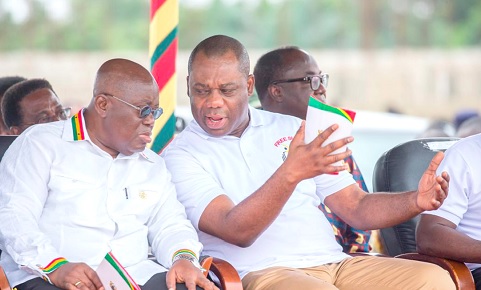
In September 2017, President Nana Addo Dankwa Akufo-Addo launched the Free Senior High School (Free SHS) policy at the West Africa Senior High School in Accra, fulfilling a long-standing New Patriotic Party (NPP) campaign promise.
Eight years later, in September 2025, Ghanaians reflect on the remarkable journey of this ambitious programme—one without parallel in the nation’s educational history.
During a memorable speech at the University of Cape Coast on September 4, 2024, His Royal Majesty Otumfuo Osei Tutu II, the Asantehene, described Free SHS as ‘the most audacious piece of social intervention in our Fourth Republic.’
That description captures both the ambition and the impact of the programme. Like any far-reaching reform, Free SHS has faced formidable challenges, yet its significance as one of the most transformative policies in modern Ghana cannot be overstated.
At the time of its launch, sceptics questioned its feasibility and sustainability.
Many feared that educational quality would decline amid rapid expansion. Others doubted whether Ghana’s economy could sustain the long-term financial costs.
These concerns were not unfounded, but President Akufo-Addo and his government demonstrated resolute commitment.
They moved decisively beyond rhetoric to delivery, ensuring that millions of Ghanaian children—who would otherwise have been excluded—gained access to secondary education.
Expansion and Innovation
One of the most pressing challenges was the surge in enrolment. Schools across the country faced shortages of classrooms, science laboratories and workshops.
In response, the government introduced the innovative double-track system, which staggered attendance and eased congestion.
Far from weakening learning, the new approach provided students with more contact hours than the traditional calendar, sustaining academic rigour while widening access.
Contrary to initial fears, there is no conclusive evidence that standards declined.
In fact, outcomes have shown resilience, and opportunities have widened.
A striking milestone has been gender parity: for the first time in Ghana’s history, girls’ enrolment in senior high schools has outstripped that of boys, a profound step towards equity in education and national development.
Ministerial Leadership and Implementation
President Akufo-Addo provided the bold vision, but it was Dr Matthew Opoku Prempeh (2017–2021) and the Ministry of Education who turned it into reality.
Tasked with translating policy into practice, he bore the responsibility of steering reform amidst constraints of infrastructure, staffing, and resources.
His stewardship ensured that the President’s pledge became a living reform that reshaped Ghana’s educational landscape.
Dr Opoku Prempeh, widely known as ‘Napo,’ combined assertive and pragmatic leadership with inclusive stakeholder engagement.
His tenure exemplified the principle that policies succeed not only because bold leaders announce them, but also because competent ministers drive their implementation with discipline and foresight.
Importantly, he did not work alone. He assembled a team of committed professionals and technocrats, working closely with his lieutenants—including Professor Opoku-Amankwah, then Director-General of the Ghana Education Service, and Mr Enoch Cobbina, Chief Director of the Ministry of Education—among many others. Through their collective efforts and consistent stakeholder engagement, Dr Prempeh underscored the importance of coordination in governance, where bold political vision is translated into disciplined ministerial execution.
Strategic Leadership and Lasting Impact
A defining feature of Dr Opoku Prempeh’s leadership was his ability to interpret and internalise the President’s vision as his personal mission. His dynamic style—sometimes forceful, often pragmatic—was instrumental in laying a strong foundation for Free SHS.
Under his supervision, the policy was rolled out nationwide and has since become a cornerstone of Ghana’s development agenda.
His capacity for strategic planning, resource mobilisation, and persistent engagement with critics enhanced public confidence in the ability of Ghana’s institutions to deliver on bold promises.
Eight years on, Free SHS remains a defining social intervention of the Fourth Republic.
It is a testament to the power of leadership, vision and execution.
President Akufo-Addo’s courage to initiate the policy, combined with Dr Matthew Opoku Prempeh’s stewardship in implementing it, has altered the trajectory of Ghana’s education system.
Conclusion
Free SHS is not without its continuing challenges. Yet, its achievements outweigh its shortcomings. It has expanded access, reduced inequality, enhanced gender parity, and positioned Ghana to better harness the potential of its youth.
As the nation marks the eighth anniversary of this transformative reform, it is fitting to acknowledge both the presidential vision that inspired it and the ministerial leadership that nurtured it into reality.
In Dr Matthew Opoku Prempeh, Ghana found a leader capable of translating bold promises into enduring reforms.
Together with President Akufo-Addo, he has left an indelible imprint on the nation’s educational landscape—one that future generations will continue to build upon.
The writer is the Executive Director, Busia Institute for Rural and Democratic Development
Email:
