
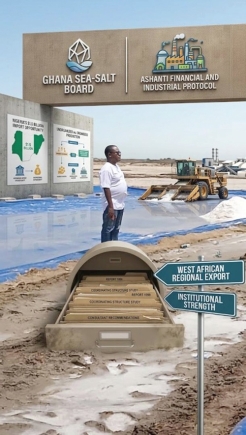
Ghana has spent two decades filing reports about a fortune it refuses to collect.
The numbers are almost embarrassing. Ghana can produce 2.2 million tonnes of salt a year. It produces 300,000 tonnes, roughly a tenth of its own capacity.
Meanwhile, Nigeria, sitting right next door, spends $1.5 billion a year importing salt from Brazil and Australia, shipping it across two oceans instead of buying it from the coastline a few hundred kilometres away.
West Africa’s industrial demand for salt exceeds 3 million tonnes annually.
Ghana’s own oil and gas industry alone needs over a million tonnes a year as drilling input and imports most of it.
This is not bad luck.
This is a country standing on top of demand and calling it scarcity.
Ghana has been told this before. In the 2000s, the Ghana Export Promotion Council actually asked the Commonwealth Secretariat to help build the coordinating structure the sector needed. Consultants came.
Seminars were held. Reports were written.
And then nothing.
The recommendations are sitting in a drawer somewhere in Accra while the opportunity they described has been quietly walking out the door for 20 years.
Ghana
Walking straight to Senegal, as it happens. Senegal did not out-produce Ghana because its coastline is better.
It out-organised Ghana.
It took thousands of scattered, individually powerless salt harvesters and put them into cooperative structures that could actually negotiate, actually access financing, actually reach a market.
It built a financing bridge, the Centre de Gestion et d’Economie Rurale, specifically because banks didn’t trust unorganised producers, so Senegal organised them until the banks had to.
It runs a standing national forum where producers, government, ECOWAS, and financiers sit in the same room year after year instead of once, for a consultant’s report.
The result is not subtle: Senegal captures 92 per cent of West African salt export value.
Ghana, despite bigger domestic demand, barely registers.
Here’s the part that should actually sting: Senegal is losing ground to undercut now by cheap refined salt flooding in from India and Egypt.
The one country that built the institution is watching that institution get eaten.
Which means the entire regional salt trade is currently unclaimed territory, sitting there for whoever moves first with something better.
Ghana could be that country. Instead, it’s still filing the same drawer.
Burkina Faso, Mali and Niger
And the leverage runs deeper than trade balances.
Burkina Faso, Mali, and Niger have no coastline at all; no domestic substitution is even theoretically possible for them.
That is not a footnote.
That is permanent structural dependency sitting on Ghana’s doorstep, and Ghana has never once organised itself to hold that leverage.
A country that controls a resource its neighbours cannot produce under any circumstances, and still fails to monetise that fact for two decades, is not experiencing bad luck.
It is choosing, year after year, not to notice its own advantage.
Why does this keep happening?
Because Ghana keeps treating institution-building as something that happens to it; something a donor funds, a consultant designs, a ministry eventually gets around to.
Senegal didn’t wait for that.
Nobody handed Senegal its cooperative structures or its financing bridge.
They built it because they understood that geography without institutions is just wasted potential, dressed up as an asset on paper.
Ashanti Financial and Industrial Protocol
This is exactly the failure the Ashanti Financial and Industrial Protocol exists to name and correct.
AFP starts from an uncomfortable truth most Ghanaian economic policy still refuses to say out loud: fiat currency is not wealth.
It is a claim on wealth, and every year it sits idle, it loses ground to its own country’s inflation and to a global monetary order that was never built to protect it.
Real wealth is productive capacity, land converted to output, capital converted to infrastructure, currency converted into something that keeps producing whether or not the cedi holds its value next year.
This is not theory offered from a lecture hall.
It is sixteen years of practice, commodity trading, physical production, real conversion of currency into real assets distilled into a doctrine only after it had already been proven to work.
Sea Salt Board: Nigeria’s $1.5 billion
A Sea Salt Board built on AFP’s conversion mechanics does what twenty years of reports never managed.
It organises Ghana’s fragmented salt producers the way Senegal organised its own, breaking the grip of whatever intermediaries currently sit between the pans and the market, taking the margin that should belong to the people doing the labour.
It goes after a market that already exists and is already paying Nigeria’s $1.5 billion import bill is not a market Ghana has to invent; it is a market Ghana has to stop ignoring.
And it becomes the proof-of-concept for something larger: the African Economic Operating System, a ten-volume architecture for converting Ghana’s real assets, starting with agriculture, and now salt, into institutions that outlast any single administration, any single commodity cycle, any single moment of political attention.
The uncomfortable question Ghana has to answer is simple: why does a country with the coastline, the demand next door, and the historical precedent of salt-financed empires before gold ever did keep waiting for someone else to build the institution first?
Every year of delay is a year Nigeria’s money keeps flying to Brazil, a year Senegal’s weakened system still eats value Ghana’s shoreline could be capturing instead, and a year the world keeps mistaking Ghana’s inaction for a lack of opportunity rather than what it actually is: a lack of will.
The coastline was never the missing ingredient.
The institution is. Ghana has the salt.
What it has never had is the nerve to build the board.
