
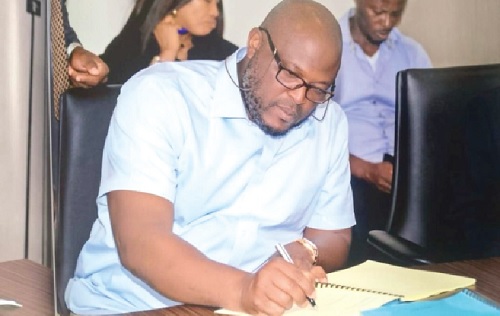
Ghana’s decision to hand Engineers & Planners Ltd (E&P) operational control of the Damang gold mine marks more than a routine concession transfer.
It signals a calculated turn in mining policy—one that seeks to tilt the balance of a historically foreign-dominated sector toward domestic hands without unsettling the fragile compact that underpins investor confidence.
The move follows the exit of Gold Fields Ltd, whose long stewardship of Damang had anchored the asset within a multinational portfolio.
Within industry circles, the development is already being read as a live experiment: can Ghana deepen local participation in extractives while preserving the operational discipline and capital flows that have long defined the sector?
The question resonates beyond Accra. Across parts of Africa, notably in Burkina Faso and Mali, governments are pressing for firmer control over natural resources, spanning both mining and hydrocarbons.
Competitive tender, strategic intent
Officials are keen to stress that Damang was not simply reassigned.
The concession passed through a competitive tender calibrated to test technical depth, financial resilience and alignment with national priorities.
Both local and international bidders were assessed on redevelopment strategies, capital commitments, environmental safeguards and projected fiscal returns.
E&P’s proposal distinguished itself through a granular operational plan and a pledge to sustain output, while extending the mine’s lifespan.
Central to its bid was a phased capital programme—backed by financing commitments exceeding $500mn—aimed at optimising existing assets while funding fresh exploration to unlock additional reserves.
At the Ministry of Lands and Natural Resources, the process is framed as both transparent and purposeful: a mechanism not only to secure a capable operator, but to advance a broader policy objective of increasing indigenous participation.
Under the agreement, E&P assumes full responsibility for operations, workforce management, capital deployment and environmental compliance.
The contractual architecture reflects familiar pillars of Ghana’s mining regime—royalties, taxes and local content rules—while adding emphasis on continuity.
Provisions to safeguard jobs and maintain production levels underscore the mine’s economic importance to the Western Region, where Damang remains a significant anchor.
From contractor to operator
E&P’s elevation marks a turning point in the evolution of a company long embedded in Ghana’s mining value chain. Founded by Ibrahim Mahama, the firm has built its reputation over two decades as a provider of mining services, spanning earthworks, haulage and infrastructure development.
Ordinarily, its success in securing Damang might have triggered accusations of political favouritism, given Mahama’s familial ties to President John Dramani Mahama.
Yet the anticipated backlash has been notably muted. Part of the explanation lies in the company’s established technical credentials; another in the fact that the transition process began under the previous administration of Nana Akufo-Addo.
Such cross-party continuity is rare in Ghana’s partisan landscape and speaks to a broader consensus around E&P’s capabilities.
Analysts point to its familiarity with local geology, regulation and labour dynamics as a competitive edge—one that may ease the leap from contractor to full-scale operator.
For Ibrahim Mahama, the Damang concession offers a proving ground for ambitions long articulated: that Ghanaian firms can move up the mining value chain.
The company’s parallel pursuit—and eventual acquisition—of the Wa-Lawra Gold Project from Azumah Resources further signals its intent to operate at scale, including in greenfield development.
E&P has framed its stewardship in terms that extend beyond output metrics.
Commitments include deploying modern mining technologies, strengthening domestic supply chains, expanding technical training and deepening corporate social responsibility.
In host communities, planned interventions in education, health care and infrastructure reflect rising expectations that extractive projects deliver visible local dividends.
Promise, limits
Ghana’s renewed push for local participation is rooted in a familiar calculus. Despite its status as Africa’s leading gold producer, a substantial share of mining profits has historically flowed offshore.
Retaining more value within the domestic economy is therefore both an economic and political imperative.
The policy also seeks to cultivate national champions—firms capable of competing beyond Ghana’s borders.
By enabling companies such as E&P to scale up, policymakers hope to deepen industrial capacity and generate higher-value employment.
Public sentiment reinforces the shift.
There is growing insistence that natural resource wealth translates into tangible benefits for citizens, and local ownership is often viewed as a conduit for that outcome.
Yet the constraints are equally clear.
Mining remains a capital-intensive, technically demanding industry, requiring sustained investment, advanced technology and disciplined risk management.
Not all local firms possess the balance sheets or expertise to meet those demands at scale.
Access to finance is a particular pressure point.
Multinationals typically tap global capital markets at relatively low cost, while domestic firms often face higher borrowing costs and tighter liquidity conditions.
This asymmetry could limit their ability to fund exploration and long-term development.
Maintaining investor confidence is the other side of the equation.
Ghana has built a reputation as one of Africa’s more stable mining jurisdictions.
Any perception of policy drift against foreign investors risks dampening future inflows, even as the country seeks a more balanced ownership structure.
For global operators, the Damang decision sends a calibrated message.
Ghana remains open to international capital and expertise, but is signalling a preference for deeper local stakes.
Companies such as Newmont Corporation and AngloGold Ashanti will be watching closely to see whether Damang becomes precedent or remains an exception.
Test case, new mining model
The implications extend beyond a single asset. If successful, the Damang model could create pathways for other Ghanaian firms to scale into operatorship.
Companies such as Asanko Gold Ghana Ltd and Adamus Resources Ltd—often operating within foreign partnerships—may find scope for expanded roles under a more localised, friendly regime.
A broader ecosystem of indigenous mining service providers could also leverage the shift, transitioning into joint ventures or full operators over time.
The cumulative effect would be a gradual reshaping of Ghana’s mining industry structure over the next decade.
Ultimately, much hinges on execution. If E&P can sustain production, meet fiscal obligations and deliver measurable community benefits, it will strengthen the case for indigenisation.
Failure, by contrast, would reinforce doubts about whether local firms can shoulder the technical and financial demands of large-scale mining.
For now, the Damang transfer stands as a calculated wager.
It reflects Ghana’s attempt to reconcile national aspirations with the realities of a globalised industry—a balancing act that will demand careful governance, policy consistency and cooperation between state, domestic enterprise and international capital.
As that process unfolds, Damang will serve not only as an operating mine, but as a signal—to investors, policymakers and a new generation of Ghanaian entrepreneurs testing the limits of what local ownership can achieve.
Writer’s email:
The writer is the Editor of the Graphic Business
