
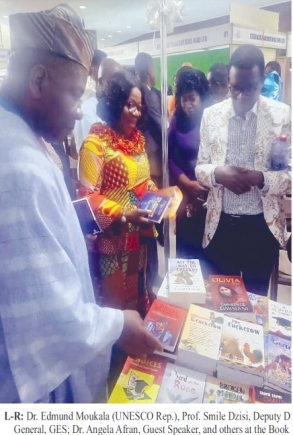
This weekend, all roads lead to the National Theatre in Accra, where books are on display in abundance, for, currently ongoing, is the 22nd edition of the Ghana International Book Fair (GIBF).
The four-day book fair, which has attracted a large gathering of book lovers from Ghana and beyond, opened with a grand ceremony on Wednesday, August 20 and closes on Saturday, August 23.
This year’s theme—“Inclusive Publishing: Celebrating Accessible Literature”— is particularly significant to all stakeholders in literature development.
The GIBF organisers stipulate that this theme “aligns with the global push for fair access to reading materials for persons with various print disabilities”.
At the opening ceremony, various speakers provided in-depth perspectives on this theme to highlight its significance.
The UNESCO Representative, Dr Edmund Moukala, who chaired the function, stated strongly that “inclusive publishing is not merely a progressive ideal; it is an imperative”.
Inclusive publishing
To understand how imperative “inclusive publishing” is, we must appreciate the fact that there are people to whom books and reading are not easily accessible due to their disabilities.
They include the visually impaired, the hearing-impaired, the physically challenged, and senior citizens. While the majority of us read via our eyes, others “read” via their ears, hands, and fingers.
Consequently, publishing books the traditional way exclusively can marginalise people who have infirmity challenges. Inclusivity in publishing addresses these concerns by promoting the development of braille, e-books, audiobooks, and large print formats for seniors.
UNESCO
In his opening statement, Dr Edmund Moukala stated that this theme resonates deeply with UNESCO’s core mission.
“For literature, in its most vibrant and potent form, is a universal right, a powerful tool for empowerment, and a vital bridge connecting diverse human experiences.”
The mention of accessibility in the theme emphasises that literature, be it written, spoken, or signed, must not be limited to just a few but for all people.
“It is a fundamental human right, not a privilege reserved for a select few,” Dr Moukala reiterated. He noted that “by embracing inclusive publishing, (we) are not just creating books; (we) are building bridges.”
He challenged publishers to consider how to integrate inclusivity into the very fabric of their operations, not only to expand their businesses but also to see it as an ethical mandate.
That should include commissioning and promoting authors with disabilities, deliberately ensuring that their works and efforts are adequately compensated.
Reading and writing
In her statement, the Deputy Director-General of the Ghana Education Service, Prof. Smile Dzisi, noted, “The ability to read and write has always marked the difference between stagnation and progress.”
She added, “It is literacy that allows us to preserve the wisdom of the past, transmit the knowledge of the present, and inspire the dreams of the future.”
“Through reading,” she noted, “We inherit the lessons of centuries; through writing, we leave behind a legacy for generations to come.”
Touching on the theme, she emphasised that barriers for persons with print disabilities must be removed. “For words are power, and power should never be limited to a privileged few.
Let us write a future that includes every voice, every story, and every reader.”
Support needed
In his welcome statement, the Chairman of GIBF and President of the Ghana Publishing Association, Asare Konadu Yamoah, disclosed that GIBF faces two key challenges: a lack of a suitable exhibition centre and a lack of funding.
He, therefore, called on the appropriate governmental organisations, such as the Ministry of Tourism, Culture & Creative Arts, and the Ministry of Education, to intensify their partnership and funding support for the Ghana International Book Fair.
He cited book fairs in North African countries such as Egypt and Algeria that receive substantial funding from their governments. Ghana could benefit from such a gesture, Mr Yamoah entreated.
His appeal vibrated with the Minister for Youth and Sports, Mustapha Ussif, who was at the opening ceremony. In his address, in which he lauded the organisers of the fair for their initiative, he promised to “look into” the chairman’s appeal for the government’s financial and logistics support for subsequent book fairs.
Endless possibilities
In a jubilant mood, the Executive Director of GIBF, Yvonne Bossman, said, “When I walk through the aisles of the Ghana International Book Fair this year, I see more than books on the shelves.
“I see doors to new worlds, fresh ideas, and endless possibilities.
I see the sparkle in a child’s eyes as they meet their favourite authors for the first time.”
Explaining the vision and mission of the four-day fair, she said, “We have come together to celebrate the written word, to showcase the richness of Ghanaian and African literature, and to create opportunities for the publishing industry to grow.”
It is to sensitise the minds of people to embrace all literature formats that this year’s Book Fair focuses on inclusivity, as opposed to the penchant to exclude sections of society in literary utilisation.
The writer is a publisher, author, writer-trainer and CEO of Step Publishers.
E-mail:
