
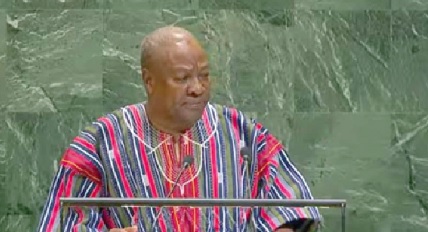
The United Nations’ recent adoption of Resolution A/80/L.48—declaring the Transatlantic Slave Trade the gravest crime against humanity—is a monumental victory for historical truth.
As H.E. John Dramani Mahama powerfully declared at the UN Headquarters, “Today, we come together in solemn solidarity to affirm truth and pursue a route to healing and reparative justice.”
This declaration is more than an academic milestone; it is a global call for a new era of cooperation.
The brutal reality of chattel enslavement
To grasp the true weight of this resolution, we must confront the trade's brutal dynamics.
This system deliberately stripped millions of Africans of their humanity.
It devastated communities, broke up families and reduced human beings to commodities whose enslaved status was passed down by birth.
The enduring consequences of this racialised chattel enslavement continue to manifest today in the persistent structural economic disparities holding the Global South back.
Dismantling the complicity myth
We must directly address the frequent detractor's argument: the claim that Africans were complicit in enslaving our own people and, therefore, forfeit any right to reparatory justice.
During my undergraduate studies in Politics, Philosophy and Economics (PPE) at London Metropolitan University, I learned to look past such gross misrepresentations designed to absolve the primary architects of the trade.
While domestic servitude existed within the continent, the industrialised, trans-generational system of chattel enslavement was a distinctly European capitalist enterprise.
The insatiable Western demand, enforced by firearms and the deliberate destabilisation of our societies, coerced local systems.
Acknowledging that local dynamics were manipulated does not negate the liability of the global empires that built their modern wealth upon this atrocity.
Decolonising our education system
Yet, as we demand external accountability, we must also confront our internal realities.
True reparatory justice will remain elusive if we do not fundamentally reform the colonial-era education system we still operate.
As Walter Rodney meticulously documented in How Europe Underdeveloped Africa, colonial education was never designed to train leaders.
It was an instrument of subordination deliberately engineered to produce obedient clerks, subservient labourers and low-level administrators.
For too long, our schools have perpetuated this archaic curriculum.
We are forced to memorise the names of colonial governors, yet we are taught virtually nothing about our rich pre-colonial history and indigenous governance structures.
Without a radical shift to foster self-reliance and true Pan-African pride, any financial compensation will fail to bring sustainable development.
A new mindset is the prerequisite for our renaissance.
Pragmatism in heritage restitution
Furthermore, our demands for the prompt restitution of looted cultural heritage—such as the high-profile returns of Asante royal regalia—must be met with rigorous domestic pragmatism.
It is not enough to simply demand the return of our artefacts.
We must ask hard questions about preservation.
The repatriation of these priceless items must be coupled with investments in world-class, secure facilities.
This ensures our reclaimed heritage serves as a catalyst for local tourism, education and direct economic benefit to the communities from which the items were violently extracted.
Ghana’s leadership and the Pan-African vision
By leading the 54-member African Group to secure an overwhelming 123-nation majority vote, H.E. John Dramani Mahama has placed Ghana at the absolute moral centre of global justice.
For Ghana, this reaffirms our historical role as the gateway to the diaspora. Just as Dr Kwame Nkrumah positioned us as the Black Star of Africa by dismantling colonialism, President Mahama is carrying that Pan-African torch forward to dismantle the enduring economic legacies of enslavement.
His leadership as the African Union Champion for Reparations has shifted the conversation from mere sympathy to a structured global dialogue.
A strategic call to the global diaspora
The upcoming "Decade of Reparations" (2026–2036) must be defined by strategic demands.
African descendants in the diaspora must work closely with the continent.
We need to unify Black capital worldwide to negotiate comprehensive debt relief, force equitable technological transfer and champion sustainable development across the entire diaspora.
As I currently pursue a Master of Arts in Democracy, Governance, Law and Development at the University of Cape Coast, I stand at the intersection of these worlds: a proud native of Assin—home to the Ancestral Slave River at Assin Manso—and an advocate for global justice.
My mission is to help ensure this diplomatic victory translates into tangible empowerment for African people everywhere.
History has been acknowledged.
Now, let us work together in mutual respect to architect a prosperous global future.
The writer is the 2024 NDC Parliamentary Candidate, Assin South.
