
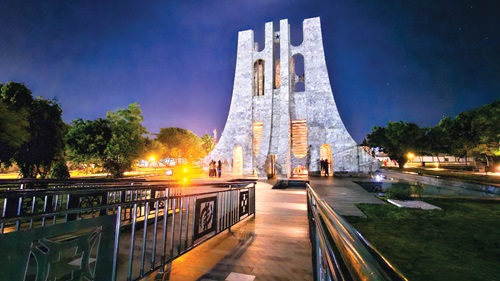
Kwame Nkrumah Mausoleum
A long the Atta Mills High Street in the heart of Accra stands one of Ghana's most important national landmarks — the Kwame Nkrumah Mausoleum. Surrounded by fountains, gardens, and watched over by a towering bronze statue of Ghana's founding president, the monument is more than a final resting place.
It is a place where history, architecture and national memory come together.
The mausoleum is located within the Kwame Nkrumah Memorial Park on the former Polo Grounds, where Dr Kwame Nkrumah declared Ghana's independence on March 6, 1957.
When the memorial was opened in 1992, it became a fitting resting place for the man who led the country to freedom at the very spot where he proclaimed that Ghana was "free forever".
Visitors entering the park pass between two rows of statues — seven horn blowers on each side of the central walkway, making fourteen in all.
Positioned within the fountains that flank the path to the mausoleum, the figures add both beauty and symbolism to the memorial.
In many Ghanaian traditions, horn music is associated with the passing of important leaders and ceremonial mourning.
The horn blowers, therefore, appear to announce the death of a great statesman while ushering visitors towards Nkrumah's final resting place.
Beyond them stands a large bronze statue of Nkrumah, his arm extended in a familiar gesture that evokes his enduring call for progress and his famous "Forward Ever, Backwards Never" philosophy.
Designed by Ghanaian architect, Dr E. G. A. Don Arthur, the mausoleum's marble structure is unique.
It is often described as an upside-down Akan sword, a symbol of peace, unity and reconciliation.
These were values that Nkrumah promoted throughout his political life.
Another interpretation sees the structure as a truncated tree, which suggests a life and mission cut short before reaching their full potential.
Thus, Nkrumah's dream of a united and economically independent Africa remained unfinished when he died in 1972.
For many visitors, the monument is, therefore, both a tribute to his achievements and a reminder of work still left to be done.
A black star at the top of the structure reflects the Black Star of Ghana and Nkrumah's Pan-African vision.
Water surrounding the mausoleum symbolises life and continuity. Inside, natural light falls gently onto the marble tombs of Nkrumah and his wife, Fathia, creating a quiet space for reflection.
The memorial park also contains a museum filled with photographs, personal belongings, books and gifts that tell the story of Nkrumah's life and political journey.
Recent renovations have further enhanced the site, making it one of the country's leading heritage attractions.
Today, the Kwame Nkrumah Mausoleum remains one of Ghana's most visited landmarks.
It stands as a reminder of the ideals of freedom, unity and African self-determination that continue to inspire generations.
