
Long-term lending facilitator, Development Bank Ghana (DBG) Ltd, has channelled GH¢2.5 billion in long-term financing to businesses through 21 participating financial institutions over the past five years, helping to ease banks' traditional reluctance to fund long-term investments.
The intervention has expanded access to patient capital for micro, small and medium-sized enterprises (MSMEs), a segment often constrained by the short-term funding preferences of commercial banks.
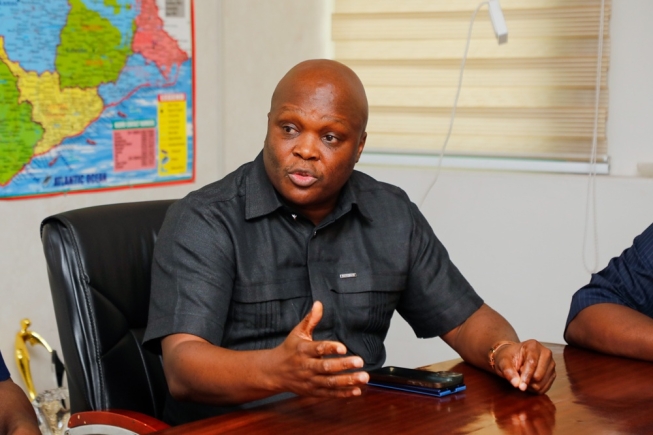
Speaking during a visit to the Daily Graphic last Thursday, DBG's Chief Executive Officer, Professor Randolf Nsor-Ambala, said the bank's wholesale financing model had enabled businesses in sectors ranging from manufacturing and agribusiness to health care, education, tourism and information technology to secure longer-tenor funding.
He said together with technical assistance, environment, sustainability and governance (ESG) advisory, and the 30 per cent counterpart funding by the 21 participating financial institutions (PFIs), the development bank’s leverage and multiplier impact were estimated at GH¢5 billion in the last five years.
Additionally, working with the PFIs that go through a rigorous onboarding process, DBG has also courted the trust and willingness of international development financial institutions and organisations to channel more long-term funds to Ghanaian financial institutions for onward lending to the business community.
Prof. Nsor-Ambala told the Daily Graphic during a visit to the media house last Thursday that working with PFIs that cut across universal and community banks, savings and loans and micro-finance institutions, DBG, through its unique development financing model, had channelled long-term capital of various amounts directly to businesses of various sizes in manufacturing, agriculture and agribusiness, and high-value services, including information and communications technology (ICT), education, health, tourism and transportation.
“It’s not a guarantee that once you are licensed by the Bank of Ghana, then you can get our facility.
We have a very solid risk evaluation structure that evaluates PFIs, and continues to monitor them annually – missions – to ensure that they keep to the covenant and the agreements.
“There is a massive and robust onboarding structure and a well-established monitoring system that enables the company to sustain its mandate without losing money,” Prof. Nsor-Ambala explained.
With heavily discounted lending rates, DBG draws long-term funding from partners such as the World Bank, African Development Bank, the European Investment Bank and the German Development Bank, KFW, and extends wholesale long to medium-term finance to PFIs to on-lend to micro, small and medium enterprises (MSMEs) and small corporates across the country.
With facilities ranging from GH¢50,000 to $1 million at rates between eight and 10 per cent, committed for the long haul, DBG has not turned down any request for funding for lack of it since its inception five years.
The CEO also explained that the development bank prioritised women-led and women-grown, as well as youth-led businesses, and that as of last year about 65 per cent of its portfolio had been invested in manufacturing and agribusiness.
Ecosystem
Prof. Nsor-Ambala said DBG had successfully created an ecosystem that had clearly made a case for long-term capital, with many international development finance companies that already had funds in Ghana realising from the DBG model that long-term project finance could be a good business if structured well.
Currently, many of the international financial lenders that already support banks with long-term capital have now expressed the willingness to allow the on-lending of their funds to longer tenors like seven years, essentially learning from us.
“The success of the model is for the financial institution to build confidence to be able to do this on their own because that is the only way you can be sure that project finance would survive, because if the private sector leads it, it would work.
“Ultimately, in 10 years, we are hoping that for the sectors we are working on, at least the banks would be able to predominantly mobilise private capital and require less from the development bank so that we can find alternative areas to channel our resources,” Prof. Nsor-Ambala stated.
He added that the key success indicator of the model was for the financial institutions to keep asking for less, in that when a deal was about GH¢10 million, it would be prepared to invest about GH¢7 million, which would mean that the development bank had been able to bolster private capital mobilisation within the financial ecosystem.
Government priority areas
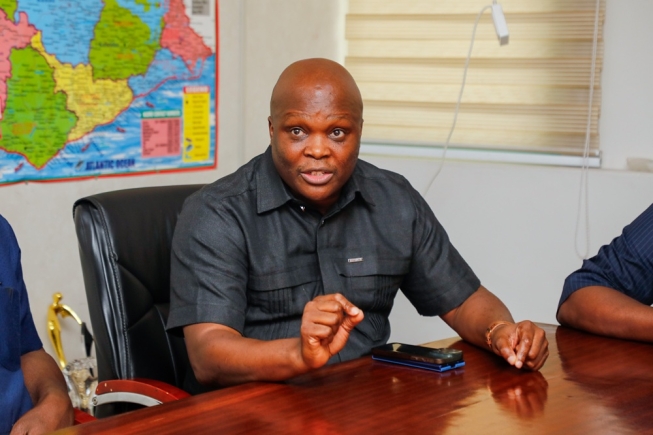
Asked about the role of DBG under GhanaCARES Obaatan Pa programme and the 24-Hour Economic and Accelerated Development Programme, Prof. Nsor-Ambala said DBG’s remit also included supporting businesses and bankable projects in government priority areas.
In such cases, all obligations placed on DBG were discussed, and the bank understood them, with the assurance that it could meet them.
With the 24-Hour Economy programme and many other government priority areas, the development bank was involved due to its leveraging ability of unlocking other funds.
Specifically, on the 24-Hour Economy, Prof. Nsor-Ambala said the government was convinced that what was to be achieved was bigger than its purse, so it wanted to leverage the private sector to achieve the ideals.
For instance, on the industrialisation drive, the government was not expecting to build the industrial parks, but to create an environment for the private sector to see the business case and invest.
“For those businesses, when they require the technical assistance, the financial support and so on, that is where we plug in to help the private sector to achieve the ideals of the 24-HR Economy”.
Prof. Nsor-Ambala stressed that the focus was to fund the private sector to leverage the ideals of the programme.
“As we speak, 24-Hour Economy passes pipelines onto us, and most of them either have been disbursed successfully or are at final stages of the conversation.
Our relationship with the secretariat is very nested,” the CEO of DBG added.
Background
Development Bank Ghana Ltd was established to provide wholesale long to medium-term finance to PFIs to on-lend to MSMEs in specific sectors such as manufacturing, agribusiness, ICT and high-value services.
The bank also provides guaranteed finance through PFIs to de-risk the MSMEs.
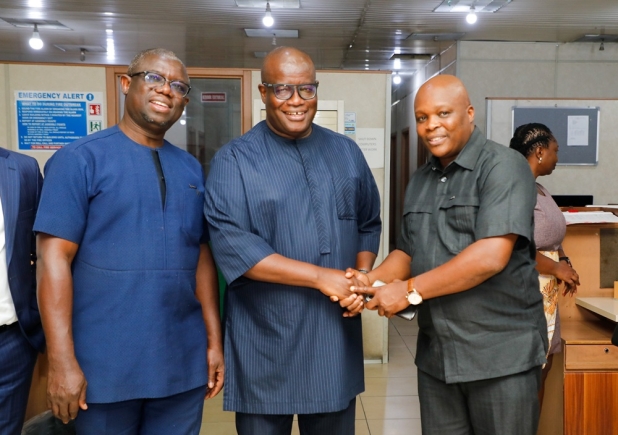
The DBG CEO was accompanied by the Deputy CEO, John Kwame Mensah Zigah, and the Chief Accountant, Kwasi Osei-Bobie.
They were received by the Editor, Graphic, Theophilus Yartey.
