
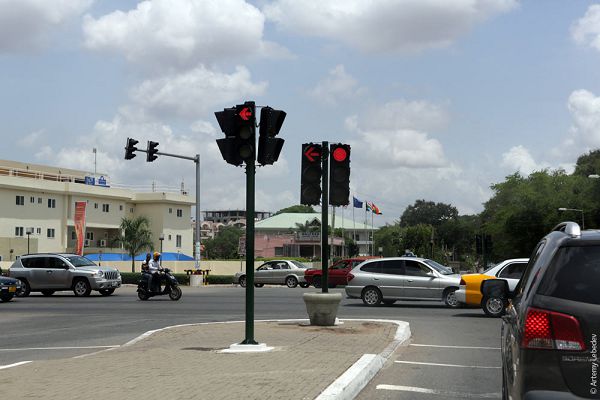
The Minister of Roads and Highways, Governs Kwame Agbodza, has blamed deliberate acts of vandalism as a major reason behind many dysfunctional traffic lights in Ghana.
He said some unpatriotic individuals, motorists and service providers often stole cables, batteries and damaged traffic light installations.
Those act, he said, was the reason why 65 per cent of the 415 traffic signals were not working.
“There are some unpatriotic members of the public who actually remove the metal parts of traffic signals and sell them as scrap metal in the same way they remove the metal gratings we put on drain covers and sell them to people to manufacture iron rods,” he said.
Getaways
Appearing before a hearing by the Committee on Economy and Development Wednesday (June 10), Mr Agbodza said there also those who stole the batteries and other parts of kits of solar lamps being piloted on some streets.
“There also situations where vehicles run into traffic lights where vehicles lose control and drive straight to destroy the lights or where we house the controls.
“And these are expensive kits and on many of the occasions, we never get to see who the drivers are and then they get away with it and we need to find money to do it,” he said.
Sabotage
The Roads Minister said often service providers, who had not been engaged by the ministry, ran underground cables, intruding into traffic signal chambers because it was convenient for them to do so.
In the process, he said, those service providers, whom he stopped short of naming publicly, damaged traffic installations.
“So, the majority of the time, when you see the light not working, it is not because of anything. it is simply because of vandalism,” he said.
He pointed out that there were about 415 traffic signals for about 60,000 kilometres of roads across the country, saying such a low presence of traffic signals was a problem.
Worriedly, despite the majority of the cities and towns in need of traffic lights, only 65 per cent of the existing signals were active, he said.
He told the committee that part of the reason some service providers had not been maintained was that “we owe them about GH₵40 million and we are in the process of retiring some of that debt for them to work”.
To curb continued vandalism of traffic signals, Mr Agbodza emphasised the need for service providers to upgrade the standards of traffic lights with better technology.
First-class roads
In terms of maintenance, Mr Agbodza called for adequate budgetary allocation to the ministry to undertake effective maintenance works within the road sector.
He said the majority of trunk roads across the country were not fit for purpose, including the Accra and Kumasi highway.
He said it was in a bid to address such a challenge that the government initiated the “Big Push” project.
Under the project, he said 2,200 kilometres of trunk roads were being constructed, assuring that those roads would be first-class roads built to any standard “you can find anywhere in the world”.
“We are not building a standard that is less than anywhere else because we have faith in our ability as Ghanaian engineers, our ability as contractors, and we know what we want is the best for ourselves,” he said.
Given that Big Push projects were expensive, he said the government had insisted that every penny committed to every inch of road must be fully accounted for in terms of speed and quality.
“And our team is making sure that we get that done partly because any delay of every road project hits the public in the pocket because the delay comes with additional cost and variations,” he said.
No shoddy projects
Mr Agbodza told the committee that as of the end of 2024, there was at least GH₵110 billion in the project portfolio and debt unpaid, with interest amounting to almost GH₵40 billion.
“The budget can simply not take that because part of that also includes interest on delayed payment,” he said.
The minister assured that the days when contractors engaged in shoddy construction works and walked away freely were over.
“We are trying to build the best roads because when we say we build a road that lasts six years, it must last six years at least if it is maintained,” he said.
He added that almost all the development partner-sponsored road projects stalled because of the debt restructuring.
However, he said the government had since managed to restart a few of those road projects, including the first tranche of the Motorway to Central University and Ashaiman Roundabout to Atimpoku.
However, he said projects like the Bolgatanga-Bawku-Pulmakom completely “died off because it is a commercial agreement and we could not resuscitate that”.
“The president directed that all those should be put together as part of the next phase of the Big Push,” he said.
