
Every day, before sunrise breaks across Ghana’s coastline, the ocean is already in motion.
From Elmina, Abandze, Komenda, Anomabo to Shama all the way to Keta and countless other fishing communities along the Central, Western, Greater Accra and Volta regions, the sea and shorelines become workplaces, determining destinies.
Canoes are pushed into the water with coordinated force, engines roar into life and fisherfolk, some barely rested from the night, set off into the Atlantic with faith, experience and endurance.
On World Ocean Day, global conversations often turn to marine conservation, climate change and the future of blue economies.
But along Ghana’s coast, the ocean is life itself.
It is breakfast, school fees, rent, medicine and survival.
And behind every fish sold at the market lies a story shaped by decades of labour, risk and resilience.
Over the years, one pattern remains constant: fishing is rarely just a job.
It is inheritance, identity and continuity.
In Komenda, a fisherman, Kwabena Tetteh, said without hesitation, “I was born on the canoe. My father fished, my grandfather fished. I had no other choice.”
In Abandze, another fisherman, Kojo Essuman, with over 30 years at sea, simply said, “If I don’t go, my house does not eat.”
These are not isolated voices.
They reflect a generational reality of skills re passed down not through formal training, but through early exposure to the tides, nets and rhythms of the sea.
Uncertain livelihoods
Yet beneath this inherited knowledge lies a growing struggle. Fisherfolk consistently say the sea has become less generous.
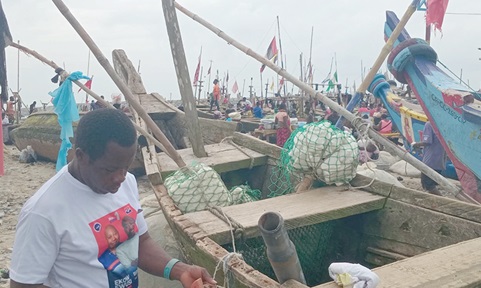
Fisherfolk say the sea has become less generous
Catches have become smaller, journeys longer and risks higher. Many attribute this to overfishing, climate variability and illegal fishing practices.
According to the Food and Agriculture Organisation (FAO), global fish stocks are under increasing pressure, with a significant proportion now fully exploited or overexploited.
In West Africa, where coastal communities depend heavily on small-scale fisheries, the situation is particularly fragile.
In Ghana, fisheries contribute significantly to food security and livelihoods, with fish remaining one of the most important sources of animal protein for the population.
According to the FOA (2024), fish accounts for about 17 per cent of global animal protein consumption, and in many West African countries, including Ghana, it is a critical source of nutrition, particularly for coastal and inland communities.
FAO’s State of World Fisheries and Aquaculture Report (2024) further indicates that over three billion people globally depend on fish as a major source of protein, while millions of livelihoods are directly linked to marine and inland fisheries.
In Ghana, fish remain one of the most consumed protein sources, forming a vital part of household diets across income levels.
From smoked herrings in local markets to freshly landed tilapia and tuna, the sea feeds both the rich and the poor.
But statistics alone do not capture what declining fish stocks mean in real terms.
For a canoe crew, it would mean returning with half a catch.
For a fishmonger, it would mean selling less at higher prices.
For a household, it would mean a reduced fish or reduced fish at all.
On several field visits, fisherfolk pointed to practices such as light fishing, use of illegal chemicals and destructive, unapproved nets as key threats to their work.
While enforcement efforts continue, many argue that compliance remains uneven, leaving those who follow the rules feeling disadvantaged.
A seasoned fisherman in Anomabo, Kojo Pintsil, at a workshop organised by University of Cape Coast, Fisheries Commission and Blue Ventures, expressed his frustration this way:
“We go by the law, but others do not. At the end, we all suffer because the sea does not increase.”
Labour behind the catch
Fishing is often imagined as the act of casting nets and hauling fish, but the industry is far more complex.
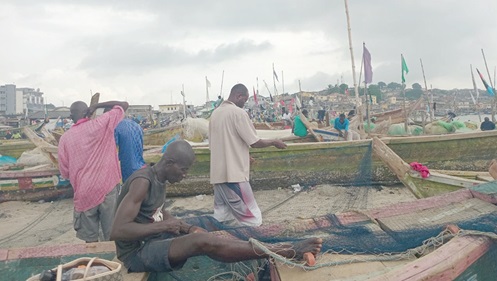
Fishermen mending their nets at the Cape Coast beach
Behind every canoe are networks of labour, net makers, engine repairers, fish processors, and market women who transform the catch into food and income.
Women, in particular, play a central role in sustaining the fisheries value chain.
In Elmina and Komenda, fish processors and traders wake up even earlier than the fishermen, preparing smokehouses, sorting catches and negotiating prices.
Their work ensures that fish not only leave the shore but also reach inland communities, where it becomes a dietary staple.
Many of these women have also spent decades in the trade.
A fishmonger, Efua Duah, like the fishermen, indicated that the rising costs, inconsistent supply of fish from fishermen, and the unpredictability of the sea economy are challenges facing fishmongers.
Beyond human pressures, environmental changes are reshaping the ocean itself.
Fisherfolk describe shifting seasons, stronger waves and unpredictable weather patterns that make fishing more dangerous than in previous decades and some of the challenges facing the fisheries sector.
Scientists have linked such changes to broader climate variability affecting sea temperatures and marine ecosystems.
Survival and sustainability
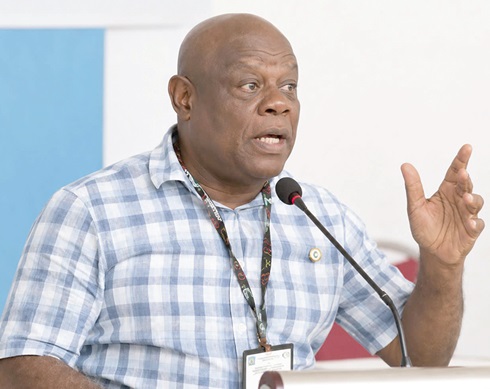
In an interview, the President of the National Fisheries Association of Ghana (NAFAG), Nana Joojo Solomon, called for stronger enforcement of fisheries laws and a collective national effort to protect Ghana’s marine resources, warning that the future of the fishing industry and millions of livelihoods depend on the sustainability of the country's oceans.
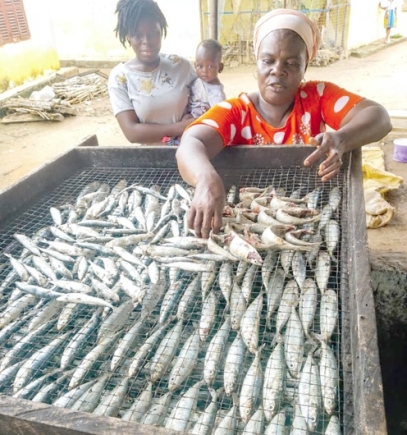
Efua Duah, a fishmonger from Abandze in the Central Region, processing her fish
To mark the celebration of this year’s World Oceans Day (WOD), Nana Solomon highlighted the critical role the ocean plays in supporting economic activities, food security, transportation, telecommunications, tourism, and the emerging blue economy.
WOD is a global observance held on June 8 each year with the aim of raising awareness about the critical role the ocean plays in the lives of people and the need to protect it.
The day, set aside by the United Nations, is dedicated to appreciating the beauty and diversity of our oceans, while also promoting conservation and sustainable use of marine resources.
This year's theme, "Reimagine: Beyond the world we know, a new relationship with our ocean”, is a call to global citizens to change the way they see and care for the ocean.
Nana Solomon, who doubles as the President of the Ghana National Canoe Fishermen Council (GNCFC), said the ocean was far more than a natural resource, stressing that it was a vital source of livelihood for millions of people across the country and an essential component of Ghana’s economic development.
Diversification
He explained that the importance of the ocean extends beyond fishing, noting that maritime transportation, naval security operations, telecommunications infrastructure, oil and gas installations, tourism and other sectors rely heavily on the marine environment.
“The ocean supports transport, security and telecommunications through submarine fibre optic cables and the oil and gas sector.
Today, discussions around the blue economy are also creating new opportunities.
This shows how important the ocean is to every individual, whether directly or indirectly,” he said.
However, Nana Solomon expressed concern over the changing state of the ocean, attributing the decline in marine resources to a combination of climate change, population growth, pollution and unsustainable fishing practices.
“The NAFAG President also raised concerns about the growing pressure on marine resources due to increasing population growth and unrestricted access to fishing activities.
He observed that the number of fishing vessels competing for limited fish stocks has become unsustainable, creating intense pressure on the marine ecosystem.
“The pressure on marine life is extremely high. We have more people chasing fewer fish, and that ratio is simply not sustainable. Unless we take deliberate action, the situation will continue to worsen,” he warned.
While public discussions often focus on light fishing, Nana Solomon stressed that all forms of illegal fishing were equally harmful and contributed to the depletion of fish stocks.
He further warned that chemical fishing poses serious health risks to consumers, as toxic substances used in fishing can eventually enter the food chain.
“The use of chemicals is particularly dangerous because it has implications not only for fish stocks but also for human health.
We are exposing ourselves to harmful substances that can contribute to various health conditions,” he noted.
Laws
Despite the existence of fisheries regulations designed to protect marine resources, Nana Solomon believes weak enforcement remains one of the biggest challenges facing the sector.
He stated that fishers are generally aware of the laws and regulations governing their activities, but continued violations occur because offenders often believe they can act without consequences.
“We have good laws in place.
The problem is enforcement. Once people realise that regulations are not being enforced consistently, they become emboldened to continue engaging in illegal activities,” he said.
The NAFAG President also called attention to marine pollution from industrial activities, improper waste disposal, and other environmental practices that continue to degrade ocean ecosystems.
He argued that addressing these challenges requires a multi-sectoral approach involving several government ministries, regulatory agencies, industries, and civil society organisations.
He said fisheries management cannot be handled by one institution alone because factors affecting marine resources often originate from multiple sectors.
Blue economy
Touching on Ghana’s blue economy agenda, Nana Solomon advocated for what he described as a “just transition,” ensuring that fishing communities were not marginalised as new industries and economic activities expand into the marine space.
He noted that increasing oil and gas exploration, telecommunications infrastructure, shipping activities, and other marine developments are gradually reducing the areas available for traditional fishing activities.
As the world marks World Oceans Day, Nana Solomon called on government, regulators, security agencies, policymakers, civil society groups, industries, and citizens to work together to protect Ghana’s oceans for future generations.
“The ocean is one of the greatest natural resources God has given us.
Every Ghanaian depends on it in one way or another.
We all have a responsibility to protect it. If we strengthen enforcement, reduce pollution, and promote sustainable practices, we can preserve this valuable resource and secure the livelihoods of millions of people for generations to come,” he said
