
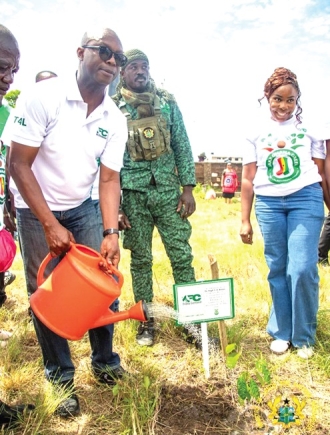
The government has entreated the citizenry to join forces to plant 30 million tree seedlings across the country.
At the launch of the 2026 Tree for Life (T4L) Restoration Initiative in Accra yesterday, the government explained that between the launch and the end of the rainy season, 13.2 million tree seedlings would be planted on government plantations; 12.2 million on private plantations; 3.5 million to be planted on farms; two million as amenity planting; and 279,000 as enrichment planting.
Among the tree species to be planted are timber, shade trees, ornamentals, fruit trees and fuel woods.
Last year, 31 million trees were planted over the period.
Launching the tree-planting exercise, which coincided with the World Environment Day, the Minister of Lands and Natural Resources, Emmanuel Armah-Kofi Buah, said the 30 million trees targeted to be planted this year reflected the government's determination to accelerate landscape restoration, strengthen climate resilience and contribute to global efforts to address climate change.
"Achieving this target will require the active participation of every sector of society. I, therefore, call upon all stakeholders to participate actively in the nationwide tree planting exercise," he said.
Mr Buah said the 2026 edition of the T4L Reforestation Initiative would place strong emphasis on post-planting care, monitoring and maintenance.
World Environment Day
The United Nations General Assembly designated June 5 as World Environment Day to raise awareness and take action to protect the environment. The first celebration was held in 1973.
The global theme for 2026 is “Inspired by Nature. For Climate. For Our Future." For Ghana, the event was marked on the theme, "Forest and Economies", underscoring the intricate nexus between healthy environment and economic development.
The event in Ghana is being spearheaded by the Ministries of Lands and Natural Resources; Environment, Science and Technology (MEST), and their respective agencies, the Forestry Commission and the Environmental Protection Authority (EPA).
Mr Buah stressed that the theme was a reminder that nature was humanity's greatest ally in addressing the climate crisis.
"Nature provides the solutions we need to mitigate climate change, restore degraded ecosystems, secure our water resources, protect biodiversity and sustain livelihoods," he said.
He added that the theme highlighted the critical contribution of forests to national development, not only as environmental assets, but economic assets.
Again, he said forests supported agriculture, provided livelihoods, supplied raw materials for industry, regulated water systems, created employment opportunities, and contributed significantly to climate resilience and sustainable economic growth.
The minister further observed that environmental protection and economic prosperity were not competing objectives but “mutually reinforcing pillars of sustainable development."
He said rising temperatures, extreme weather events, biodiversity loss, pollution and land degradation that continued to threaten the well-being of people and ecosystems across the globe were a wakeup call for all stakeholders to work together for sustainable solutions.
"Ghana is not immune to these challenges. Across our country, we are witnessing the effects of climate change through rising temperatures, erratic rainfall patterns, prolonged droughts, flooding, coastal erosion, declining forest cover and the degradation of critical ecosystems.
"These impacts threaten food security, water resources, public health, livelihoods and economic growth," he said.
Mr Buah gave the assurance, however, that the government remained committed to environmental sustainability, climate resilience and the sustainable management of our forest and wildlife resources.
It was in that regard that the Tree for Life Reforestation Initiative was started as one of the flagship interventions meant to restore degraded landscape.
"I am pleased to announce that under the 2025 edition of the Tree for Life Reforestation Initiative, over 31 million trees were planted across the country through the collective efforts of government institutions, traditional authorities, schools, religious bodies, civil society organisations, communities, development partners and the private sector," he added.
He noted, however, that the true measure of success was not the number of seedlings planted but the number of trees that survive and mature.
"A tree planted and neglected contributes little to environmental restoration; a tree planted, nurtured, protected and allowed to grow becomes a lasting investment in our future," he said.
Sustainability
The minister stressed that concerted efforts would be made to ensure that every seedling planted had the best possible chance to survive and flourish.
"I therefore urge all institutions, communities, schools and individuals participating in this year's exercise to take ownership of the trees they plant.
"Let us water them, protect them from fire and destruction, monitor their growth and ensure that they become thriving forests that will benefit future generations," he said.
Success rate
Throwing light on the key achievements under the 2025 edition of the initiative, the Chief Executive of the Forestry Commission, Dr Hugh C. A. Brown, said 23,600 hectares of deforested and degraded landscapes across the country were put under restoration through enrichment planting and forest plantation development.
He added that 1.9 million seedlings were planted under the amenity planting component, while 2.1 million seedlings were planted by farmers within their farming systems.
"In total, an estimated 30.8 million tree seedlings were planted last year by the Forestry Commission, private sector and civil society organisations (CSOs)," he said.
Dr Brown said a recent survival survey conducted in forest reserves within the 2025 planted areas presented a success rate of about 85 per cent in the high forest zone and about 78 per cent in the Northern Savannah Zone.
He stressed that given the importance of forests in national development, all stakeholders must work in a collaborative manner to protect them.
