
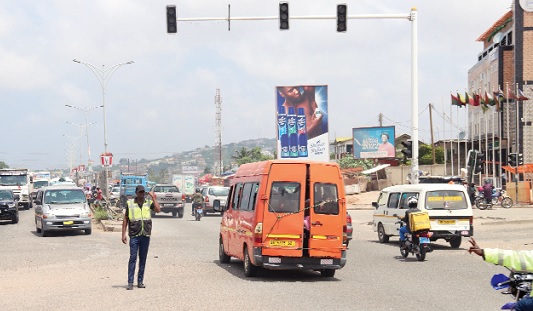
Driving in Accra and perhaps other cities in Ghana is a daily drill, becoming extremely difficult to grapple with.
Call it hazardous, and you would not be far from right, especially in certain parts of Accra.
Unfortunately, lately, there are too many traffic lights not working and left unattended for weeks, sometimes months, adding to the stress for drivers, especially those of us who want to drive safely and soundly.
Then also are the too many sirens and warning flashes coming from behind or on-coming vehicles as one waits in a very tight traffic queue with no space to pull aside or give way.
These nuisance sirens and “emergency lights” tend to completely confuse a conscientious driver whose focus on the road is driving safely.

Default lights
At one point, earlier this year, I started counting the number of default traffic lights whenever I was out there.
I, however, lost complete count, realising that I was overburdening myself needlessly.
Now the reality is dawning and one cannot help but speak out.
There are just too many malfunctioning traffic lights to contend with.
Many drivers will admit the chaos and danger those intersections with faulty traffic lights pose in this era of endless lawlessness of commercial motorcycle riders (Okada) and now tricycle riders.
They have tripled in numbers and their bold affronts in causing additional mayhem at intersections where traffic lights are not functioning are unimaginable.
Though one tries hard to grapple with the nuances of Okada and tricycles on normal days, on abnormal days, when traffic lights do not work, especially at busy intersections, which is where one begins to curse those who are in charge of traffic lights in the city.
Is it that they do not care, that their systems do not function well and so they are unable to tell which one is faulty from their control rooms, or that they do not have systems in place for automatic tracking?
Ordinarily, why should traffic lights, which are meant to bring normalcy and some degree of orderliness on our busy roads, be left to go off for months and weeks?
Sirens, warning lights
As the neglect goes on unattended, others take advantage to cause even more mayhem on our roads.
I am talking about those who consistently use sirens and warning lights to get their way through traffic as if they are special and cannot wait in line, just as everyone else out there.
A friend recounted how, at a non-functional traffic light in the airport area, a motorcycle with a siren, leading a convoy of four vehicles with flashing lights, hit the back of her car at a faulty traffic light intersection where there was chaos as usual, with no room to manoeuvre to the side.
The siren just sped off.
The car was badly dented, so she drove to the nearest police station to report and was told that because those motorcades with sirens were not identified by number plates, it was difficult to trace the culprit.
She had to bear thousands of cedis in repairs to get her car fixed.
The good news is that in some areas on the highways, the police Motor Traffic and Transport Department (MTTD) seems to be cracking down on the needless use of sirens and emergency lights.
In the Ghanaian Times newspaper of last Tuesday, June 2, the East Regional MTTD is reported to have arrested 13 drivers for the unauthorised use of sirens and emergency lights during a special enforcement exercise conducted along the Kasoa-Winneba highway.
Reportedly, the operation, which happened on May 30 at Budumburam, was meant to educate offenders on Regulations 65 and 74 of the Road Traffic Regulations 2012 (L.I. 2180) after which they were processed according to the law.
Further to that, drivers who were found using the unauthorised sirens and the emergency lamps had them removed from their vehicles and the drivers were issued with warning letters and cautioned against engaging in the practice.
Perhaps, it is time for MTTDs in the capital to start applying Regulations 65 and 74 to check unauthorised use of sirens and flashlights in traffic by a few, while serious action is taken on malfunctioning traffic lights.
Restoring them to prompt functioning will help the police concentrate on other policing issues while safety is maintained at intersections.
The police MTTDs, admittedly, are doing their best to assist in the mornings to bring some sanity where the lights are not working.
However, by mid-morning, when they leave for their various offices, chaos returns.
We need our traffic lights to work all the time, 24 hours and non-stop.
They help to enforce order and discipline on our roads while keeping all drivers and pedestrians safe.
Writer’s E-mail:
