
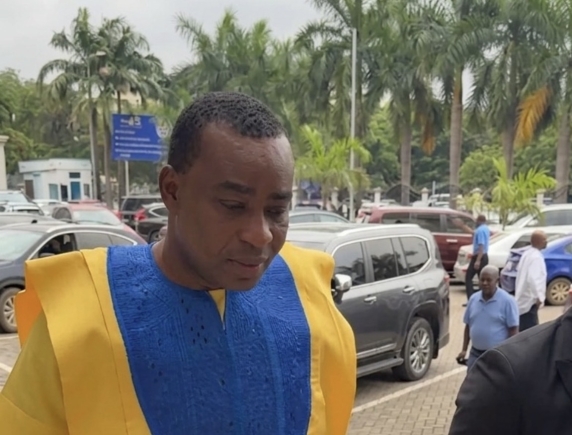
The High Court on Monday sentenced the Ashanti Regional Chairman of the New Patriotic Party (NPP), Bernard Antwi Boasiako, also known as Chairman Wontumi, to a 20-year jail term for assigning mineral rights granted to his company, Akonta Mining Limited, to two persons, Michael Gyedu Ayisi and Henry Okum, without obtaining approval from the Minister of Lands and Natural Resources.
In a verdict that could truncate his ambitious campaign for the national chairmanship of the NPP, he was also handed another 20-year jail term on the charge of purposely facilitating an unlicensed mining operation on the Samreboi concession in contravention of Section 99(2)(b) of the Minerals and Mining Act, 2006 (Act 703) as amended by Section 3 of the Minerals and Mining (Amendment) Act, 2019 (Act 995).
The high-profile case had attracted wide media coverage during the over 12 months’ trial.
In addition to the custodial sentence, Chairman Wontumi was fined GH¢120,000 for each offence. In default of the fine, he will serve an additional three years in prison.
The sentences are to run concurrently, including the fine.
As a result, he will serve 20 years behind bars.
Akonta Mining Limited is to pay a fine of GH¢180,000 on each count for assignment of mining right without ministerial approval and purposely facilitating an unlicensed mining operation in contravention of Section 99(2)(b) of the Minerals and Mining Act, 2006 (Act 703) as amended by Section 3 of the Minerals and Mining (Amendment) Act, 2019 (Act 995).
Meanwhile, Kwame Antwi, a Director of the company, who was slapped with two counts of assigning mineral rights without the sector minister’s approval and purposely facilitating an unlicensed mining operation on the Samreboi concession, is still on the run.
Justice Audrey Kocuvie-Tay handed down the sentence after analysing the facts presented by both the prosecution led by the Deputy Attorney-General, Dr Justice Srem-Sai, and the then defence lawyer, Andy Appiah-Kubi, at trial.
Analysis
Relying on circumstantial evidence, the presiding judge, before drawing her conclusions, resolved issues on the exclusivity of the mineral rights relationship between Chairman Wontumi, the sole shareholder and a Director of Akonta Mining, and whether the company had an operating board/executive management separate from Chairman Wontumi to determine if he was the true de facto holder of the mineral right.
As regards the issue of facilitation of unlicensed mining, the court analysed whether Chairman Wontumi and Akonta Mining permitted Okum and Ayisi to conduct mining without a registered licence under Act 703, among others.
To establish the exclusivity of the mineral licence, the court analysed the lease agreement granted to Akonta Mining, where portions of the lease agreement confirmed same.
To resolve the issue of whether the transfer of mineral rights constituted an assignment, the court, among others, relied on the testimony of Okum, the second prosecution witness in the case.
Chairman Wontumi had admitted that although he permitted Okum to enter Akonta Mineral’s concession, it was meant for land reclamation by planting coconut trees, and not for mining.
The court held that the arrangement for the land reclamation was not documented and there was no witness to the transaction.
As a result, the court relied on the dictates of Duah v The Republic, a landmark Ghanaian criminal case that established crucial legal precedents regarding circumstantial evidence, to make inferences from the available facts.
Justice Kocuvie-Tay said that while Okum had stated that he was a small-scale miner with about seven years’ experience, Chairman Wontumi’s evidence to the court was that he did not know him as a small-scale miner and that Okum only presented to him that he was a mine support service provider.
The court held from the above that Chairman Wontumi gave no evidence to verify this claim or show that Okum was into land reclamation or had had any previous experience in land reclamation, questioning hypothetically: “On what grounds did he ask Okum to enter the concession?”
It was also Okum’s testimony that Chairman Wontumi did not give him any money to reclaim the land, and as a result, Chairman Wontumi permitted him to mine for gold on the unused portion of the concession to use the proceeds from the mining activity to defray the cost of reclamation.
“This court holds that no reasonable explanation exists to rival the conclusion that Chairman Wontumi permitted and allowed Okum to carry out mining operations on the concession.
“Chairman Wontumi’s subsequent explanation that he was expecting Okum to recover the cost from the future sale of mature coconut can only be an afterthought,” the court held.
On the count bordering on the transfer of mineral rights, the court confirmed that Akonta Mining Limited was the holder of the mineral right, while Chairman Wontumi was the controlling Director of the company.
Corporate veil
A corporate body is separate from its owners per the common law case of Salomon v Salomon and the Ghanaian case of Morkor v Kuma.
To determine the legal liability of Chairman Wontumi, the court cited the exceptions in the seminal case of Morkor v Kuma, and lifted Akonta Mining's corporate veil, finding no functioning management or executive board within the company.
It held that Chairman Wontumi was the true de facto holder of the mineral right and the sole controlling mind of the company during the period the offences were committed.
“Akonta Mining’s corporate veil should be lifted as there is no real difference between the two (Chairman Wontumi and Akonta) in relation to dealing with the persons permitted to mine.
“There was no functioning management board and executive management board to deal as a company. All acts were done by Chairman Wontumi, the true de facto holder of the mineral right,” the judge said.
On the count of facilitation, it held that while Chairman Wontumi himself had told the court that he did not personally visit the concession, he himself sought the assistance of the Western Regional Security Council to protect the activities of Okum, as the prosecution witness confirmed that he did not know Akonta Mining but dealt directly with Chairman Wontumi.
Charles Boakye, who held brief for the substantive counsel, Samuel Atta Akyea, together with other lawyers in the packed courtroom, pleaded with the judge to temper justice with mercy since Chairman Wontumi was a well-known business mogul with no criminal record and had employed several Ghanaian youth.
The court, after listening to the lawyers, imposed a 20-year jail term for the offences, which had maximum jail term of 25 years and a minimum of 15 years.
Charges
The Attorney-General charged Chairman Wontumi and his company, Akonta Mining, with six counts of permitting Henry Okum and Michael Gyedu Ayisi to mine on the company’s mining concession without obtaining prior approval from the sector minister and facilitating unlicensed mining.
The prosecution called four witnesses to firm up its case against the accused persons.
At the close of the prosecution’s case, then counsel for Chairman Wontumi, Mr Appiah-Kubi, argued that Chairman Wontumi’s decision to permit the two persons to mine on the concession did not constitute an assignment of rights.
“Permission is a licence or authorisation to do something on another person's property without transferring any proprietary rights.
“An assignment, on the other hand, involves the transfer of proprietary rights themselves.
The distinction is critical and well established in law,” counsel submitted, adding that the prosecution's failure to adduce evidence of an assignment was not a minor or technical deficiency, but a fundamental failure to prove an essential element of the offences of permitting the two persons to mine on his client’s concession without ministerial approval.
The prosecution, led by Deputy Attorney-General, Dr Srem-Sai, urged the court to dismiss the submission of no case, with the court eventually ordering Chairman Wontumi to open his defence.
Who is Chairman Wontumi?
Bernard Antwi Boasiako is the Ashanti Regional Chairman of the NPP.
He has been at the helm of affairs of the party in the Ashanti Region since January 2014.
Born in the Ashanti Region, he had his secondary education at Prempeh College in Kumasi before venturing into business and politics.
He began his political career at the grassroots level of the NPP, and rose through the party's ranks before being elected Ashanti Regional Chairman in 2014.
He retained the position in the party's regional elections in 2018 and 2022.
In addition to politics, Chairman Wontumi is an entrepreneur with interests in the mining sector and the media industry.
He is the Director and shareholder of Akonta Mining Company Limited and owns Wontumi Radio and Movement TV.
In 2025, the Economic and Organised Crime Office (EOCO) commenced investigations into allegations of illegal mining and related financial offences involving him.
He was subsequently arrested and granted bail pending investigations.
