
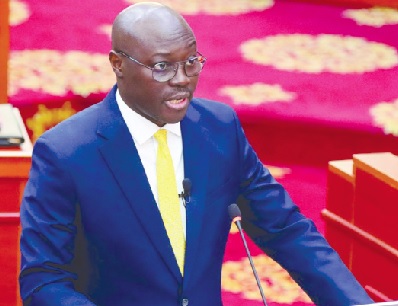
If the first-quarter performance of the 2026 budget offers an indication, then the main question hanging over tomorrow's Mid-year Fiscal Policy Review is whether the Minister of Finance, Dr Cassiel Ato Forson, will ensure that government expenditure catches up with the resources voted by Parliament for policies and programmes.
The minister’s task will be to assure the nation that enough steps will be taken to improve revenue target for the second quarter and rest of the year to achieve ambitious targets such as the Big Push infrastructure development programme.
For instance, while revenue measures were expected to help generate about GH¢268.1 billion by the end of the year, the first-quarter results released by the Ministry of Finance show that GH¢57.53 billion had been mobilised, slightly below the expected pace.
Significantly, the government spent GH¢62.09 billion in the first quarter against a planned total expenditure of GH¢302.5 billion for the year, representing about 20.5 per cent of the annual expenditure budget, suggesting relatively restrained spending during the first three months of the year.
Within the context of an economy implementing the Big Push programme, the situation left substantial fiscal space for the remaining nine months, provided revenue mobilisation improves in line with projections.
As a result, two economists from the University of Ghana told the Daily Graphic in separate interviews in Accra yesterday that Thursday’s constitutional requirement per Article 179 of the 1992 Constitution and the Public Financial Management Act, 2016 (Act 921) should not contain major policy surprises, particularly the introduction of new taxes, but rather provide updates on the implementation of existing fiscal measures and the government's economic recovery agenda.
Professor of Finance at the University of Ghana Business School (UGBS), Prof. Godfred A. Bokpin, and an economist and former Director of the Institute of Statistical, Social and Economic Research (ISSER), Professor Peter Quartey, shared similar sentiments about their expectations on the budget review.
No major surprises
Prof. Bokpin said he was not expecting major surprises in the Mid-year Budget Review because the government had already outlined its key policy measures in the 2026 Budget.
He explained that although some macroeconomic assumptions might have changed, any revisions should only reflect current economic conditions rather than introduce new taxes or significantly alter the fiscal strategy.
He stated that the review should provide an update on Ghana's IMF-supported programme, which was expected to conclude after the IMF Executive Board meeting scheduled for July 29.
He added that the Finance Minister should also outline the country's post-IMF policy direction, including the proposed Policy Coordination Instrument and how the economy would be managed after the programme.
Revenue and debt sustainability
Prof. Bokpin explained that the review should also assess the performance of the government's revenue mobilisation measures and indicate whether they were sufficient to meet medium-term targets.
"Our tax-to-GDP ratio is just around 14 per cent, which is still below the 18 to 20 per cent target by 2027, so the minister should explain what additional administrative and compliance measures will be used to improve revenue," he said.
He stated that the government had made significant progress in restoring debt sustainability through expenditure restraint and fiscal discipline.
Prof. Bokpin added that the minister would likely highlight Ghana's transition from a high debt-risk category to a moderate-risk status, describing it as one of the major achievements under the current fiscal programme.
Growth, "New Economy"
The Professor of Finance said the government should use the review to provide preliminary details of its proposed "New Economy" programme, even if the full policy package would only be presented in the 2027 Budget Statement.
"They cannot keep the market waiting because the Finance Minister has consistently indicated that a new growth strategy is coming," he said.
However, he explained that the government should carefully balance its planned expansionary policies with the need to preserve macroeconomic stability.
Revenue mobilisation
For his part, Prof. Quartey said the government needed to accelerate digitalisation to improve revenue collection and reduce leakages.
"We just have to be more aggressive with our digitalisation agenda because many of the revenue measures are still being implemented manually," he said.
He explained that expanding online payment systems and improving electronic tracking would make tax collection more efficient.
He added that the informal sector, which accounted for about 70 to 80 per cent of the economy, remained largely outside the tax net, while weak property rate collection continued to undermine domestic revenue mobilisation.
Prof. Quartey said the government had remained fiscally prudent and should now shift attention to financing growth.
"We have stabilised enough. I think it is about time we take off," he stated.
He explained that the review should indicate how resources would be allocated to road infrastructure, local assemblies and ministries to improve service delivery.
He added that investment in internal roads, sanitation and job-creating programmes would be essential to sustain the economic recovery.
"I don't expect to see new taxes. It is about reforming the existing tax system to make it more efficient," Prof. Quartey said.
