
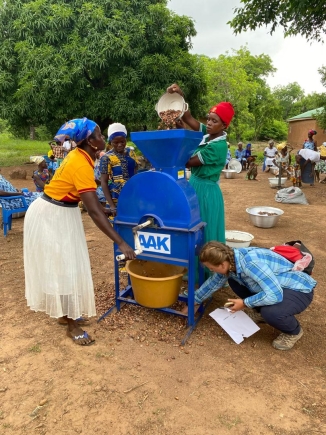
Every year in March, the world pauses to celebrate women for their resilience, their contributions, and their quiet and not-so-quiet revolutions. At AAK, however, this moment is more than a calendar observance. It reflects a commitment made over fifteen years ago: that responsible business means uplifting the people at the very heart of AAK’s supply chain. And in that world, those people are women.
Where it all began
In 2009, AAK launched Kolo Nafaso as a small, almost experimental initiative in Burkina Faso. The premise was both simple and transformative: what if the layers between AAK and the women collecting shea kernels in rural West Africa were removed? Building a direct relationship with the women at the very beginning of the supply chain would ensure that they capture a larger share of the value.
Kolo Nafaso, meaning “the house of benefits of shea kernels” in the Dioula language, was never conceived as a charity program; it was built on respect and recognition. The women who collect shea are not passive beneficiaries of development initiatives; they are smallholder farmers, shea collectors and pillars of their communities. Above all, they are economic actors who deserve a fair seat at the table.
Over the years, what began as a modest pilot has grown into one of AAK’s most impactful sustainability initiatives, and the largest direct sourcing program of its kind. Today in Ghana, Kolo Nafaso is going strong, reaching more than 250,000 women. Yet this number represents far more than scale: it represents transformation. Behind every figure is a woman with a name, a family, and aspirations, many of which have historically been constrained by structural barriers beyond her control. Through Kolo Nafaso, AAK is working to change that narrative by ensuring that women at the heart of the shea value chain are recognised, respected and fairly rewarded for their contribution.
The impact of Kolo Nafaso: Before and after
To understand why Kolo Nafaso matters, it is important to understand what rural shea supply chains looked like before direct engagement models like Kolo Nafaso. Across West Africa, women have long been the backbone of shea collection, a physically demanding, seasonal activity that is both culturally significant and economically undervalued. The structural barriers they faced were never invisible; over time, they had simply become normalised.
Before the collection season began, many women needed access to cash to buy food for their families, cover transport costs or simply manage the months before farming income arrived. Without access to formal credit, many turned to traders who offered advance payments at unfavorable terms, often locking them into selling their harvest at reduced prices. In many cases, women had little certainty about who would buy their kernels, what price they would receive, or when they would be paid.
Distance presented another challenge. Women often travelled long distances to sell their kernels, sometimes losing a portion of their earnings to informal transport arrangements that reduced already thin margins. With no formal records of transactions and no digital footprint, most remained excluded from financial systems that could have provided access to savings, credit, or other financial services.
Kolo Nafaso was designed to change this reality, not by addressing these barriers in isolation, but by tackling them together through a more inclusive and transparent supply chain model. The strength of Kolo Nafaso lies not in a single intervention, but in how several elements work together to support women across the entire shea value chain. When a woman joins the program, she does not simply gain access to a buyer. She becomes part of an ecosystem designed to support her productivity, stability, and long-term economic participation.
Interest-free, commitment-free pre-financing
One of the most transformative aspects of the program happens before a single kernel is collected. Through AAK’s pre-financing mechanism, women receive funds ahead of the shea harvest season without interest and without a binding obligation to sell exclusively to AAK.
Unlike traditional credit, this pre-financing model is designed to ease the economic pressure women often face before the collection season begins. It provides the working capital they need to prepare their agricultural activities while maintaining their financial independence. Fuseina Abdul Rahman, a former Kolo Nafaso Extension Officer, now Program Coordinator, explains: “My position gives me the opportunity to link the women to AAK and give them access to the pre-finance they take. So before they even start collecting their kernels, the women already have the money they need.”
For many women, that early access to funds helps cover immediate household needs from purchasing farming inputs to paying school expenses long before income from shea collection begins.
Bringing the supply chain closer to home
Physical distance is an often-overlooked cost in rural supply chains. Women traditionally travelled long distances to sell their kernels in larger markets, losing valuable time and income to transport arrangements.
Kolo Nafaso addresses this challenge by establishing collection and transaction points within the communities where women live and work. By eliminating the time and cost required to access markets, the program allows women to dedicate more time to productive activities and family responsibilities.
A guaranteed commercial outlet
In many traditional shea markets, women have little certainty that their harvest will be purchased or that they will receive a fair price. Under Kolo Nafaso, AAK provides a reliable commercial outlet by committing to purchase the kernels collected through the program. This assurance allows women to plan their work with greater confidence and focus on improving the quality of their harvest.
With a guaranteed buyer, women are also better positioned to avoid exploitative spot market arrangements that often undermine their earnings.
Training that strengthens the value chain
AAK’s field-based Extension Officers work closely with women’s groups typically averaging 50 members, providing training in shea quality management, processing techniques, health and safety practices, and environmental stewardship.
This engagement is not a one-off intervention. The trainings are a continuous exchange that builds knowledge, strengthens trust, and ensures that women are equipped with the skills needed to produce high-quality kernels while protecting the natural resources on which the shea sector depends.
Full traceability and transparency across the supply chain
Kolo Nafaso has achieved 100 per cent traceability across its supply chain, a standard rarely reached in agricultural value chains of this scale. Every transaction is digitally recorded, enabling each batch of kernels to be traced back to the women who collected them. For the women participating in the program, this digital footprint also creates something equally important: a formal economic record.
Kolo Nafaso has also achieved FairWild certification – the first ever for a shea sourcing initiative – which provides assurance to AAK customers that the program meets global standards for sustainable, ethical, and transparent harvesting. The FairWild certification applies to Kolo Nafaso shea kernel collection operations, and non-transformational processing such as shelling, steaming, drying and storing.
“The certification motivates us to continue evolving to ensure lasting impact for the shea landscape and the women who depend on it – now and for generations to come,” says Jakob Nybroe, Sustainability Manager, West Africa.
Beyond the numbers: Women tell the story
The program’s results are significant. Pre-finance repayment rates exceed 99 per cent. Women report improved bargaining power in local markets and more stable income streams that allow them to plan beyond immediate household needs. Yet the true impact of the program is most visible in everyday life. Predictable income means children are more likely to stay in school, households are better able to manage seasonal financial pressures and women gain greater recognition for their economic contributions within their families and communities.
As the shea industry continues to evolve, AAK’s focus goes beyond investing in driving demand – it remains committed to the mission it began 16 years ago, ensuring that women collectors are not left behind, but instead supported with stable incomes. At its core, the program is more than a supply chain initiative; it is a long-term partnership built on trust, resilience, and shared progress – one that AAK is committed to strengthening for years to come.
