
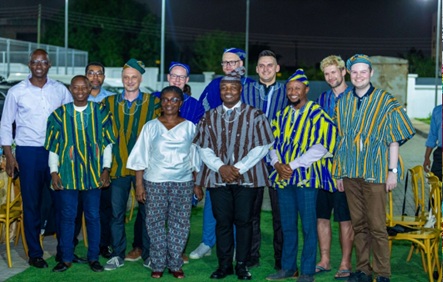
What began as a lighthearted social media jab at President John Mahama for wearing the fugu, the traditional handwoven smock of Northern Ghana, has unexpectedly captured global attention, going viral across digital platforms.
The image sparked pride, curiosity, and renewed interest in one of Ghana’s most authentic indigenous garments. Suddenly, what was meant as mockery became a celebration of Ghanaian culture, and the fugu was at the centre of the conversation.
Ghanaians across the country shared images of themselves in fugu, while social media feeds buzzed with admiration for the craftsmanship and history behind the garment. Beyond the cultural pride, the viral moment revealed economic potential: local weavers, tailors, and designers could see a new market emerging, fueled by attention that reached far beyond Ghana’s borders, opening doors for a new indigenous fashion industry.
The phenomenon recalls a similar cultural-economic success from the early 2000s under President John Agyekum Kufuor, when the National Friday-Wear initiative encouraged Ghanaians to wear locally made fabrics to work. Offices across the country, became runways for kente and wax prints, revitalizing the nation’s struggling textile industry. Local designers thrived, manufacturers regained relevance, and indigenous fabrics reclaimed their place in everyday life. The National Friday Wear programme, encouraging public servants, professionals, and private sector employees to wear made-in-Ghana fabrics every Friday to work. Far from being merely a style choice, this policy was intended to stimulate demand for locally produced textiles, support artisans and manufacturers, and foster national pride in Ghanaian design. At the time, Ghana was also importing millions of dollars’ worth of used clothing yearly figures hovered around $38–$43 million in imported second-hand garments, which had contributed to the decline in domestic textile production. While hard figures on the direct GDP contribution of Friday Wear are sparse, industry leaders at the time credited the initiative with re-directing a significant portion of textile demand toward local producers, one manufacturer reported that up to 50 % of its business was tied to Friday Wear orders from churches, companies, and organizations seeking branded African cloth. This infusion of patriotic demand helped cushion an industry battered by cheap imports, empowered small fashion enterprises, and reinforced the idea that deliberate cultural policy could have real commercial impact.Though not without challenges, the initiative demonstrated a powerful lesson: when culture is deliberately positioned within policy, it can drive real economic outcomes.
Two decades later, that same spirit of cultural-led economic strategy is being tested again this time with fugu, the iconic handwoven smock of Northern Ghana. Today, the fugu’s viral moment shows how cultural pride and economic opportunity can intersect once again, proving that Ghana’s traditions can shine both on social media and in the marketplace." This moment has converged with a bold policy proposal from the Ministry of Tourism, Culture and Creative Arts: the institutionalisation of Wednesday Fugu Wear.
At first glance, this may appear as a mere cultural homage to Ghanaian heritage. However, beneath the surface lies a potentially transformative economic opportunity. Should even 90% of the nation’s estimated 13 million active workforce adopt the fugu as official Wednesday attire, the ramifications for local industry and employment could be substantial. In my capacity as a Professor of Accounting and Finance, I take this opportunity to examine the phenomenon, evaluate its economic potential with respect to job creation, and propose informed recommendations for leveraging this cultural trend.
Economic ramification
Imagine if I told you that a single garment could simultaneously boost our economy, create thousands of jobs, and showcase Ghanaian culture to the world.
That garment exists it is the fugu, our iconic handwoven smock from Northern Ghana. More than a symbol of heritage, the fugu is a powerful, yet underutilized, engine for economic growth.
Before I continue, it’s important to note that this perspective is grounded in economic theory. According to the Keynesian Multiplier Theory and Indigenous Resource Development Theory, when domestic consumption rises, particularly for goods produced using local, indigenous resources, investment and national income naturally increase. Every fugu purchased from a local weaver circulates money within our communities, supporting artisans, tailors, designers, and the farmers who supply raw materials. In effect, cultural pride transforms into tangible economic benefits.
To put this into perspective, consider this scenario: if approximately 11.7 million working Ghanaians each purchased just two fugu outfits per year at an average price of GHS 300, the total market potential would exceed GHS 7 billion annually. Even with more conservative adoption rates, the industry could generate nearly GHS 4 billion per year, an output that dwarfs the current capacity of the traditional weaving sector.
Unlike imported mass-produced clothing, fugu production is highly localised and labour-intensive. This means a significant portion of the revenue would flow directly into rural economies, particularly in the Northern, Upper East, and Upper West regions. If only 40% of this value reaches producers in these areas, that equates to nearly GHS 3 billion injected annually into northern Ghana, a transformative boost that could reduce poverty, create jobs, and help rebalance regional economic disparities.
Employment potentials
It is important to recognise that the fugu industry’s potential extends far beyond revenue generation, it represents a massive opportunity for job creation.
A surge in demand would necessitate expanding weaving capacity alone, potentially creating over 200,000 direct jobs for weavers. The tailoring and fashion sector could absorb an additional 300,000 to 500,000 workers, while the revival of cotton farming, ginning, and processing could generate more than 100,000 rural employment opportunities. Altogether, the ‘Wednesday Fugu Economy’ could catalyze over 800,000 jobs across the entire value chain.
Beyond employment, the industry could spark the emergence of entirely new sectors. We could see the rise of ready-to-wear fugu brands, innovative textile research firms, export-oriented cultural fashion houses, and tourism-driven craft ecosystems that showcase Ghanaian heritage. With strategic development and continental collaboration, Ghana has the potential to become a leader in African heritage fashion, leveraging our cultural assets to compete in global and African markets while promoting sustainable economic growth.
In a nutshell, a well-structured Wednesday Fugu policy could generate employment across multiple layers:
Weaving and Loom Manufacturing – Modernising looms and scaling production.
Garment Manufacturing – Establishing Fugu-based fashion factories.
Branding and Export Marketing – Positioning Fugu globally.
Creative Design Industry – Contemporary Fugu suits, corporate wear, and accessories.
E-commerce and Logistics – Online marketplaces and delivery systems.
Tourism and Cultural Experience Centres – Weaving villages as tourist destinations.
Over time, Ghana could see the emergence of a Northern Textile Industrial Corridor, similar to how Friday Wear revitalised southern textile printing factories.
Macroeconomic gains and industrial potential
The Wednesday Fugu initiative promises significant macroeconomic benefits beyond its cultural appeal. By boosting domestic production of Fugu, Ghana can reduce its reliance on imported second-hand clothing, which currently accounts for an estimated over 80% of the country’s clothing market, draining foreign exchange. Substituting imports with locally made garments would help stabilise the Ghanaian cedi, conserve hard currency, and retain billions of cedis within the domestic economy.
Moreover, the initiative would expand the creative economy’s contribution to national GDP. The textile and apparel sector currently contributes roughly 0.7–1% of GDP, but with structured nationwide adoption of Fugu wear, this could realistically double or even triple within a decade, particularly if ancillary industries weaving equipment, fashion design, dye production, e-commerce, and logistics are included.
The parallels with the historic Friday Wear campaign under President John Agyekum Kufuor are instructive. Friday Wear successfully revived existing textile factories and increased demand for Ghanaian prints. However, the potential scale of Wednesday Fugu Wear is far more ambitious. While Friday Wear rejuvenated an industry already in place, the Fugu initiative has the power to create a new industrial ecosystem from scratch, centered on northern Ghana’s weaving communities. This would transform cultural heritage into a structured supply chain, generating employment for thousands of artisans, spinners, tailors, designers, and marketers.
The lesson is both simple and profound: Ghana’s cultural heritage is not merely a vestige of the past; it is an untapped reservoir of economic value. If effectively harnessed, the Wednesday Fugu Economy could convert identity into industry, tradition into opportunity, and national pride into measurable prosperity. By turning a weekly cultural practice into a strategic economic intervention, Ghana stands to not only strengthen its creative economy but also drive inclusive growth, reduce regional inequality, and position itself as a global exemplar of culture-driven industrialisation.
National policy
Recognising the economic, cultural, and social potential of Ghana’s indigenous Fugu (Batakari) weaving tradition, and building on the success of the Friday Wear initiative introduced by President John Agyekum Kufuor, the Government of Ghana should therefore establish a comprehensive policy framework to develop the Fugu Industry as a national cultural-industrial sector. This policy aims to transform Fugu production from a traditional craft into a structured industry capable of generating employment, promoting inclusive economic growth, and enhancing Ghana’s creative economy.
Conclusion
The Wednesday Fugu Economy represents more than fashion reform. It is a deliberate economic strategy rooted in identity. It offers Ghana an opportunity to commercialise culture responsibly, reduce regional inequality, and create a proudly indigenous industry. If 90% of Ghana’s workforce embraces Wednesday Fugu wear, the threads woven in Tamale and Bolgatanga will not only stitch garments they will weave prosperity into the national fabric. Just as Friday Wear revived Ghana’s fabric industry in the 2000s, Wednesday Fugu Wear could define Ghana’s next chapter of inclusive industrialisation where culture becomes capital, and heritage becomes industry.
The author is Prof. John Kwaku Mensah Mawutor, Professor of Accounting - Department of Accounting - University of Professional Studies, Accra
