
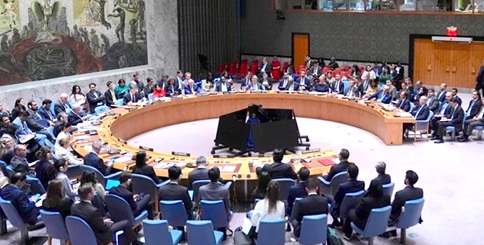
Permanent members of the UN Security Council were selected based on their economic and military strength.
All five (5) permanent members are nuclear powers.
Apart from being nuclear powers, these countries are economic powers.
Though countries like Germany and Japan are economic powers, they were not considered.
Germany’s Hitler started the Second World War, and Japan at that time also couldn’t have been selected.
The role of these countries in the war and their military might at that time underpinned their selection as permanent members.
Africa’s readiness to be given a permanent seat at the security council
Should the possession of nuclear arms be a precondition for the selection of permanent members, then Africa may need some time to get to that stage.
Even if that is the case, some African countries may have the capability to possess nuclear arms. For instance, countries like South Africa can develop to become a nuclear power, possibly Egypt, Nigeria, and others.
What would be the role and the reaction of the International Atomic Energy Agency should some countries develop nuclear weapons just to become permanent members of the Security Council?
The issue of a permanent seat for Africa at the Security Council is an opening.
South America, a vast continent, may also contend for a permanent seat on the Security Council.
Brazil, Argentina, and other countries may present themselves as contenders for a seat.
If there is a need for one or two countries to be chosen as permanent members, then they must become nuclear powers.
If that condition should persist.
Review of the UN Charter
The Charter of the United Nations is the “Religious Literature” that guides and monitors the affairs of the world body.
The charter spells out the role of the Security Council and the role of the five (5) permanent members of the Security Council.
A review of the charter must be tailored to suit the admission of other members into the arena of the five (5) permanent members.
The fundamental role of the Security Council will remain unchanged, as well as the role of the permanent members.
The role of the permanent members has been bestowed on them by the charter, which grants them a permanent seat on the Security Council.
The charter becomes the authoritative document that guides the day-to-day activities of the United Nations.
To propose any change in the structure of the charter, there is a need to review this segment of the charter.
The admission of any new member into the arena of permanency at the Security Council implies that the occupier of the seat can veto any substantive Security Council resolution.
History bestowed upon the five (5) permanent members the power of veto.
So, these five (5) countries emerged victoriously after the Second World War, and they had much to say in the future structure of the United Nations.
Can these sovereign states share the power of veto with African or South American countries?
Will it be easy to depart from these circumstantial considerations?
The Possession And Use Of Nuclear Weapons
The five (5) nuclear powers, which are the permanent members, are still under the inspecting eyes of the International Atomic Energy Agency.
The extensive discussion of the problem of banning or restricting the use of certain weapons at various international forums has shown that certain prohibitive and restrictive actions, in the main, reflect the interest of the international community as a whole, rather than particular countries.
Russia-US summits reflect the interests of the international community and the world nuclear watchdog on arms control.
New Development
The Security Council is mandated by the Charter to maintain international peace and security.
Some permanent members of the Security Council have defied the principles enshrined in the charter; as a result, the mediation and stabilisation role of permanent members has been affected.
They are to monitor the movement of the barometer of international peace and stability with a neutral lens. Over the past two decades, matters have regrettably taken a course different from what we have all strived for and contrary to the aspirations of the international community.
NATO’s military campaign, which was led by the US in Kosovo, defied the UN charter.
These permanent members of the UN Security Council are members of NATO, Great Britain, and France.
The US military campaign against Iraq defied the charter.
Russia’s military actions against Ukraine also defy the UN charter.
In all these instances, the diplomatic option as prescribed by the charter was sidestepped.
These permanent members still hold their seats.
The charter did not prescribe punitive measures for permanent members who defy the charter.
They still hold to their veto.
The veto is an aspect of the structure of the United Nations.
The Proposal
The formation of the United Nations gives some countries a political advantage as permanent members of the Security Council.
Today, we live in a time in which we are confronted by difficult or perhaps puzzling questions concerning the destiny of the world and the future of the human race.
The President of the Republic of Ghana, His Excellency John Dramani Mahama, is playing a conspicuous international role in fighting for a permanent seat for Africa at the UN Security Council. The proposal is welcome.
Yes, African leaders need stability of purpose.
They should move systematically towards achieving the goal.
But we must bear in mind the ingredients needed to acquire a permanent seat, if possible.
We must be mindful of the historical imperative of the formation of the United Nations.
The writer is an
Initiator, International Forum on the Status of Refugees in the World,
Convener, Kofi Annan Memorial Lecture,
Senior Lecturer, University Of Ghana.
