
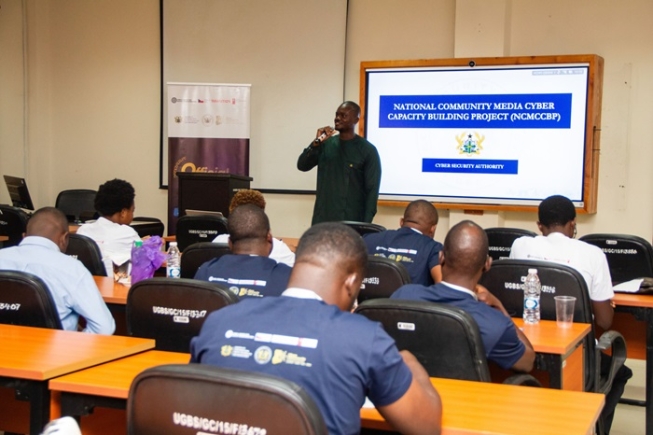
The Cyber Security Authority (CSA) has urged the public to call its 292 hotline to verify suspicious online transactions before sending money, saying funds transferred to fraudsters were often difficult to recover once withdrawn.
The Senior Manager for Critical Information Infrastructure (CII) at the CSA, Mr Alex Awere-Kyere, said although the Authority worked with the police and other security agencies to investigate fraud cases, recovery of funds could not be guaranteed once they had been withdrawn.
Mr Awere-Kyere made the call in Accra on Monday, August 10, 2026, when he addressed journalists on the protection of critical information infrastructure and the Cybersecurity Act, 2020 (Act 1038).
The engagement formed part of a series of training sessions under the National Community Media Cyber Capacity Building Project (NCMCCBP), which is being implemented by the CSA, the Africa Centre for Digital Transformation (ACDT) and the Government of the Czech Republic.
The project was launched in Accra on August 3, 2026, to build the capacity of journalists and media practitioners in cybersecurity reporting.
Mr Awere-Kyere said the public should not wait until money had been lost before contacting the CSA, explaining that an early report could give the Authority and the police an opportunity to take action before a transaction was completed.
He said once a victim transferred money to a fraudster and the money was withdrawn from a mobile money account, the prospects of recovering it became very slim.
“Once the money is withdrawn, it becomes very difficult to recover,” he said.
Mr Awere-Kyere said the CSA could not guarantee that money lost through fraud would be recovered, even where a case had been investigated and prosecuted.
He explained that the Authority would make efforts to recover the money after a suspect had been convicted, but said preventing the loss in the first place was preferable to attempting to recover the funds afterwards.
He said reports made through the 292 hotline were assessed by CSA officials, who gathered information and evidence from callers before working with the Ghana Police Service and other security agencies to investigate the cases.
According to him, an early call could also allow the Authority to advise a potential victim and, where necessary, work with the police to intercept a suspected fraudster before money was transferred.
Mr Awere-Kyere also explained the provisions of sections 35 to 40 of Act 1038 relating to critical information infrastructure.
He said the provisions empowered the Minister responsible for cybersecurity to designate systems as critical information infrastructure and to withdraw such designation where necessary.
The CSA, he said, was also required to register designated systems and conduct audits, while owners of such systems were required to report cybersecurity incidents within 24 hours of detecting them.
Mr Awere-Kyere said unauthorised access to critical information infrastructure was an offence under Section 40 of the Act.
He said 13 sectors, including banking and finance, energy and health, had been designated as critical information infrastructure sectors because disruption to their operations could affect national security or the economy.
Touching on emerging cyber threats, Mr Awere-Kyere mentioned advanced ransomware, attacks on operational technology and industrial control systems, large scale data theft, distributed denial of service attacks involving infected personal devices and supply chain compromises.
He also identified artificial intelligence driven threats, including deepfakes, as emerging risks to the designated sectors.
Mr Awere-Kyere cautioned journalists against publishing unverified claims made by cyber criminals or details of unresolved vulnerabilities in computer systems.
He said premature publication of such information could provide useful information to persons seeking to exploit the vulnerabilities.
In response to questions from journalists, Mr Awere-Kyere said mobile money fraud involving stolen personal data was handled through the Joint Cybersecurity Committee established under Section 13 of Act 1038.
He said members of the Committee included the CSA, the Bank of Ghana, the National Communications Authority, the Economic and Organised Crime Office (EOCO), the Ghana Army and the Criminal Investigations Department (CID).
Mr Awere-Kyere said dealing with the causes of mobile money fraud also required addressing how personal information got into the hands of fraudsters.
He said this required the CSA to work with institutions such as the Data Protection Commission and telecommunications operators, in addition to the work of the Joint Cybersecurity Committee.
The engagement was part of the NCMCCBP, which is training more than 100 journalists and media practitioners in Accra during August before the programme moves to Kumasi in September.
