

The decision by the Chamber of Cement Manufacturers, Ghana (COCMAG) to introduce a uniform GH¢12 per bag clinker demurrage surcharge has raised concerns.
In a press release issued Friday (Sept 4, 2026), CUTS International, Accra, a leading public policy think tank, said it acknowledges the serious cost pressures confronting cement manufacturers because of congestion at the Tema Port but raised “competition concerns”.
According to the cement manufacturers, vessel waiting times have increased from an average of seven days in January 2026 to between 30 and over 40 days in August 2026, resulting in estimated industry-wide demurrage costs of US$45 million to US$50 million during the first eight months of the year.
To CUTS International, it does not dispute these costs and that businesses must recover legitimate costs, remain financially sustainable, and earn reasonable returns on their investments.
“Our concern is the reported collective determination of a uniform surcharge by firms that compete against one another,” It said.
“Cement manufacturers are businesses. If a manufacturer incurs additional demurrage costs, it has every right to factor those costs into its pricing. The competition concern arises when competing firms meet and collectively determine the amount consumers should pay. Legitimate cost recovery should not become a basis for price coordination,” said the Director for West Africa Regional Centre of CUTS International, Appiah Kusi Adomako.

Competitors should determine their prices independently
According to COCMAG, the GH¢12 surcharge comprises GH¢10 before tax and GH¢2 in taxes and levies.
It said the decision was reached at an emergency meeting on August 28, 2026 and that the surcharge will remain until December 31, subject to monthly monitoring and a review in January 2027.
From a competition perspective, describing the amount as a “demurrage surcharge” rather than a price increase does not resolve the concern. A surcharge forms part of the amount ultimately paid by the consumer.
To CUTS International, competition requires each manufacturer to determine independently whether to pass additional costs to consumers and, if so, how much.
It said different cement manufacturers have different shipping contracts, clinker volumes, vessel arrangements, inventory positions, operational efficiencies and exposure to demurrage and that their additional costs therefore need not be identical.
It said one manufacturer might need GH¢12 per bag to recover its additional costs. Another might require GH¢8 and that a more efficient manufacturer might absorb part of the cost to retain customers or increase its market share. That difference is competition at work.
“The question we should ask is why manufacturers with different cost structures and different exposure to demurrage should all arrive at exactly GH¢12. Each company should calculate its own costs and independently determine what it charges. Competitors should not collectively determine a common charge to consumers,” Mr. Adomako said.
Airline fuel surcharges offer a useful comparison
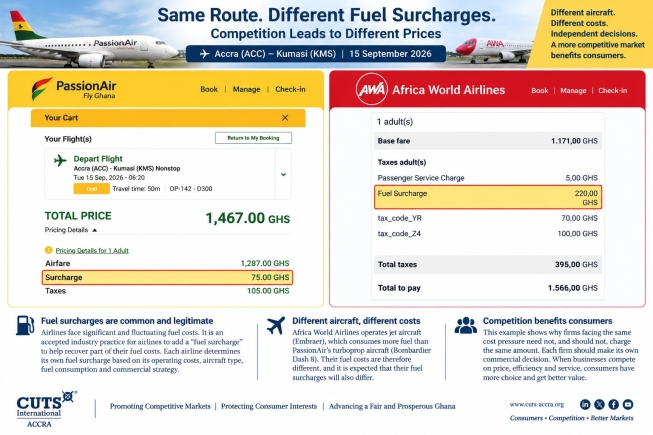
It said the airline industry provides a useful illustration. Fuel is one of the highest operating costs for airlines, accounting for around 30 percent of industry costs. Airlines have long used fuel surcharges as one mechanism for responding to significant fuel-cost pressures, but the level of such surcharges varies between airlines.
For illustration, it said current domestic fare information available to CUTS indicates different fuel surcharges on the Accra-Kumasi route, with Africa World Airlines applying about GH¢220 and PassionAir about GH¢75 per flight. There are legitimate reasons why the costs of the two airlines might differ. Africa World Airlines operates jet aircraft, while PassionAir operates turboprop aircraft. Their fuel consumption, operating costs, fleet economics and commercial strategies are therefore different.
The important competition principle is that each airline independently determines how much of its fuel cost to pass on to passengers.
If competing airlines met and agreed that every passenger should pay an identical fuel surcharge, that arrangement would raise similar competition concerns.
The same principle should apply to cement manufacturers. A common cost shock does not require a common price response.
Trade associations must avoid facilitating price coordination
CUTS recognises COCMAG's legitimate role in representing the cement industry. Manufacturers have every right to collectively engage the government and Ghana Ports and Harbours Authority on congestion, berth availability, vessel delays and other industry-wide problems.
Indeed, CUTS supports urgent action to resolve the congestion at Tema Port. The line should be drawn when collective advocacy moves into collective determination of prices or components of prices.
CUTS therefore urges COCMAG to clarify whether the GH¢12 surcharge represents a collective decision or recommendation to members and whether individual manufacturers remain free to impose no surcharge or independently determine a different amount.
CUTS also urges COCMAG to ensure that its monthly monitoring and January review do not facilitate exchanges among competitors concerning future prices, production volumes, individual cost structures, clinker stocks or other commercially sensitive information.
Ghana does not yet have a comprehensive domestic competition law. This does not mean coordinated conduct among competitors is beyond competition scrutiny.
Address the port problem and preserve competition
CUTS calls on the government and Ghana Ports and Harbours Authority (GPHA) to urgently address the operational constraints creating excessive demurrage costs at Tema Port.
At the same time, cement manufacturers should preserve independent pricing.
“COCMAG should collectively advocate for a solution to the demurrage problem. What each manufacturer charges consumers should, however, remain the independent commercial decision of each company. Businesses must recover their costs, but competitors should compete,” Mr. Adomako said.
CUTS further calls for renewed urgency in passing Ghana's Competition and Fair Trade Practices legislation and establishing an effective national competition authority. The present issue demonstrates why Ghana needs a clear domestic framework to address agreements and practices capable of harming competition and consumer welfare.
