
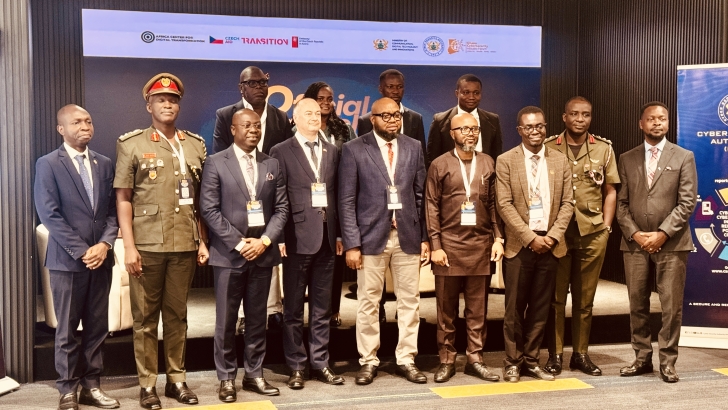
Journalists and media practitioners across the country are to receive specialised training in cybercrime reporting as online fraud continues to affect both ordinary Ghanaians and senior public officials.
The training forms part of the National Community Media Cyber Capability Building Project, which seeks to improve media coverage of cybercrime and strengthen public awareness of online safety.
The project is being implemented by the Cyber Security Authority, the Africa Centre for Digital Transformation (ACDT) and the government of the Czech Republic under the Czech Republic's Transformation Cooperation Programme.
Launching the project at the National Communications Authority Tower in Accra on Monday, August 3, 2026, the Deputy Minister for Communication, Digital Technology and Innovations, Mr Mohammed Adams Sukparu, said cyber security had become an important part of Ghana's digital development agenda.
Representing the sector minister, Mr Samuel Nartey George, Mr Sukparu said cyber threats continued to evolve, making cyber security an economic, governance, national security and development issue.
He said cyber fraud had become so widespread that even senior government officials were falling victim. Mr Sukparu disclosed that the Director-General of the Cyber Security Authority, Mr Divine Selase Agbeti, had informed him that two chief executives and a deputy minister were defrauded the previous week. He said the incident showed that no Ghanaian, regardless of position, was beyond the reach of cyber criminals.
Mr Sukparu also recounted an experience during the 2024 general election campaign when he warned a family in his constituency that an offer of a vehicle from an overseas contact was fraudulent. He said the family ignored his advice, paid money to the fraudsters and later realised they had been deceived after losing the money.
Addressing the gathering, Mr Agbeti said social engineering remained one of the hardest forms of cybercrime to combat because fraudsters often spent weeks or months studying their intended victims before making contact.
He advised Ghanaians to be cautious about the personal information they shared on social media, explaining that details such as family members' names, schools attended and previous relationships were often used by fraudsters to gain the confidence of their targets.
Mr Agbeti said the Cyber Security Authority worked with the Ghana Police Service, National Security, the Economic and Organised Crime Office and other security agencies to investigate cyber-enabled crime. He encouraged members of the public to report suspected online fraud through the Authority's 24-hour reporting line.
A Board Representative of the Africa Center for Digital Transformation, Mr Emmanuel Agyare, said about 60 media houses would participate in the programme. He said the training would cover cyber security fundamentals, reporting on online fraud, digital forensics for journalists, media ethics, the law and child online protection, including sextortion.
Mr Agyare said participants would be required to complete all training sessions and submit a journalistic report before being inducted into the proposed Cyber Security Press Corps, a national network of accredited journalists specialising in cyber security reporting.
The Ambassador of the Czech Republic to Ghana, Mr Pavel Bílek, said the initiative built on more than four years of cooperation between Ghana and the Czech Republic in cyber security. He recalled that the Czech Republic donated specialised digital forensic hardware and software valued at almost GH¢450,000 to the Cybercrime Unit of the Ghana Police Service in May this year.
Mr Bílek said more than 100 journalists and media practitioners would benefit directly from the programme, which would be held in Accra throughout August before moving to Kumasi in September.
The Director of the National Counterterrorism Fusion Centre, Major General Dr Timothy Tifucro Ba-Taa-Banah, said violent extremist groups were increasingly using online platforms to recruit followers, raise funds and spread propaganda. He called for sustained engagement between the media and security agencies to improve public education on cyber threats.
The President of the Private Newspaper and Online Publishers Association of Ghana, Mr David Sitsofe Tamakloe, urged journalists to verify information with credible sources and avoid publishing reports that could unintentionally spread fear.
The Director of the KNUST E-Learning Centre, Professor Emmanuel Kofi Akowuah, said the university would support the project by helping to simplify cyber security concepts for journalists and the wider public.
