
Diaspora remittances hit $7.8bn; BoG pushes shift from consumption to investment
Ghanaians living abroad remitted nearly $7.8 billion to the country in 2025, significantly exceeding foreign direct investment (FDI), but much of the inflow continues to be channelled into consumption rather than productive investment.
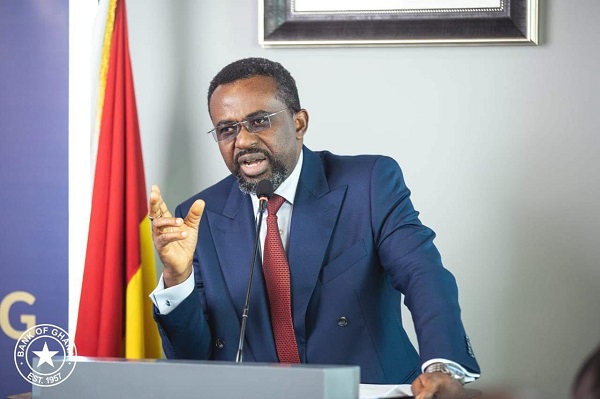
The Governor of the Bank of Ghana, Dr Johnson Pandit Asiama, disclosed this at a diaspora engagement held in Virginia, United States, on Sunday, April 19, 2026.
The roundtable, organised under the theme The Central Bank Bridge: Remit2Invest at the Hilton Alexandria Mark, brought together Ghanaian professionals in the Washington DC area, central bank officials and representatives of the Ghana Investment Promotion Centre.
Dr Asiama said remittance inflows surged from $4.6 billion in 2024 to nearly $7.8 billion in 2025, representing about six per cent of gross domestic product and surpassing FDI inflows.
“The diaspora represents first a critical source of foreign exchange inflows, second a powerful channel for technology transfer and innovation, and third an important bridge to global capital markets,” he said.
“The Ghanaian diaspora is not peripheral to our economy. You are central to our external stability, to our investment strategy, and to our economic transformation agenda.”
Dr Asiama stressed the need to transition from remittance-driven consumption to long-term investment.
“Our next phase is not just about remittances. It is about turning diaspora income into long-term investment capital for Ghana. We must treat the diaspora as domestic investors that are abroad, not external senders of money,” he said.
He also raised concerns about the use of informal remittance channels, warning that such transfers may not translate into foreign exchange inflows.
“I do understand you giving a few dollars to your friend or somebody, that is fine. But when it comes to the significant sums, it is safer when you use the formal channel. We are making sure that when you remit your funds, the cost will be minimal and there will be safety,” he said.
Concerns over transparency and investment climate
Participants at the forum questioned whether all remitted funds ultimately benefit Ghana’s economy.
“What really happens to the dollars that we bring here?” one participant asked. “Do they have to go to Ghana or do they stay here? Do they not show up on the balance of payments? There is definitely something that needs to be looked at. We need to ensure that that money is coming to Ghana and benefiting our people.”
The Chief Executive Officer of the Ghana Investment Promotion Centre, Mr Simon Madjie, said diaspora inflows in 2025 were more than double the $2.7 billion recorded as FDI, but noted that much of the money was not being invested.
“Your money in Ghana is higher than FDI,” Mr Madjie said. “But that money is not going. It is not turning itself into investment. Because you have to convince yourself about being an investor in your own country.”
He added that reliance on relatives to manage investments often undermines outcomes.
“Many of you do business with your relatives. But while you are doing your business with your relatives, you are not professional. You have to do business with professionals who would assist you to really invest in Ghana,” he said.
Some diaspora members said they would only commit funds under stronger governance and accountability systems.
“The issue of trust, whereby not only having individual dealings with individuals, but even at the government level, there are countless incidents of misappropriation where there are no mechanisms in place to hold people accountable. We need a list of approved products that investors can confidently invest in, and we need mechanisms to hold people accountable so that people investing will have recourse if they run into any issues,” a participant said.
A diaspora panellist, Professor Addae Mensah, expressed frustration over past engagements that failed to yield results.
“When governments come, they would ask me to come and speak. You speak, they say wow, and then nothing happens,” he said.
“You can do all that we are talking about here. But if there is not accountability in Ghana among those who oversee things, you can try to fill a bucket that has holes, it will never get full. There should be punishment for wrongdoing, especially from the top,” he said.
Despite his concerns, he acknowledged some progress.
“I like what I am seeing. But please, let it bear fruit. Let it not be a one-off event. From this, there should be a series of meetings until we get to implementable solutions, and then there is monitoring and a feedback loop,” he said.
Dr Asiama cautioned that Ghana risked losing engagement with second-generation diaspora if targeted strategies were not developed.
“The intentional inclusion of our second-generation Ghanaians is equally important,” he said. “Their engagement will depend on modern digital and identity-based approaches that utilise their savings preferences and investment objectives.”
The Head of Fintech and Innovation at the central bank, Mr Rexford Agyemang-Sarpong, noted shifting behavioural patterns among younger diaspora members.
“Our kids may not see the need to remit because maybe all your friends are in the US. There is no strong connection to your grandmother,” he said. “We need to create that opportunity for our children to be able to remit without any intermediary. We need to move from obligation-based remittances to opportunity-based remittances.”
Another panellist, Mrs Adams Safianu, emphasised the importance of income security and skills.
“Everything we set out for is dependent upon our ability to go to work and make money. What if you are not able to go to work because of sickness, stroke, disability, cancer? Our ability to make the money is gone. The people we support back home depend on us. Investment is not only money. The most powerful investment is skills,” she said.
In his closing remarks, Dr Asiama invited diaspora members to raise banking concerns directly with him.
“Just send me an email. Everything you send goes to me. So just send a letter and tell them what problem you are having with any bank, it can be solved. We will get it resolved,” he said.
He added that the central bank would roll out diaspora bonds, foreign currency investment products, tokenisation-based payment systems and structured engagement platforms to channel remittances into long-term economic activity.
