
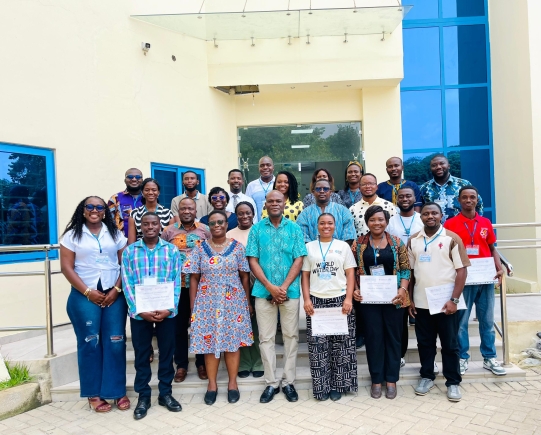
Ghana moves closer to first Marine Protected Area as 20 trained in Cape Coast
Twenty stakeholders have completed a five-day intensive course on Marine Protected Areas (MPAs), aimed at strengthening capacity and deepening awareness on the management and sustainability of MPAs in Ghana.
Marine Protected Areas are designated and legally managed sections of the ocean, including reefs, bays and open waters, created to conserve natural resources, ecosystems and cultural heritage. They are designed to protect biodiversity, enhance fisheries through “spillover” effects and improve climate resilience.
The training comes at a critical time as Ghana prepares to declare its first-ever MPA at Greater Cape Three Points in the Western Region. Cabinet approved the establishment of the MPA in October 2025, following the completion of all required documentation.
Covering 700 square kilometres, the area is intended to protect vital breeding grounds for fish, whales and turtles. The MPA, expected to be formally declared in 2026, will focus on sustainable fishing practices and ecosystem restoration.
The course was organised by the Centre for Coastal Management at the African Centre of Excellence in Coastal Resilience (ACECoR), University of Cape Coast (UCC), in partnership with the Ocean Country Partnership Programme under UK International Development.
It sought to build the capacity of relevant stakeholders on issues relating to the relevance, governance and long-term sustainability of MPAs.
Participants were taken through the fundamentals and global context of MPAs, their development and governance in Ghana, identification processes, regulatory and legal frameworks, as well as management planning and adaptive strategies.
They were also trained in monitoring and evaluation, performance indicators, Marine Spatial Planning and its integration with MPAs, stakeholder engagement, compliance and community participation.
The Chairman of the Technical Advisory Committee (TAC) on the MPA said fisheries governance and compliance in the country remained weak and required collective effort to reverse declining fish stocks.
He described the MPA as an essential tool to support the recovery of fishery resources.
He disclosed that the TAC was inaugurated in May 2025 and had since developed the roadmap leading to the establishment of Ghana’s first MPA. He expressed optimism that the formal declaration of the protected area would be expedited.
Dr Arize noted that Ghana had several potential sites that could qualify as MPAs but emphasised that successfully establishing the first one would provide valuable lessons and experience for future expansions.
In his remarks, the Acting Director of ACECoR, Prof. Precious Agbeko Mattah, reaffirmed the centre’s commitment to supporting the creation of MPAs to enhance marine conservation.
He observed that environmental challenges, particularly along the coast, had had a significant impact on communities and marine ecosystems. He stressed the need for education and awareness to enable stakeholders to appreciate the implications and contribute to sustainable environmental solutions.
He assured that the centre would collaborate with like-minded organisations in Ghana and beyond to build communities committed to environmental sustainability.
A research fellow at ACECoR and facilitator of the course, Dr Sika Abrokwah, said MPAs were critical to conserving Ghana’s marine ecosystem and maximising gains within the fisheries sector.
For his part, the Deputy Director of Hen Mpoano, a non-governmental organisation focused on fisheries and coastal management, Mr Stephen Kankam, stated that the primary objective of the MPA was to conserve biodiversity and restore degraded ecosystems.
He said this would help rebuild fishery stocks and create a spillover effect that could positively impact dwindling catches. He added that the initiative could also boost tourism and generate economic gains for the country.
The participants pledged to apply the knowledge acquired to strengthen marine governance processes and contribute meaningfully to the implementation of Ghana’s first Marine Protected Area.
