
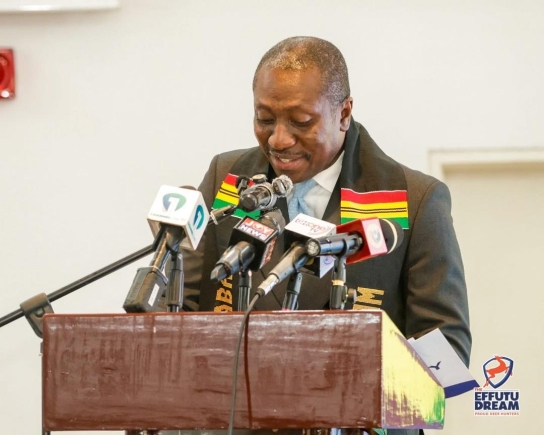
More than 3,046,172 students enrolled in senior high school under the Free SHS policy between 2017 and 2024, the Minority Leader, Alexander Afenyo-Markin, has stated, describing the programme as a structural break from Ghana’s past.
Speaking at a policy lecture, Mr Afenyo-Markin urged his audience to allow the figure to “settle”, arguing that the numbers reflect more than statistics but represent lives redirected by public policy.
He maintained that before the intervention, access to secondary education was heavily shaped by household income, regardless of constitutional guarantees.
“The brilliant child of a poor parent sat at home. The less gifted child of a wealthy parent went to school. That was Ghana’s reality.”
According to him, the reform did not stop at abolishing tuition fees.
It expanded state responsibility to include the feeding of students in senior high schools, extending meals even to day students, thereby reducing the indirect costs that often forced families to withdraw their children.
He contended that the broader social effects became visible over time, citing declines in streetism, child labour and teenage pregnancy in communities where young people, particularly girls, remained in school.
“The difficulty of finding young domestic workers that some people complained about was not a social problem,” he said. “It was social progress.”
Mr Afenyo-Markin framed the policy within a philosophy that sees education as the primary engine of economic mobility and national productivity.
In his assessment, Free SHS moved secondary schooling from a formal entitlement on paper to a lived right for children who would otherwise have been excluded.
