
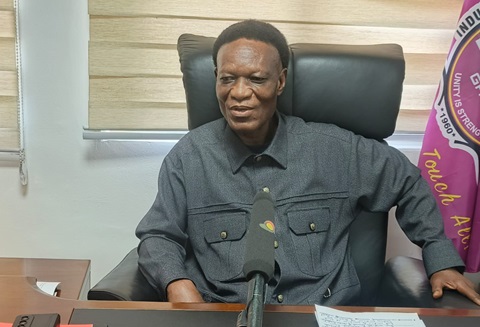
2026 Budget forward-looking – ICU
The Industrial and Commercial Workers Union (ICU) has described the 2026 budget as a forward-looking economic policy document.
It said the budget held promise for the future of the country.
“Some are even calling the budget overambitious, but we think that it is a promising budget,” the General Secretary of the ICU, Morgan Ayawine, said when he commented on the 2026 Budget of the government from the perspective of labour.
On Thursday, November 13, 2025, the Minister for Finance, Dr Cassiel Ato Forson, presented the 2026 National Budget to Parliament.
Commenting on the cocoa sector, for instance, he said it held the key for the country, given its critical role in the transformation and development of the country through schools, hospitals, roads, and other infrastructure.
Acquisition
“I am happy about the aspect where the minister talked about the government acquiring 200,000 hectares for cocoa production. If we can do this, there would be no doubt in anybody’s mind that COCOBOD would be moving towards the achievement of one million tonnes of cocoa,” he emphasised.
For instance, he said COCOBOD did not need any magic wand to continue to survive and play the role expected of it; what it needed was capital injection.
Among other things, Dr Forson noted that cocoa export receipts — including beans and processed products — had risen sharply by 158.6 per cent to $2.56 billion in September 2025, compared with $989.9 million a year earlier.
“This remarkable performance reflects increased production, stronger global prices and Ghana’s expanding capacity in cocoa processing,” he said.
The 2025/26 crop season began on a strong note, supported by favourable weather, better farm-gate prices, and the success of the Productivity Enhancement Programmes.
Government’s initiative to acquire 200,000 hectares for cocoa cultivation, Dr Forson said, was a decisive step towards reviving the sector, targeting production levels of one million metric tonnes and boosting foreign exchange earnings.
Role
Mr Ayawine said the government had done well by fully recapitalising the National Investment Bank (NIB).
“They were recapitalised partially during the previous government, but now we are told that NIB has received full recapitalisation, and that is a good example to look at.
So, once we talk about a good example, what do we do? We need to escalate to other banks that are seriously distressed,” he said.
On the textiles and garment sector, he said that it was at the heart of the union.
“When the new government assumed office, we were the first to send a letter to the minister, wanting to pay a courtesy call. Not only that, but more importantly, talk about the challenges within the sector.
“We also were the first to have bought into the 24-hour economy and the need to reset the country,” he emphasised.
Textile
Mr Ayawine said that if the textile and garment sector were fully revamped, it would help address the unemployment situation among the country's youth.
He said that in the past, there were about 40 companies in the textile and garment sector, but only three or four remain today, possibly due to mismanagement and other factors.
“These existing factories are moribund; they are not in full operation.
Thousands of workers are at home, counting the days they would be called back to work, and the ICU is in the lead championing that,” he said.
He said the government was coming up with a laudable idea to set up three companies to add to the existing ones.
However, he said it was the belief of the union that existing companies would be helped to sustain their operations, and when workers were retained, adding more would make economic sense.
