
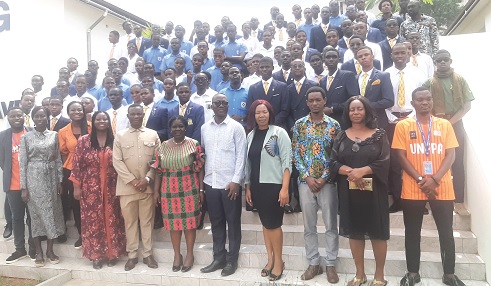
Africa’s youthful population can drive growth if properly prepared — Prof. Amponsah
Africa’s youthful population presents a strategic advantage for economic growth but that can happen only if young people are deliberately equipped with relevant skills, values and practical education.
While many advanced economies are struggling with ageing populations, Africa remains demographically advantaged, an asset that must be fully utilised to benefit both indviduals and the continent as a whole.
Delivering the keynote address at the New Year Conference and Youth School yesterday, the Head of Distance Education, Professor Samuel Amponsah, said: “Many countries are dealing with ageing populations, while Africa is blessed with a youthful one. The future is bright, but only if the youth prepare themselves for it.
He said education systems must shift from rote learning to practical application of knowledge to nurture human capital for inclusive growth.
“We are living in an era where knowledge must be applied. Education must produce problem solvers who can add value to society,” he said.
The event featured panel discussions and a practical session at the University of Ghana Innovation Enclave where students were taken through the use of some technologies, including a 3D printer.
Values, technology
Moderating two panel discussions at the event, an author, Baptista S. Gebu, said rapid digitalisation without strong human values could undermine development efforts.
“We can digitise everything, but there is an aspect of human nature you cannot take away. Skills such as teamwork, emotional intelligence and discipline must go hand in hand with technology,” she said.
She cautioned young people against allowing social media trends to shape their thinking uncritically.
“The most important technology that exists is your mind. If you lose control of your thinking faculties to social media, you lose direction,” she added.
Collaboration
The first panel discussion which featured these students, Doe Iko Kwame of Legon Presbyterian Boys’ School, Samuel Amber and Kenneth Ofori Agyeman of Accra Academy, and Mary Davis of Accra High School, called for stronger collaboration between schools and industry to give young people practical exposure and prepare them for entrepreneurship and leadership.
The student panellists said the country’s education system must deliberately prepare young people to become active contributors to national development rather than passive recipients of opportunity.
They said young people should be equipped with practical skills alongside academic knowledge, adding that soft skills such as communication, teamwork and leadership were increasingly becoming important in the modern workplace.
The students further called for early exposure to real-world work environments, explaining that creativity and innovation thrived when learners were allowed to test ideas beyond the classroom.
They also urged policymakers and school authorities to create pathways that enabled students to translate learning into enterprise, noting that youth participation in nation-building should begin while they were still in school.
Skills, Career, job creation
The second panel discussion, which featured Kwateng Gabriel-Kweku and Adubofour Opoku of Accra Academy, Ngusra Einsten Adum, a Biomedical Engineering student of the University of Ghana, and Portia Cobbinah of Accra High School, focused on skills development, career direction and job creation.
The panellists said emerging fields such as biomedical engineering, artificial intelligence and digital technology offered opportunities for innovation and business creation.
Mr Adum said digital competence was no longer optional, particularly as artificial intelligence continued to reshape industries.
“As we move into an AI-driven world, digital skills are essential, but how you build and manage relationships will determine how far you go,” he said.
The panellists also said strong communication skills, emotional intelligence and ethical conduct were critical across professions such as law, medicine, engineering and counselling.
They argued that entrepreneurship and business creation provided a more sustainable response to unemployment than reliance on white-collar jobs, since businesses had the capacity to create employment for others.
The students further identified discipline, integrity and effective time management as essential foundations for leadership, cautioning that weak personal values often translated into poor governance and corruption later in life.
They encouraged young people to use social media and online platforms productively to acquire skills, develop ideas and solve problems within their communities.
