
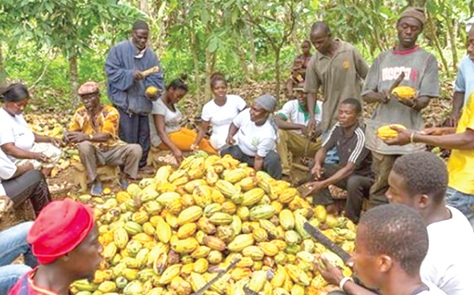
Cocoa paradox: How Ghana missed the boom and paid the price
Cocoa is not just a crop in Ghana.
For decades, the soft commodity has been a backbone of the country’s foreign exchange earnings, a critical buffer against currency depreciation, and the livelihood of an estimated 800,000 families depends on this crop.
But today, that pride is buried under a mountain of debt, broken promises, and bitter irony.
The very season global cocoa prices hit historic highs, Ghana watched on from the sidelines, locked out of the windfall.
The story of how the world’s second-largest cocoa producer missed the biggest boom in a generation is not simply one of bad luck.
It is a story of a system failure, mismanagement, structural neglect, and a financing model that finally buckled under its own weight, and unfortunately, farmers have been the ones to pay the heaviest price.
Collapse started years back
Ghana’s cocoa decline did not happen overnight. Production has registered three consecutive seasons of decline: 683,269 tonnes in 2021/22, down to 655,808 tonnes in 2022/23, and a devastating 530,873 tonnes in 2023/24, the worst performance in 15 years.
From a peak of over one million tonnes in the 2020/21 season, Ghana had lost nearly half its output in just three years.
The causes are well documented: unpredictable weather, the deadly cocoa swollen shoot virus disease spreading across farms, and the creeping invasion of illegal small-scale mining, which has destroyed farmlands across the country.
Smuggling has also been another challenge, with the country losing an estimated 160,000 tonnes in the 2023/24 season alone, as farmers exploited the country’s porous borders to sell to buyers in neighbouring countries who offered higher prices.
While the causes of Ghana’s poor production figures are widely known, the response has not been enough.
The forecasting blunder
At the heart of Ghana’s crisis lies a staggering miscalculation. COCOBOD projected an output of 800,000 tonnes for the 2023/24 crop season and committed 786,672 tonnes in forward contracts.
Actual production came in at around 500,000 tonnes, a deviation of about 43 per cent from the projection.
To put that in context: variations in crop forecasts typically run between 5 and 15 per cent.
A 45 per cent deviation was unprecedented.
Ghana had sold cocoa it did not have at prices that would soon look laughably low.
The shortfall resulted in rollover contracts of 333,767 tonnes at an average price of $2,661 per tonne.
These were contracts that locked the new season’s crop into legacy prices at a time when the market was surging well above $8,000 per tonne.
While chocolate manufacturers scrambled for supplies and cocoa futures briefly surpassed $11,000 per tonne on international markets, Ghana was delivering cocoa at roughly a quarter of that price.
The result was a loss of over $1 billion that would otherwise have flown to cocoa farmers and other stakeholders.
Côte d’Ivoire, despite facing its own production challenges, was better positioned to capture some of those gains. Ghana, largely, was not.
Breakdown in the financing model
Compounding the production crisis was the collapse of the financing architecture that had underpinned the sector for three decades.
COCOBOD’s annual pre-export syndicated loan, used to finance the purchase of cocoa from farmers at the beginning of each season, began showing cracks.
According to the Ministry of Finance, in 2023, for the first time, the annual syndication suffered significant delays due to a loss of confidence in the Ghanaian economy, with the first tranche arriving in December, four months after the season’s start.
By mid-2024, the situation had worsened.
COCOBOD could not pay the final tranche of the syndicated loan due in July 2024 and required a $70 million bridge financing from the Ministry of Finance to avert a default.
The regulator’s balance sheet was in ruins, weighed down by billions of cedis in debt owed to
Licensed Cocoa Buying Companies, the Ministry of Finance, the Bank of Ghana, and other suppliers.
With the traditional financing model in tatters, COCOBOD turned to international cocoa buyers to pre-finance purchases.
But this arrangement carried its own vulnerabilities.
The Finance Ministry has explained that the key motivation for buyers was the rollover contracts priced far below prevailing market rates. Once that gap closed and the rollovers were serviced, buyers had little incentive to continue pre-financing.
Subsequently, it was the farmers who suffered most visibly.
Farmers went unpaid for months for beans they had delivered to LBCs, who themselves owed banks about GHc7 to GHc8 million due to the disrupted cash flow from COCOBOD.
In cocoa communities across the country, farmers who had harvested and sold their crop waited months to be paid, borrowing from traders and moneylenders to survive the lean period.
When the market turned
If the rollover contracts represented Ghana’s failure to benefit from the boom, what followed represented a second, equally painful blow.
Global cocoa demand fell sharply, leading international prices to halve over the course of a year to two-year lows of around $4,000 per metric tonne.
The market that had once offered Ghana a lifeline it couldn’t reach had now swung in the opposite direction entirely.
The consequences were immediate. COCOBOD’s farmgate price, set at 58,000 cedis per tonne ($5,300), meant international traders faced losses on Ghanaian cocoa purchases, and their purchases dwindled as a result.
With Ghana’s beans now overpriced relative to the global market, buyers simply walked away.
COCOBOD confirmed it had approximately 50,000 metric tonnes of unsold cocoa sitting at the country’s ports, while farmers in the fields reported significant stocks at home with no buyers in sight, as LBC district offices were closed.
Ghana had missed the boom and was now stuck in the bust.
In February 2026, the government announced a cut in the farmgate price to $3,580 per metric tonne for the remainder of the 2025/26 season, a reduction of nearly 29 per cent to realign Ghana’s pricing with global market reality and restore buyer interest.
Reform package
Alongside the price cut, the Finance Ministry unveiled what amounts to the most comprehensive reform package the cocoa sector has seen in recent memory.
A new domestic cocoa bond financing model to replace the discredited syndicated loan structure, with repayments tied to sales proceeds within the same crop year.
On processing, the government announced an ambition to fundamentally shift how Ghana earns from its cocoa.
Rather than continuing to export raw beans at the mercy of volatile international prices, the plan is to process at least 60 per cent of cocoa locally from next season, with the remainder of this season’s harvest being directed towards local grinding.
Ghana already has installed domestic grinding capacity of 504,780 tonnes, though local processors have been operating at below 50 per cent of that capacity due to insufficient bean supply.
The government has also proposed legislation that would guarantee farmers at least 70 per cent of the FOB price of cocoa exports.
While these measures commendable, they come after years of inaction on problems that were never invisible.
The swollen shoot disease outbreak, the galamsey incursion into cocoa lands, the over-reliance on forward contracts that left no room for price optimisation; none of these was a surprise.
Ghana’s cocoa sector does not need another set of promises.
It needs structural reform that reaches the farmgate: better-resourced extension services, real enforcement against illegal mining in cocoa zones, fair and timely payments to farmers, and a pricing and contracting model that allows the country to benefit when the market rewards producers.
The boom has passed. Prices on international markets have cooled sharply.
The window has closed for now.
Whether Ghana is ready when the next one opens is the question the sector must now answer.
