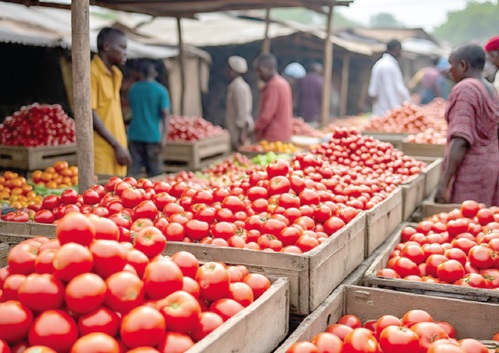
Ghana grows tomatoes – So why does Ghana keep importing them?
Sheila M. De-Heer
Opinion 5 minutes read
Ghana grows tomatoes – So why does Ghana keep importing them?
In Ghana, tomatoes are more than just a food ingredient – they are a daily necessity. From stews to jollof, tomatoes are embedded in the country’s food culture. Yet, year after year, Ghana faces a frustrating and costly paradox: farmers dump tomatoes during periods of glut, consumers pay high prices during shortages, and the country continues to import large volumes of both fresh and processed tomato paste.
This contradiction is more than puzzling – it is a symptom of a deeper structural problem within Ghana’s agricultural system.
The numbers tell a troubling story
Ghana produces hundreds of thousands of metric tons of tomatoes annually, largely from regions such as Upper East, Bono, and Northern Ghana. Yet post-harvest losses range from 20% to 50%, depending on the season and location.
At the same time, Ghana spends tens of millions of dollars each year importing processed tomato products, while also relying on fresh imports during seasonal shortages.
The contradiction is clear: Ghana grows tomatoes, loses a significant portion after harvest, and then imports what it could have processed locally.
Gluts that destroy farmer livelihoods
During peak harvest periods, tomato supply floods local markets. Prices collapse – sometimes below the cost of production. In extreme cases, farmers abandon their harvests or dump produce because transport costs exceed expected revenue.
This is not just inefficiency; it is a livelihood crisis. Smallholder farmers are left exposed to extreme market volatility.
The real problem: Weak value chains
For decades, policy responses have focused on increasing production – improved seeds, fertilizers, and irrigation. While important, these efforts have not addressed the core issue: a fragmented and underdeveloped tomato value chain.
Tomatoes are highly perishable. Without storage, aggregation, transport, and processing systems, increased production leads to increased losses.
What Ghana lacks is not tomatoes, but the systems to manage them efficiently.
The missing piece: Climate-adapted tomato varieties
One of the most overlooked drivers of Ghana’s tomato crisis is the mismatch between tomato varieties and local growing conditions.
Many farmers cultivate varieties that are highly susceptible to heat stress, drought, and disease – especially during the dry season. This leads to low yields and inconsistent supply, reinforcing seasonal shortages.
Investing in climate-adapted varieties – heat-tolerant, disease-resistant, and durable – could significantly improve year-round production. Ghana has the institutional capacity to lead this effort through bodies like the Council for Scientific and Industrial Research (CSIR). However, innovation must move beyond research stations into farmers’ fields.
Stronger coordination between research institutions, seed companies, extension services, and farmer groups is essential to ensure widespread adoption.
With the right varieties combined with irrigation and extension support, Ghana could significantly improve year-round tomato production and reduce seasonal supply gaps.
Why imported tomato paste wins
Imported tomato paste from countries like Italy and China dominates Ghana’s market because it offers longer shelf life, consistent quality, and lower prices driven by large-scale production.
Local processing remains limited and inconsistent, often constrained by unreliable raw material supply and high operational costs. Past factory investments have struggled, showing that production without supply chain coordination is not enough.
The Burkina Faso option: A temporary fix
During shortages, Ghana often imports fresh tomatoes from Burkina Faso to stabilise supply.
While this helps stabilise supply in the short term, it exposes the country to price volatility, transport risks, and external shocks. Recent disruptions in cross-border trade have highlighted just how fragile this dependency can be.
Regional trade can complement domestic supply, but it cannot replace a well-functioning local system.
A smarter path forward
Solving Ghana’s tomato crisis requires a shift from production-focused thinking to system-wide solutions:
Decentralized processing to absorb surplus during peak seasons
Improved market coordination through better price and demand information
Investment in storage and transport infrastructure
Stronger farmer cooperatives and aggregation systems
The role of agricultural extension must evolve
Extension services must go beyond production and focus on market-oriented agriculture.
Farmers need support in post-harvest handling, quality standards, value addition, and market timing. This is essential for transforming farming into a sustainable business.
Policy must move beyond rhetoric
Reducing food imports requires more than ambition, it requires targeted investment in:
Infrastructure
Irrigation
Processing industries
Agribusiness financing
Without these, Ghana will continue to produce what it cannot manage – and import what it already grows.
Turning a paradox into progress
Ghana’s tomato crisis is not inevitable – it is solvable.
With the right mix of climate-smart production, strong value chains, and coordinated policy action, the country can stabilize supply, reduce imports, and improve farmer livelihoods.
Until then, the question will remain: why does Ghana keep importing what it already grows? Ghana does not need more tomatoes – it needs a system that ensures the ones it already grows are not wasted.
The writer, Sheila M. De-Heer is a PhD. Candidate, Agricultural Sciences at the Southern Illinois University Carbondale
She champions evidence-based solutions for agricultural transformation and rural prosperity! She holds a master’s degree in Agricultural Economics from Tuskegee University. Her work focuses on agricultural policy analysis, smallholder farmer resilience, agricultural education and extension systems, and sustainable development strategies. She contributes research-informed perspectives on improving productivity, income stability, and long-term sustainability in agricultural systems.
Email: This email address is being protected from spambots. You need JavaScript enabled to view it. or This email address is being protected from spambots. You need JavaScript enabled to view it.