
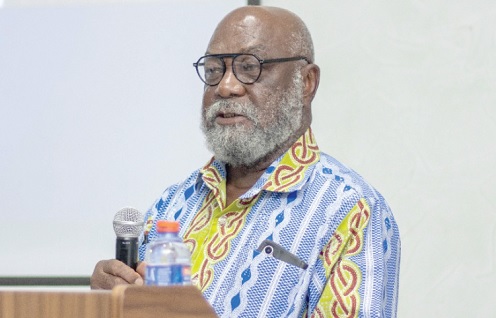
Form alliances to hold governments to account - Prof. Karikari urges African media
A media luminary, Prof. Kwame Karikari, has urged African media practitioners to form alliances to hold political leaders and institutions to account in addressing continental and sub-regional issues.
That, he said, required that the African media develop the capacity to study and analyse key instruments such as contracts; policy documents; diplomatic statements by governments, foreign and national; resolutions and communiqués by multilateral agencies; position papers by corporate institutions and their interests and interventions in international affairs.
“What can the African media do to promote among the people of Africa improved and reliable knowledge of African affairs and to facilitate among them a stronger sense of solidarity with other Africans facing difficult problems,” he asked.
Media capacity
Prof Karikari was speaking at an international media capacity workshop organised by the International Desk of the Ghana Centre for Democratic Development (CDD-Ghana) in partnership with the West Africa Democracy Solidarity Network (WADEMOS) in Accra.
It was on theme: “Enhancing media capacity on foreign influence, geopolitics, and democracy resilience in West Africa and the Sahel” and attracted media practitioners from West Africa and the Sahel regions as well as other African countries.
The training forms part of broader efforts to strengthen media capacity, equipping journalists with the skills to report more critically and accurately on issues of disinformation, foreign influence, and democratic resilience in an increasingly complex information environment.
Participants were taken through the increasing use of digital platforms, artificial intelligence tools, and coordinated propaganda campaigns, which are being deployed to distort facts and sway democratic discourse in several countries across West Africa.
Safeguards
Prof. Karikari, who is a board member of the Media Foundation for West Africa (MFWA), said the continent’s media needed to promote reliable knowledge of African affairs, strengthen solidarity and safeguard sovereignty against external threats.
He, therefore, urged journalists to always study the meanings, implications and effects of governments’ responses on the interests and well-being of the people.
“Our media, in their strategic functions as institutions of public information and education, ought to be awakened to their responsibilities and important developments on the continent,” he said.
He nexpressed regret that there was no voice of confidence and trust speaking for Africa.
“Our political leaders seem to have resigned themselves into the cocoons of their narrow, small national or country domains where they feel comfortable as small‑minded chieftains,” he said.
Threats
On his part, a security expert, Colonel Festus Aboagye (retd), stated that journalism had real leverage to defend the West African cause from destabilisation.
He noted that the democracies in four West African countries were the targets for destabilisation by the West.
“What Ghana, Benin, and Senegal decide in the next 18 months determines their trajectory,” he stated.
Col Aboagye said 55 per cent of all militant Islamist fatalities in Africa occurred in the Sahel with more than 22,000 deaths linked to militant groups in the past year.
“Security has deteriorated despite—and partly because of—accelerating military technology deployment.”
He said Türkiye, China, Russia, Western partners, Iran and Ukraine were all actively supplying drones, deploying advisors, and negotiating basic rights
“This is not a Cold War-era proxy conflict. It is live, commercial, and largely invisible to regional publics,” he stated.
Col Aboagye said decisions made in the next 18–24 months would determine whether Ghana, Benin, Cote d’Ivoire and Senegal follow the Sahelian pattern or a different path.
Journalism
He said in a governance crisis, it was on the journalist who still functioned.
“When parliaments are suspended, courts are captured, and civil society is silenced — informed, accurate, and persistent journalism is the primary institutional check on how military technology is used against populations,” he stated.
