
Africa wins historic vote on slavery: Ghana spearheads resolution at UN - Trafficking declared gravest crime
The United Nations (UN) has adopted Ghana’s resolution on transatlantic slave trade, slavery, colonisation and apartheid at the UN General Assembly in New York, the United States of America (USA).
The resolution entitled, “Declaration of the Trafficking of Enslaved Africans and Racialised Chattel Enslavement of Africans as the Gravest Crime Against Humanity”, was overwhelmingly adopted by the UN member states.
The resolution saw 123 countries vote in favour; 52 countries abstained from voting, while three countries, namely the USA, Israel and Argentina, voted against the resolution.
The adoption of the resolution means the transatlantic slave trade and slavery can now be called the gravest crime against humanity and set the tone for legitimate pressure for reparative justice and the return of stolen artefacts from Africa during the period of the slave trade, colonisation and apartheid.
Ghana, under the leadership of President John Dramani Mahama, moved the motion with the backing of the African Union (AU), ECOWAS and the Caribbean countries, among others.
Stand up and be counted
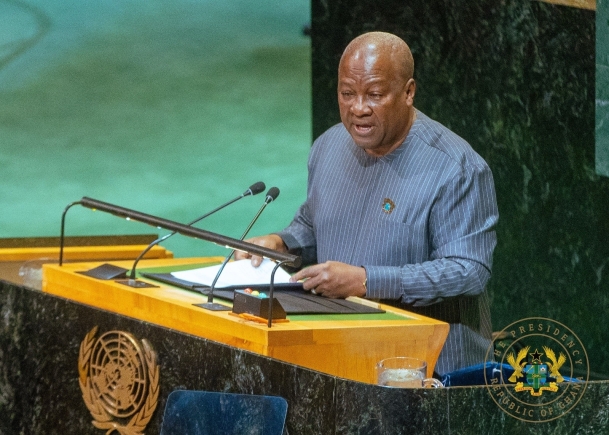
Moving the motion for the adoption of the resolution at the UN headquarters yesterday, President Mahama called on UN member states to stand up and be counted on the right of history by supporting the resolution on slavery and the transatlantic slave trade.
“Let it be recorded that when history beckoned, we did what was right for the memory of the millions who suffered the indignity of slavery. Let our vote on this resolution restore their dignity and humanity,” he said.
President Mahama, who spoke on behalf of the African Union (AU), tabled the motion at the UN General Assembly in New York yesterday as part of the observance of the International Day of Remembrance of the Victims of Slavery and the Transatlantic Slave Trade.
Rationale
The resolution, known as “Declaration of the Trafficking of Enslaved Africans and Racialised Chattel Enslavement of Africans as the Gravest Crime Against Humanity”, sought the recognition of the cruel history of the transatlantic slave trade, slavery, colonisation and apartheid.
It sought reparations and reparative justice as well as the return of cultural and historic artefacts of African countries and people of African descent across the world.
It also calls for a crucial adjustment of world systems to afford African countries and Africans equal opportunities to exercise their rights.
President Mahama urged UN member states not to sit on the fence of neutrality on the adoption of the resolution, backing his statement with a quote from a former President of the USA, Theodore Roosevelt, that, “With a great moral issue involved, neutrality does not serve righteousness; for to be neutral between right and wrong is to serve wrong.”
He also stressed the need to pursue justice, reminding delegates at the UN General Assembly of the civil rights leader, Dr Martin Luther King’s, assertion that, “the arc of the moral universe is long, but it bends toward justice.”
The President added that while the road had been long, especially for Africans, each step guided by a desire to be better and do better, had brought the world closer to “the kind of world we would like to leave for our children”.
Remembrance
President Mahama underscored the importance of remembering the victims of the transatlantic slave trade, saying progress was made in steps towards a better future.
He said the marking of the International Day of Remembrance of the Victims of Slavery was not only to honour the 13 million Africans enslaved over centuries, but also to bring the world to a better place.
“We remember them through articles and oral histories, through broadcast programmes, books, music, visits to museums, monuments, and memorials, such as the Ark of Return, located right here at the Visitors Plaza of the United Nations Headquarters.
“Through these activities, we do more than remember. We document and educate; we gain a greater perspective; we find the delicate balance of learning from history so we do not repeat it, while leaving the pain behind.
“In doing so, we begin to heal, individually, within our immediate communities, and within the global community,” President Mahama stated.
For his part, the UN Secretary-General, António Guterres, stressed the need to dismantle false narratives and racial realities and call out the underlying white supremacy.
“By dismantling its damaging falsehoods online, in the media, in schools, at work, in politics, and within ourselves, and by working on truth, justice, and rebellion to recognise the extraordinary courage of the exploiters, we honour their determination to be free, their quiet resilience, and their organised resistance,” he said.
He stressed that the perverse global order fostered by the slave trade and slavery thrived because power acted without conscience, adding that leaders must now use power for better things.
“Now we must improve the persistent barriers that prevent so many people of African descent from exercising their rights and realising their potential. We must commit fully and without hesitation to human rights, equality, and the inherent worth of every person,” the UN Secretary-General stated.
Affirmation of truth
Speaking after the resounding vote in favour of the motion at the UN General Assembly, the Minister of Foreign Affairs, Samuel Okudzeto Ablakwa, said the adoption of the resolution was an affirmation of truth.
“We have chosen remembrance over silence, dignity over erasure and shared humanity over division.
We have advanced the cause of justice, and we have done that so emphatically,” he said.
“This is an emphatic victory for justice. Our ancestors, Africans, and all people of African descent are today honoured that our humanity and our dignity have been restored,” he said.
Mr Ablakwa indicated that the adoption of the resolution was not an arrival at a destination, but rather a major step in the ongoing journey and collective conversation of the sponsors of the resolution for reparatory justice.
He said the sponsors of the resolution remained committed to continued engagement with all member states in the shared spirit of cooperation adding that, through this resolution, the world had spoken with clarity and truth.
“We have affirmed that the trafficking of enslaved Africans and their racialised chattel enslavement is the gravest crime against humanity, a crime whose scale, structure, and enduring consequences demand recognition at the highest level of our shared global conscience so that we can move forward in healing and in preventing such a crime from ever happening again.
This resolution is not about apportioning blame across generations or nations. It is not about reopening old wounds; it is about ensuring that those wounds are neither forgotten nor denied.
It is about creating space for truth, for education, and for a more honest global conversation that allows us to move forward together with greater understanding,” he stated.
Refuting claims
Mr Ablakwa rejected the reasons the United States adduced for voting against the UN motion on slavery, calling them "stonewalling" and "red herring".
He stated that the government had undertaken extensive consultations, involving experts and historians worldwide, to push for the adoption of the justice.
Mr Ablakwa affirmed that September would mark 100 years since slavery was abolished, yet justice remained elusive.
Clarification, appreciation
Mr Ablakwa also clarified that reparations for the transatlantic slave trade were not about direct payments to individuals.
Rather, they pertained to addressing structural inequalities and promoting development in affected communities.
He explained that the proposed frameworks would support education, empowerment, skills training, and entrepreneurship through endowment funds.
The Foreign Affairs Minister added that African and Caribbean leaders were not seeking personal gain, but rather collective redress for historical injustices.
