
‘Even 50 years wouldn’t be enough’ — Ablakwa hits back at US over slavery vote
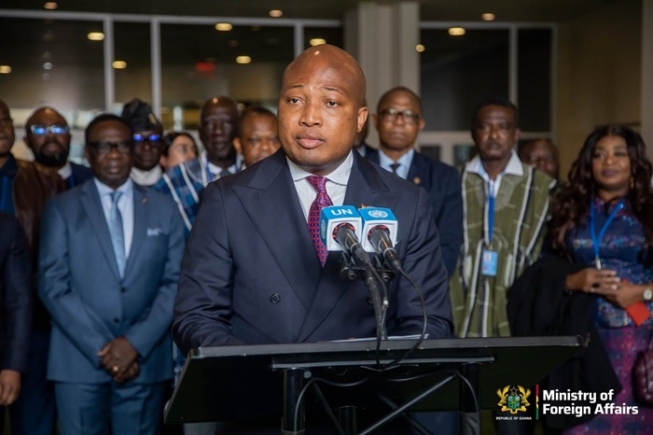
The Minister for Foreign Affairs, Samuel Okudzeto Ablakwa, has said the United States would not have supported the United Nations resolution on reparatory justice for the transatlantic slave trade, regardless of how long negotiations had taken.
“Even if we gave them 50 years, they would say that the time is not enough,” he told journalists on March 25, 2026, at a press conference at the United Nations General Assembly in New York after the adoption of Resolution A-80-L48.
The resolution was approved by 123 member states, with 52 abstaining. The United States, Israel and Argentina voted against it.
US position
Washington, in its official explanation of the vote published by its mission to the United Nations, outlined two main objections.
The United States said it does not recognise a right to reparations for historical acts which were not illegal under international law at the time they occurred.
It also argued that the resolution appeared to place crimes against humanity in a hierarchy, which, in its view, diminishes the suffering of victims of other atrocities.
Mr Ablakwa said the United States also raised concerns during negotiations about the time allocated for consultations.
Ghana rejects claims of rushed process
Mr Ablakwa rejected the assertion that negotiations were rushed, insisting that the process had been extensive and inclusive.
He said John Dramani Mahama gave formal notice of the resolution at the UN General Assembly in September 2025, providing member states with advance notice of Ghana’s intentions.
He explained that negotiations began shortly afterwards and went through several rounds of consultations, with each session lasting three hours.
“In the history of the United Nations, this has been a resolution that has gone through so many rounds of consultations,” he said.
He added that the group behind the resolution included academics, researchers and historians from across the world.
“We disagree with the notion that there was no time for negotiations,” he said.
Regarding concerns about ranking crimes, Mr Ablakwa said the resolution does not seek to compare crimes against humanity but rather addresses a specific historical injustice.
“We are only speaking to a historical fact,” he said. “Never in the history of mankind have we had such a systemic crime. We are talking about the contextual framing of what has happened, not about the ranking of crimes.”
Scale of impact
Mr Ablakwa said the transatlantic slave trade, which lasted more than 300 years, continues to have lasting consequences, including racism and inequality.
He noted that more than 12.5 million Africans were taken during the slave trade, with over three million dying during the crossing.
“More than three million people died, were tossed into the transatlantic ocean, which is a mass gravesite,” he said.
He added that UNESCO has identified Ghana as the country with the highest number of slave forts and castles in the world.
Focus on structural redress
Addressing concerns about beneficiaries, Mr Ablakwa said the resolution prioritises long-term development interventions rather than direct financial payments to governments.
“We do not want any payments made to us directly,” he said. “We are talking about causes to deal with the structural inequalities.”
He explained that the resolution proposes measures such as endowment funds for education, skills training and support for entrepreneurs.
Mr Ablakwa also highlighted calls for the return of cultural artefacts, including items from Egypt and the Ashanti Kingdom, stressing that such restitutions should not be carried out in a piecemeal manner.
Support and next steps
Mr Ablakwa said he engaged key advocacy groups ahead of the vote, including the Congressional Black Caucus, the NAACP and the National Action Network, led by Al Sharpton, all of which supported the resolution.
He revealed that 62 members of the Congressional Black Caucus wrote to the US Ambassador to the United Nations urging a vote in favour, but the ambassador ultimately voted against it.
Mr Ablakwa noted that September 2026 will mark 100 years since the League of Nations Slavery Convention of 1926 and called for meaningful progress on reparatory justice.
“We can no longer wait,” he said. “September, we will be commemorating 100 years. A whole century, and yet there has been no justice.”
He described the adoption of the resolution as the beginning of a broader process and called on all member states, including those that abstained or voted against it, to engage constructively.
“The work of justice does not end with remembrance,” he said. “We therefore urge every member state to consider carefully the actions it must take to ensure inclusive and good faith dialogue on reparatory justice.”
