
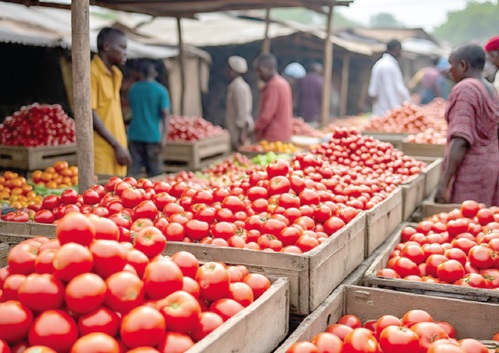
Tomantoes’ was how we called tomatoes, growing up as primary school children around Independence, into the mid-1960s, before we went to secondary school.
Probably, in a genetic playback in later years in the 1980s as a parent, my little boy shortened it to “mantoes,” despite all efforts to correct him.
Tomatoes were “Headline News” on all TV stations on Friday, March 20, 2026, next to reports on the celebration of Eid al-Fitr, signifying the end of the 30-day Ramadan fasting by Muslims.
During the week, Burkina Faso announced a suspension of its export of tomatoes, following of the killing of seven Ghanaian tomato-traders in Burkina Faso in a terror attack on February 14, 2026.
For Ghana, which imports 90 per cent of its tomatoes from Burkina Faso, the suspension has elicited lots of discussions, with mixed opinions.
While some opine that this is a good opportunity to wean ourselves off there and develop the growing of our own tomatoes to enhance our food security, others applaud the government’s decision to send a delegation to request the postponement of the suspension/ban.
In Gen-Z parlance, an immediate question is, “for real?”Meanwhile, recent history has it that the tomatoes from Burkina used to be grown around Navrongo, Ghana, in 1965 under Osagyefo Kwame Nkrumah’s Vea Irrigation Project, hence the name ‘Navrongo tomatoes!’
Taking its national interest into account, Burkina Faso suspended the export of raw tomatoes effective March 16, 2026, to process its tomatoes for value-addition and preservation for export, under the new “Societe Faso Tomatoes” (SOFATO).
An article I wrote on Coconuts, watermelons and tomatoes in May 2018 is quoted below.
‘CWT’
The almost forgotten abbreviation “cwt” that we were taught in Science at school in the 1960s stood for “hundredweight.”
This is a unit of measure which has one hundred weight equivalent to one hundred (100) US pounds, or 112 Imperial or British pounds.
My experience is that while fruits and vegetables are weighed and sold by the pound or kilogram in many African countries I have visited, Ghana does not sell fruits and vegetables by weight, even though we do so for meat.
Therefore, during the season of plenty, coconuts, watermelons and tomatoes (cwt), as well as all perishable agricultural commodities, sell cheaply.
During the lean season, a few months later, prices rocket to space.
There is no canning to serve as a buffer for balance.
Watermelons
A rough approximation of the average-sized watermelon is about the size of a football.
Five such jumbo-sized watermelons were recently bought for GHȼ10 at Ada Junction.
The alternative for the farmer is to leave the melons to rot and go hungry, which is not a realistic option.
As soon as the peak season is over, prices will start rising.
In the lean season, one watermelon sells for over GHȼ20! This is an annual ritual.
A few months back, tomatoes suffered the same fate with a glut on the market.
As I write, tomato price has shot up because the season is over with the coming of the rains.
Questions
I asked myself, why do we do this to ourselves?
Why do we decide to continue to operate so close to nature with all the knowledge and science, and technology around us?
Are our leaders interested only in themselves and their families and friends, or “misleaders”, as African leaders are described by the Kenyan civil rights activist Professor PLO Lumumba?
Even if they did not know before becoming leaders, they travel outside Ghana and see the thinking that has gone into basic operations like the canning of fruits and juices.
Ghana had the Nsawam Canneries as far back as the 1960s.
Over 60 years after independence, why do farmers watch helplessly as their fruits and vegetables rot, while our shops are filled with expensive fresh and canned fruits from other parts of the world?
Why can we not have a cannery in the general area of Ada-Dawhenya for watermelons and tomatoes, and one for citrus in the Asamankese-Kade area? How about mangoes, which grow all over the country?
Solution
In advocating solutions, I may be guilty of reinventing the wheel.
This is because there is nothing new to tell Ghanaians which we have not known since I was a little boy in the 1960s.
The problem has been bad leadership.
We had the Bolgatanga Corned Beef Factory, Pwalugu Tomato Factory and Nsawam Canneries for fruits and vegetables.
Nantwi Milk was produced at the Agricultural Farm at Amrahia.
Today, milk produced in the Volta Region is left to rot for lack of market, the result of bad roads.
Meanwhile, Ghana imports milk and dairy products.
We import tomatoes while local tomatoes in Ningo-Prampram rot away.
Outside Ghana, I have drunk canned coconut juice.
Why do we still drive whole coconuts from the Western Region to Accra only for the husks to add to our insanitary conditions?
Leadership
Our problem is leadership.
Leaders are paid to solve problems, and not talk copiously, explaining why they have failed to solve problems.
Leadership will be effective if it is selfless and honest with integrity.
Over sixty years after independence, we have no reason to continue importing food, fruits and fruit juices, which Ghana produced in the 1960s.
Coconuts, watermelons and tomatoes (cwt) deserve better and so do Ghanaians! Governance is not rocket science!
What happened to the Pwalugu Dam?
Where are our “Akumadan-tomayrose” as the politician pronounced tomatoes?
Are we forever, almost 70 years after independence, dependent on imported rice, sugar, chicken, and tomatoes, with water predicted to join soon, following contamination by “galamsey”? Need I say more?
Leadership, lead by example /integrity/humility! Fellow Ghanaians, wake up!
The writer is a former CEO, African Peace Support Trainers Association, Nairobi, Kenya; Council Chairman, Family Health University, Teshie, Accra. E-mail:
