
The Producer Price Review Committee (PPRC) has announced new prices for cocoa at the farmgate for the rest of the 2025/2026 crop season, pegging a tonne of the beans at GH¢41,392 and a bag of 64 kilogrammes at GH¢2,587.
Although the new price is a reduction from the GH¢58,000 per tonne and GH¢3,625 per bag announced on October 2, last year, the new price amounts to 90 per cent of the free on board (FOB) export price, while the previous prices were about 70 per cent of the FOB price.
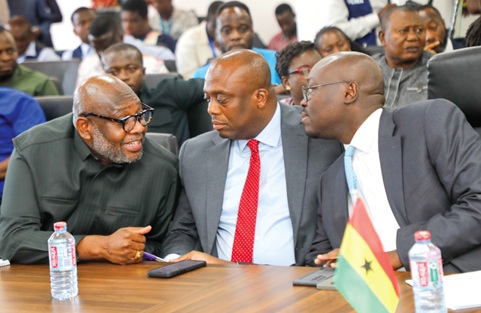
The Minister of Finance, Dr Cassiel Ato Forson, who also chairs the PPRC, announced this in Accra last Thursday at a press conference to convey a raft of short to medium term measures the government had taken to clean up the cocoa sector.
The measures come after cries from cocoa sector players demanding payment of arrears and the lifting of beans from the farms, which prompted an extraordinary Cabinet meeting last Wednesday.
Dr Forson said the PPRC arrived at the new prices after it met on Thursday to assess the challenges facing the sector and review the producer price for the remainder of the 2025-2026 crop year, as is usually the case.
He said in order to cushion the farmer, the PPRC recommended that the farmer be paid 90 per cent of the achieved gross FOB of $4,200 per tonne to mitigate the adverse impact on the farmer as a result of the fall in the world market price.
“As a result of that the PPRC thereby announces that effective today, Thursday, February 12, 2026, the new producer price for the remainder of the 2025-2026 crop season will now be GH¢41,392 per tonne,” he said.
The world market price of cocoa has dropped significantly from an average of $7,200 per tonne to $4,100 per tonne, making Ghana’s cocoa beans uncompetitive and creating liquidity challenges.
When the producer price was being set in August last year, the gross FOB price was S$7,200 per tonne based on an exchange rate of GH¢10.25 to the US dollar.
Current situation
The current situation, Dr Forson said, was largely driven by the unwillingness of buyers to purchase Ghana's cocoa because it had become uncompetitive and very expensive.
Cocoa from other producing countries, he said, was now selling at a price significantly lower than that of Ghana's producer price.
Meanwhile, he said Cocobod did not have the liquidity to purchase cocoa from farmers and stock for hedging or other trading decisions.
“This was due to the financing model invented in the year 2024-2025 when the syndicated loan failed,” he said.
Under that model, Dr Forson said the buyers financed the purchase.
“By 2022, cocoa board finances had deteriorated badly. It defaulted and restructured the cocoa bills in the year 2023.
“For the first time in the history of the cocoa industry, in 2023, the annual syndicated suffered significant delays due to the loss of confidence in the Ghanaian economy and the sector,” he said.
Transfer
Dr Forson accused COCOBOD under the previous administration of awarding cocoa road contracts of up to GH¢26.5 billion between 2014 and 2024, with GH¢21.5 billion of contracts awarded in 2018/2019, 2019/2020, and 2020/2021 crop years.
He said in spite of an agreement under the International Monetary Fund (IMF) programme in 2023 for the government to rationalise COCOBOD’s commitments of GH¢21.7 billion to GH¢6.9 billion, the previous board and management of COCOBOD failed to conduct this exercise.
“The exercise has subsequently been completed under the supervision of the Ministry of Finance,” the Finance Minister said.
Dr Forson added that the Ministry of Roads and COCOBOD jointly conducted the rationalisation exercise to reduce the exposure on cocoa roads, and upon the completion of the exercise, the total exposure of GH¢21.7 billion had been reduced to GH¢4.35 billion, a liability Cabinet directed should be transferred to the Ministry of Roads and Highways.
